
Liberia, Costa Rica, 10.01 am
Liberia, Costa Rica, 10.01 am
by Patrick Appel
A reader writes:
Will Wilkinson is on my very short “daily read” list, but he gets the “resenting wealth” thing completely wrong. I think very few (completely misguided) people resent “wealth” per se. I don’t remember anyone ever begrudging Bill Gates’ wealth, either. When people resent wealth, more often than not the resentment is directed at how the wealth is accrued rather than at who has accrued it. In certain instances, the how and the who become one and the resentment oozes toward the individual. I’m thinking of the Paris Hilton’s of the world in this instance. Here’s somebody who has done nothing of substance whatsoever; her wealth was accrued by virtue of genetic lottery. But those instances where people resent a particular person for their wealth are, I think, rather rare.
Both Jobs and Gates (along with Zuckerberg, Arthur Blank, Sam Walton, etc.) made their money by making things that tangibly and obviously make our lives better or at least more interesting. Their sparks of genius led us to new technologies, new ways of staying in touch with those we cherish, and new, easier, and more efficient ways to build our homes and lives. I don’t think I’ve ever heard any person begrudge the wealth of that type of entrepreneur.
But is there resentment of those who have made tens and hundreds of millions by coming up with exotic financial products that, when poorly regulated, led to a financial melt-down that seemed to affect everyone in the world *except for* those who brought on the crisis? Hells yeah, there is. These guys made money for themselves (that they never had to return) by engaging in risky behavior with other people’s money. I think some resentment there is natural. And the difference between people who have made their money that way and people who have made their money the way Steve Jobs has couldn’t be more stark.
Lastly, I think Wilkinson’s example of the “the guys who get rich digging oil out of the ground” is misplaced. I think what people resent about the oil industry is that their business is wildly over-subsidized with tax-payer dollars. Any company that can make billions upon billions of profits every quarter and still suckle the government teat for a little more is unseemly, and people notice. But that isn’t resentment of the guy who digs oil out of the ground, it’s resentment of the way in which some of their marginal dollars are “earned.”
by Zack Beauchamp
In response to the recent study Dan Savage looked at demonstrating the existence of male bisexuality, Alexandra Petri snarks:
This must come as a relief to bisexuals, who had been hovering in a state of Cartesian uncertainty for years. “We think we exist,” they would say, “but we’re waiting for the results to come back from the lab.”
Except that they, uh, were. From Josh Eidelson:
Being attracted to women meant that I could pursue romantic relationships with the gender everyone expected me to without feeling like those relationships were dishonest, but I was troubled by a growing sense that the important people in my life didn’t know the whole story. Part of what kept me from doing something about it sooner was the stereotype that bisexuals were lying to themselves—that, for men, bisexuality was just a pit stop on the way to gayville…The New York Times headline blared, “Gay, Straight, or Lying?” I hadn’t told the person who showed me the article—or anyone else, for that matter—that I was wrestling with my own sexuality. I had promised myself that I would use my last year of college to figure out what my deal was. Seeing that article reinforced a fear that, however dishonest it may have been to portray myself as gay-friendly straight guy, there was nothing I could say about my identity that would be both honest and perceived as such.
Now, it's not totally clear from Josh's article that the scientific evidence caused him to doubt his own sexuality rather than have difficulty coming out. Regardless, being told "science proves male bis don't exist!" makes the already difficult process of figuring out one's own sexual identity even harder for young bi men. After all, how you exist if hard, objective science says otherwise? Further, being kept in the bi closet created by social expectations confirmed by scientific data itself has an imprisoning effect on developing your identity.
by Zack Beauchamp
Real-life Colombiana Lina Salazar is irked by the film premiering today:
Colombiana’s title is a brazen attempt by Hollywood producers to capitalize on the decades-old reputation of a country that has made tremendous progress in recent years. It is a purely commercial strategy grounded in fantasy, not reality. And what producers don’t realize is that perpetuating the myth that Colombia is a violence-ridden failed state can have real costs for people living there, and that negative perceptions can have serious negative real world consequences, such as an impact on tourism.
Alyssa Rosenberg had previously thought through the gender politics at work in the movie.
by Maisie Allison
John Yoo gloats that GOP "isolationists" should be embarrassed by the collapse of Qaddafi's regime. His inevitable conclusion:
Republicans in both chambers, and on the campaign trail, should embrace Bush’s freedom agenda. It is in our interests to bring down the authoritarian dictatorships in the Middle East and hopefully replace them with democracies allied in some way with the United States — even if they don’t want to call it that. One can argue over the costs, or about the benefits of any individual intervention, but the spreading of democracy, freedom, and markets through persuasion, coercion, and sometimes force provides a principled foreign policy that is consistent with America’s greatness in the past and continues our exceptional role in the world in the future.
Ramesh Ponnuru pushes back:
For [Yoo], it appears that anyone who believes that presidents tend to have too expansive a view of their own powers under the Constitution qualifies as an “isolationist.” That seems like an idiosyncratic definition. But in any case, it’s hard to see how anything that has happened in Libya could possibly settle the constitutional question either way.
Andrew McCarthy piles on with a pretty thorough defense of the anti-interventionist position (of course, his support of congressional war powers in this case is heavily qualified). Yoo's response here. Ponnuru points to this compendium of wars that "may or may not have been fought between democracies."
by Zoë Pollock
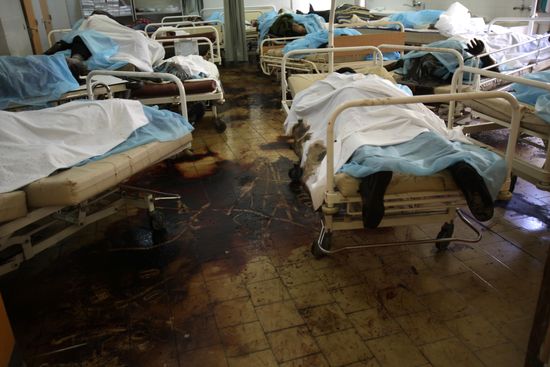
Alex Thomson files a harrowing dispatch from a hospital in the Abu Salim district in Tripoli:
Piles of surgical dressings, bloody sheets and half-empty blood bags were all around us, oozing fluids onto the ground. … Inside, it is not a hospital but a mortuary – or something for which there is no word. Stretchers and beds are stained with fluids and blood, some still dripping on the floor. In one room a picture of Colonel Gaddafi smiles down on at least 23 more corpses shoved onto trolleys at all angles. There is no language for the stench. You fear even to breathe in here.
Al Jazeera's Andrew Simmons visited the hospital for a video report. On a related note, Hitchens draws a comparison to Ian Kershaw's new book on the final days of the Third Reich:
One of the most chilling and nauseating aspects of the story is the number of brave Germans who were murdered by the Nazi regime even after it had technically ceased to exist. … The continuing slaughter of those who will be needed in the rebuilding of Libya and Syria will not be countenanced.
(Photo: Dead bodies lie in beds in the general hospital in the Abu Salim neighborhood of Tripoli, on August 26, 2011. The putrefying bodies of around 80 people were found. By Patrick Baz/AFP/Getty Images.)
by Patrick Appel
Friedersdorf replies to critics of Ron Paul by citing Paul's civil liberties record. Adam Serwer is unimpressed:
Is Paul going to unilaterally end the War on Drugs? I could imagine him being better than Obama in terms of things like not raiding medical marijuana dispenseries, but he can't change federal law without Congress, which couldn't even bring itself to completely repeal the crack/powder cocaine disparity. Take a look at how ICE reacted to Obama telling them to focus on deporting criminals instead of teenager and sick people, and you can get an inkling of the institutional backlash should Paul try to stop enforcement of federal drug laws. Is he going to stop state police from enforcing draconian drug laws in the states? Of course not, because he wants to leave them alone. Ending the War on Drugs is going to take more than a president, it's going to take a nationwide shift in public policy, one that seems to be occurring already but will take time to come to fruition.
In related commentary, Pascal-Emmanuel Gobry's Ron Paul fears are close to mine.

by Chris Bodenner
For New Yorkers such as myself, real bad. Cuomo convenes an emergency cabinet meeting. Dan Amira is live-blogging updates. Choire assembles a survival guide for Brooklynites (money tip: transport your baby in a cat carrier). From the inbox, a Floridian who isn't being a dick:
If you actually get hit by a hurricane you are somewhat screwed. Construction of everything in Florida takes into account hurricanes. We have shutters or shatterproof windows. We don't have water towers on top of buildings or any type of siding in our houses, even street signs and lamps are designed for storms. Our drainage systems are designed to reasonably handle several inches of rain per hour. For geographic reasons, we have one tunnel in the entire state and nothing subterranean like a subway or basement. Heck, people in the Florida Keys aren't allowed to have a first floor at ground level. A selling point for a house or condo in Florida is that it is on the same power grid as a hospital or jail. There are a lot of generators, and if you don't have one, a person with a generator quickly gets reminded of all the nice things you did for them.
The Northeast has little or none of this.
Having been through more than half a dozen hurricanes, there are a couple necessities that don't make the list too often. A pack of cards, a lot of wine and a bunch of books are as much necessities as batteries and flashlights.
I was visiting family out in Michigan this week, so I was a little bummed that I missed the earthquake. Now it seems the gods are answering my wish for a natural disaster, but on a much suckier scale; my Brooklyn apartment is in an evacuation zone. A reader sent the above photo, captured yesterday in Nassau, Bahamas. Ominously enough, my place is next to Nassau Avenue.
by Zack Beauchamp
The MEK, a Iranian cult-of-personality Marxist terrorist organization immensely unpopular among Iranians, is staging a rally outside the White House today to protest its place on the terrorist organization list. When was the last time you could remember any other terrorist organization that killed Americans demonstrating outside the White House and lobbying influential American politicians? What's next, HezbollahPAC?
And just to make apparent the bunkum that is the MEK's claim to leading the democratic opposition, here's an editorial from Kaleme, a leading Green newspaper:
Mojahedin-e Khalq is the symbol of “violence and terror” in Iran and the slightest mention of this word [MEK] and the remembrance of this organization is needed to remind the Iranian audience of the violence, terror, and treason they caused. As long as the groundwork of this organization is cult-like behavior, the only solution for them is to submit to foreigners in order to stab its own people in the back. Any country that supports this organization defames itself among the Iranian people and remains infamous for defending violence and betrayal.
It's hard to think of anything worse we could do in the name of supporting Iran's democracy movement than delisting the MEK. For more evidence, here's leading Iran expert Abbas Milani, firsthand observer of the MEK Elizabeth Rubin, and some great roundups from Chris last month.
by Chris Bodenner
A reader continues the popular thread:
Contrary to your reader, the USPS has actually been quite innovative in providing ways to avoid waiting in long lines. Need to ship a package? Just weigh it at home, go to their website, and print out a shipping label. They'll even pick it up from your home at no charge. Don't have a scale? Go to the post office and use their automated stations where you can weigh your package and get printed postage right there. Need a shipping envelope? Just go to their website and they'll mail it to you. You can even go to most grocery stores to buy stamps and, quite frequently, ship packages vis USPS. Frankly the post office compete quite effectively in this market against UPS and FedEx.
Another:
Regarding the reader who wrote about postal employees "when you look at their average annual compensation ($64k/year), they are clearly not overpaid" … please.
Factor in their pension plans, which while I admit not knowing the precise details, know full well that defined benefit plans are dinosaurs and are becoming totally confined to the public sector, and you have a job with salary and benefits that few would describe as "clearly not overpaid". I don’t think that teachers in the US earn that same average wage. I’m not disparaging their jobs, but letter carriers aren’t exactly splitting atoms out there, and you don’t need a college degree to deliver mail.
And the cheapest rate you can find in other countries is 98 cents? Here in Canada the rate is 59 cents, and except for Saturday delivery (who cares?) is equally as fast and efficient, and we have a much sparser population density in a much larger country which makes delivering mail much more expensive. Is this really that hard of a problem to solve? Raise prices. Or is that a "tax increase" in the current political culture?
Another:
The primary reason USPS is facing catastrophic losses is because of a 2006 law that requires it to do something no other government agency or business is required to do: prepay future retirees benefits (and they can't raise rates to cover this cost), which means the agency which is required by law to "break even" is now forced to operate at an ever-increasing annual loss. Turns out USPS has actually overpaid into the federal retirement fund and the Obama administration is willing to grant them some relief in the 2012 budget, but (of course) the Tea Party wants to decimate it. Rep. Darrell Issa as an alternative has introduced legislation to create a commission to take over USPS to deal with its budget.
And as for the ridiculous notion that we could just get rid of the USPS and FedEx and UPS would pick up the slack, that suggestion could only have come from someone with no knowledge of US geography, population density, or the complexity of postal infrastructure. Just two years ago, when USPS tried to end service to the "the only backcountry air mail route remaining in the lower 48 states" that was already subcontracted to an aircraft company, the residents revolted and put a halt to that plan, since it's not like UPS or FedEx were salivating to take over that route.
Now you could propose we get rid of the uniform charges so that those in more dense and easily serviceable areas stop subsidizing those in costlier service areas. Great idea. The problem is it will NEVER happen when those costlier customers are overrepresented in the US Senate. And that will remain true if and when USPS is all or partially privatized – those responsible for that decision will make sure their constituents remain subsidized in some fashion. They wouldn't survive politically if they didn't.
Another:
It might interest some to compare this to how Sweden handled it in the '90s. I lived there at the time, and it was a major shift in how the postal service operated and was perceived, but overall it was a successful transition. A case study about it can be found in page 2-3 of this PDF document.
The Swedish postal service faced virtually identical problems that the USPS now faces. The government met the challenge by abandoned the monopoly on mail delivery and made the Swedish postal service a for-profit operation. They closed down a huge number of post offices and replaced them with franchises in gas stations, grocery stores, etc (according to the above PDF document, there are now 1,600 cashiers, compared to 16,000 in the early '90s). They shed about half the work force and opened up the market to competition.
It was not a particularly well-received transition, but it was by all accounts successful. I see absolutely no reason why the USPS could not do a similar transition. The idea that we should just close it down is both unrealistic and unnecessary – why throw out the baby with the bath water?
Another recommends a long Guardian piece about the privatization of mail in Europe.
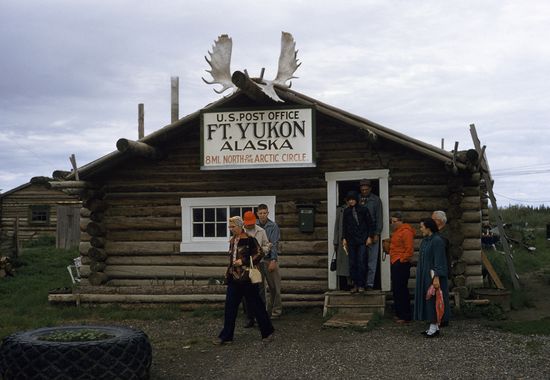
(Photo: Tourists mail letters from a post office north of the Arctic Circle, Fort Yukon, Alaska. By W. Robert Moore/National Geographic/Getty Images)
 The Dish