Propping Up Factory Jobs, Ctd

Capitalism

by Patrick Appel

A reader writes:

The problem we see in manufacturing and elsewhere is that technology is constantly allowing us to do more with less.  From a resource perspective this is vital if we're to continue to maintain economic growth in a world of finite resources.  However, this same innovation is also allowing us to be more productive with less employees.  We have factories full of robots to build our cars and computers.  Who needs a secretarial pool when you have e-mail, copy machines, and printers?

Up through roughly the 1980s, if you had a minimal education, you could still find gainful employment that could provide a middle class income.  That is less and less the case now, and it will only get worse in the future.  So how do we, in a capitalist democracy, address the fact that some people will be incapable of a meaningful contribution to productive output?  People who do not have the skills and are not capable of learning those skills will be unable to make a living, much less rise up from poverty.  So we will find ourselves with an ever increasing under class that has no economic opportunity available to them.  

This disparity of opportunity is one of the main reasons we have such a polarization in US politics today is because this issue has continued to go unaddressed.  The tea party is not angry at government as such, but rather angry about getting screwed by the system.  But their right leaning politics assumes that the target of their ire should be the government.  The left, similarly angry, blames large corporations.  While the object of their derision may differ, both left and right are fundamentally reacting to the same sense that the future is looking ever bleaker.  

Of course as poverty rises, wages stagnate, and unemployment remains high for less educated workers, politicians are all too happy to demagogue, blame the other side, and make the situation even worse.  So we wind up with a self-reinforcing problem where greater inequality leads to greater polarity and makes real solutions more difficult to achieve.  In the end, this is unsustainable.

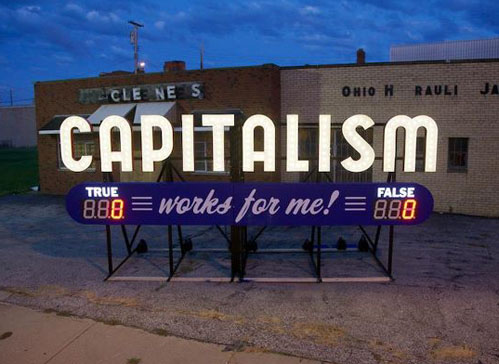
(Photo: Image of  Steve Lambert's traveling art project, which is being funded through Kickstarter. Hat tip: This Isn't Happiness)

Will Anyone Seek The Hispanic Vote?

by Maisie Allison

As Perry backs off his relatively pragmatic record on immigration, Mike Riggs sees an opportunity:

A recent Gallup poll shows Obama’s approval ratings falling a full 12 points among Hispanics, which suggests Hispanics don’t need reminding that Obama sucks on immigration. But they may need convincing that there are alternative options. That former New Mexico Gov. Gary Johnson and former Utah Gov. Jon Huntsman–neither of whom sits all that well with Tea Partiers or the GOP's kingmakers–both received F grades from [anti-immigration organization] NumbersUSA would actually serve them quite well with Hispanic voters. 

The Root Of Guilty Pleasures

by Zoë Pollock

Matt Yglesias started this thread off:

I know it’s just a turn of phrase, but I think the whole conceptual framework of “guilty pleasures” speaks to some weird underlying puritanical elements in American life. Despite the whole “life, liberty, and pursuit of happiness” thing in the Declaration of Independence, our public culture is very resistant to the idea that people should try to spend more time doing things they enjoy or that producing enjoyment for others is a good thing to do in life.

Zolltan chalks it up to peer pressure:

The concept of “guilty pleasures” in music has nothing to do with the puritanical background of America. Because musical “guilty pleasures” – as opposed to say “guilty pleasures” in food – aren’t about guilt at all – they’re about shame. … [I]f you’re listening to “a guilty pleasure” and you just finished listening to it, you don’t feel bad at all – you feel great! The bad part comes when someone sees you listening to “Umbrella” or “Dragostea din tei” or whatever and makes fun of you.

Amanda Marcotte draws an important distinction:

The classifications of "indulgent" or a "guilty pleasure" or even just "bad taste" are often influenced strongly by certain prejudices.  In some cases, it's just blatant racist or sexist or classist prejudice.  But I've also noticed that some music gets classified as less tasteful because it's music that  provokes one's more "animalistic" desires to dance and party and fuck, instead [of], I don't know, sit around drinking coffee and thinking deep thoughts.

Lindsay Beyerstein's take:

"Guilty pleasures" are things people like but can't justify liking. The concept of a guilty pleasure only makes sense if you try to live by an aesthetic code in the first place. If you just like whatever you like, for any reason, or no reason–you don't have guilty pleasures. If you can admit that you like a song just because it was playing while you lost your virginity, the concept of a "guilty pleasure" is irrelevant for you. A lot of people who aspire to have good taste won't admit that they sometimes like songs for "irrelevant" reasons. It's human nature to enjoy music that you associate with other pleasures.

Alyssa expounded on how the concept of guilty pleasures applies to food.

The Adult In The Race

by Patrick Appel

Steve Kornacki sums up Obama's strategy going into 2012:

[T]he looming jobs fight offers Obama a chance to further drive down the GOP's standing (if that's even possible). And the more reviled the Republican Party is, the more it raises the possibility that Obama — even if he himself is saddled with a poor economy and low poll numbers — might manage to squeak through to a second term in 2012.

"Adult in the room" strategy may not be the right term for this. What Obama is really hoping is that voters in 2012 will end up rejecting the snotty, bratty, tantrum-prone child in the room.

How Hospitals Harm Us

by Chris Bodenner

After the jump is a startling infograph about the dangers associated with hospital stay. Hospitals improve far, far more lives than they harm, of course, and every system has its flaws, but the following stats are cause for concern:

Number of hospital-acquired infections that lead to death: 
Europe: 1 in 122
United States: 1 in 7

Lopsided numbers like those lead to the US ranking last out of 19 developed countries in preventable deaths in hospitals. Here is the full ream of stats:

The Hazards of Hospitals
Created by: Medical Billing and Coding

The “Decoupling Of Attitudes”

Views
by Zoë Pollock

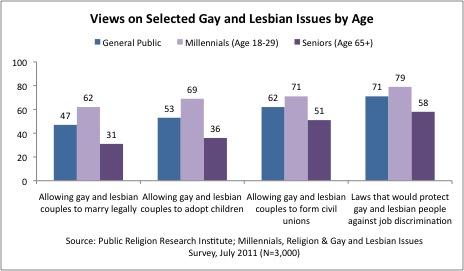
That's what a new Public Religion Research Institute report calls the fact that those who support marriage equality don't always support abortion. Amanda Hess summarizes:

Today, while 57 percent of people under 30 see gay sex as "morally acceptable," only 46 percent of them would say the same thing about having an abortion.

She chalks it up to the conservative appeal of marriage equality:

Over the past several decades, the mainstream gay rights movement has aligned its priorities with fundamentally conservative institutions: Gays and lesbians want the right to get married, adopt children, and serve in the military. These family-friendly, all-American demands appeal to the conservative base … Reframing abortion rights as a family value is a trickier sell. Though about one-third of women will abort a pregnancy in their lifetimes—a figure that spans age, ideology, and religion—many who have undergone the procedure remain in the closet.

Could President Perry Repeal Health Care Reform?

by Patrick Appel

Not by himself. But if the GOP makes a clean sweep, the calculus changes:

In a world where President Rick Perry is joined by Majority Leader Mitch McConnell and Speaker John Boehner — a world that Nate Silver, for one, thinks is possible — this conversation is moot: The law’s regulations and mandates could be waived and its Medicaid expansion and insurance subsidies could be repealed through the budget reconciliation process.

Mitt Romney Is Bad At Politics

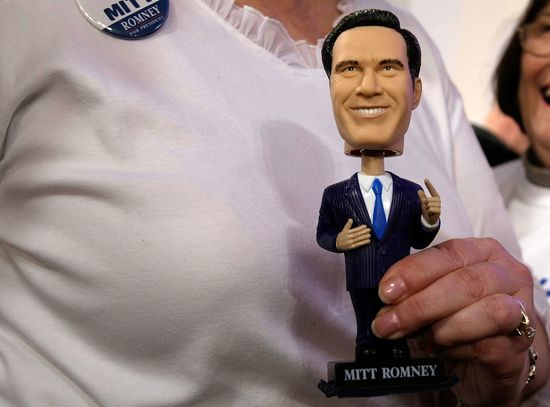
GT_ROMNEY_BOBBLEHEAD_CROP_04042011

by Maisie Allison

Jonathan Last counters Douthat, insisting that Romney is simply a "non-starter as a political commodity" because he has no core supporters. Relatedly, he's not particularly good at winning elections:

[Romney has] a 17-year career average of 5-18. I don’t think you could find any other figure in politics who has run this far below the Mendoza line and still managed to get taken seriously as a presidential candidate. In fact, the only reason Romney gets taken seriously is his money. Strip away the $500M treasure room and the willingness to blow large chunks of his kids’ inheritance, and he’s Ron Paul without the ideological moorings and grassroots support.

Referring to Romney's putative strategy against Perry, Scott Galupo adds:

You can practically hear the clanging and buzzing of Romney Robotic Manipulation technology…As in 2008, when he tried and failed to outflank Sen. John McCain's right, Romney appears to think that he can run like a literary composite character. Yes, Rick Perry is eminently vulnerable to a Medi-scare campaign. And, at least among the conservative base, it would appear that Perry is disturbingly pragmatic when it comes to immigration. But, at this point in the history of U.S politics, it would be a highly unusual creature who could launch both attacks simultaneously.

(Photo: Alex Wong/Getty.)

Did The Stimulus Work? Ctd

by Patrick Appel

New research looks at the types of jobs that were created:

 In our survey, just 42.1 percent of the workers hired at ARRA-receiving organizations after January 31, 2009, were unemployed at the time they were hired … More were hired directly from other organizations (47.3 percent of post-ARRA workers), while a handful came from school (6.5%) or from outside the labor force (4.1%)

Tyler Cowen thinks this "paper goes a long way toward explaining why fiscal stimulus usually doesn’t have such a great 'bang for the buck'":

Many of the created jobs involved hiring people back from retirement.  You can tell a story about how hiring the already employed opened up other jobs for the unemployed, but it’s just that — a story.  I don’t think it is what happened in most cases, rather firms ended up getting by with fewer workers.

Drum sees the data differently. Earlier thoughts here.