The Giant Gambian Rats Of Brooklyn, Ctd

by Chris Bodenner

A reader writes:

Note that the Gambian rats are used as land-mine sniffers in Tanzania, and they are not truly "rats." It sounds like the likelihood of being able to bread with Norway rats is unlikely.

Another points to the below photo and writes,"To be fair, they are capable of cuteness." A reader familiar with the rats shares his experience:

Gambian pouched rats last shared a common ancestor with Norway rats about 25 to 30 million years ago. That's on par with our divergence from monkeys (not apes, monkeys). We are much closer relatives to orangutans and gorillas than those two 450px-Food_Reward species of rodents are with each other. I've observed and captured Gambian pouched rats in the wild in West Africa and they usually seem to be eating something such as frogs or smaller rats. Admittedly the rats they were eating (soft-furred rats in the genus Praomys) were from a slightly smaller species than Norway rats, but I guarantee that if they are in New York and spending time with Norway rats, they aren't just looking for company.

Their presence is potentially bad news. There has been a population on Grassy Key off the coast of Florida for several years. A study in 2006 modeled their native ecology in Africa and looked for comparable habitat in North America. The authors concluded that if they got to the mainland, they could prosper along much of the Gulf Coast as well as in the Pacific Northwest. Most of the US (including New York) appears to be potential habitat thanks largely to its wetness, but it's mostly a matter of how the animals handle hard frost (moist habitat plus hard frost aren't a combination you find in their native Africa). We may find ourselves having to get used to rats the size of raccoons.

Another takes a detour from the science:

The post about the giant rats made me (and I am sure many others) think of this:

Fleas the size of rats sucked on rats the size of cats
And ten thousand peoploids split into small tribes
Coverting the highest of the sterile skyscrapers
Like packs of dogs assaulting the glass fronts of Love-Me Avenue
Ripping and rewrapping mink and shiny silver fox, now legwarmers
Family badge of sapphire and cracked emerald
Any day now The Year of the Diamond Dogs

– David Bowie "Future Legend" (the first track on "Diamond Dogs", which any true Bowie fan knows is his best album.)
Huntsman’s Orthodoxies

by Patrick Appel

Douthat questions Huntsman's strategy:

Given that this is a recession election, not a culture war election, a candidate trying to successfully brand himself as a “different kind of Republican” would be far better off breaking with conservative orthodoxy on an economic issue — by calling for looser money, maybe, or attacking the totally unpersuasive right-wing conceit that we need to raise taxes on the American working class. Instead, Huntsman is toeing the party line on pocketbook matters, and picking fights on boutique issues that are at best tangentially related to the major controversies of the Great Recession.

Larison chips in his two cents. Josh Marshall attended a Huntsman Q&A yesterday:

He skirted the issue of taxes by saying he's for revenue neutral tax reform — closing loopholes, lowering rates etc. The implicit message seemed to be: I'm not some hidebound Norquist type who's not going to let any tax go up or any loophole get closed. Sort of gave him a little wiggle room. But still, no net new revenues.

Absorbing The Tea Party

GT_HATCHTEAPARTY_110825
by Maisie Allison

Dave Weigel explains why it is "increasingly likely that no incumbent Republican will lose a primary to a Tea Partier in 2012":

It's hard winning elections. It's even harder because the Republican "establishment," insofar as such a thing still exists, consists of fairly smart people who know what happened last time. When Bob Bennett's slayer, Mike Lee, arrived in the Senate, [Orrin] Hatch started copying his homework and showing up at every Lee presser. He kept up his outreach to Utah's Tea Party leaders, like classic car dealer David Kirkham. He used his powerful position as ranking member of the finance committee to add credibility to Tea Party arguments about the debt, like the idea that the administration was fibbing about the impact of passing the Aug. 2 deadline without raising the debt limit.

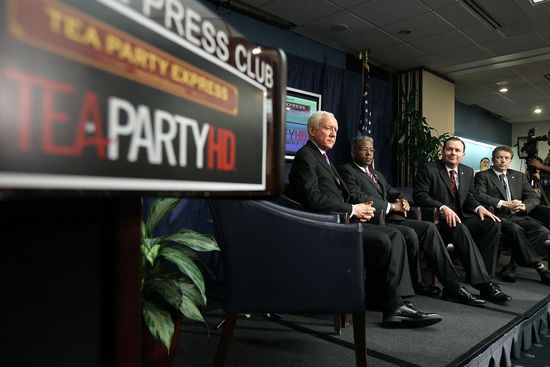
(Photo: Sen. Orrin Hatch (R-UT), Rep. Allen West (R-FL), Sen. Mike Lee (R-UT) and Sen. Rand Paul (R-KY) listen during a Tea Party Town Hall meeting  at the National Press Club in Washington, DC. The town hall meeting was held by the Tea Party Express and Tea Party HD to address issues Tea Party members were concerned over. Photo by Alex Wong/Getty Images)

How Bad Could Irene Be?

by Patrick Appel

Nate Silver prepares for the worst:

According the model, a hurricane with wind speeds of about 100 miles per hour — making it a “weak” Category 2 storm — might cause on the order of $35 billion in damage if it were to pass directly over Manhattan. Such a storm would probably flood New York’s subway system as well as acres upon acres of prime real estate in neighborhoods like the East Village, the Financial District, TriBeCa, Coney Island, Red Hook, Dumbo, as well as parts of Staten Island and most of the Rockaways.

Although far from the most likely scenario, this may represent a reasonable-worst-case estimate of what could happen if Hurricane Irene took exactly the wrong turn at exactly the wrong time.

City by city warnings here. Mike Smith at Meteorological Musings is updating constantly on the situation. From Smith's damage projection:

Because of the wet ground, it will be easy for the hurricane to uproot trees which will bring down power lines as they fall. So, regardless of the exact path of the storm, trees will topple causing extensive power failures. Those power failures will last more than a week in a number of areas. In addition, the difference in wind speed between the ground and the top of skyscrapers makes glass damage especially likely. Storm surge will exceed 10 ft. in some areas causing coastal flooding and river flooding will likely occur as a result of these heavy rains.

Can Perry Win?

by Patrick Appel

Frum points to Perry's weak spots:

Do Republicans really want to run a candidate who has put in writing his opposition to Social Security and Medicare? Do they really want to volunteer to reverse this election from a referendum on President Obama’s record to a referendum on Rick Perry’s intentions? Is “don’t believe my book” really going to impress frightened older voters as much of a talking point? Remember, House Republicans have already voted to end the Medicare guarantee for future generations. So deniability is getting to be a problem here. Or is the plan to follow Rumsfeld’s rule: If you can’t solve a problem, make it bigger?

“One Of The Best Transport Innovations Of Our Time”

GT_BOLTBUS_110825

by Maisie Allison

Aaron Renn defends resurgent intercity bus travel against its urbanist critics, who are concerned that it undermines the case for high speed rail:

What Megabus & Co. are proving is that there is a viable market for intercity transit-style travel at the right price. Thus they are helping to get people used to the idea of traveling that way and in a sense priming the pump for high speed rail at a later date as demand increases. The bus operators are doing the hard work of creating and proving out the market for this. Also, Megabus will hopefully force the backers of many of these HSR proposals to rethink their concept around 110MPH peak speeds in favor of true high speed rail…Conceivably if and when HSR investments are made, these bus operators will service a different, lower end market and/or evolve into more of a rail complement.

Stephen Rees adds:

[W]hile new, innovative bus services on some routes in the United States are winning new customers to long distance buses, they will pose little threat once there are true high speed railway services to compete with. They will probably be price competitive, but speed and service quality of the kind now enjoyed in France, Germany, Japan – and even across the English Channel will secure a much larger chunk of what is now airline travel. 

Previous discussion on the successes and safety hazards of intercity bus travel here

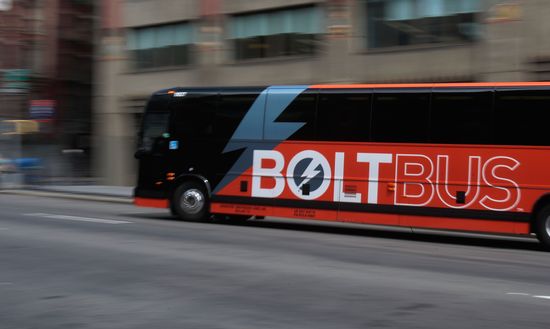
(Photo: A BoltBus leaves Manhattan for Washington DC. Photo by Chris Hondros/Getty Images)

Meeting The Post-War Challenge In Libya

by Zack Beauchamp

Daniel Serwer lays out the difficulties:

The people of Libya in the meanwhile are living in dreadful conditions. Food, water, health care and electricity are lacking, especially in vulnerable populations like the poor and displaced. The TNC needs somehow to begin to deliver goods and services, especially in the major cities. Libyans will be celebrating for a few days, but then they are going to start to wonder how they are better off. That is a question that will persist even once immediate needs are satisfied. Ten years from now Libyans will be discussing whether justice has been done to those who committed crimes under the Gaddafi regime, and whether the traumas of that regime and the civil war have been healed.

Joby Warrick and Karen DeYoung look at the genesis and implementation of the TNC's post-war plan. Bernard Avishai is hopeful about Libya's future.

Will The GOP Flake Out On Entitlement Reform?

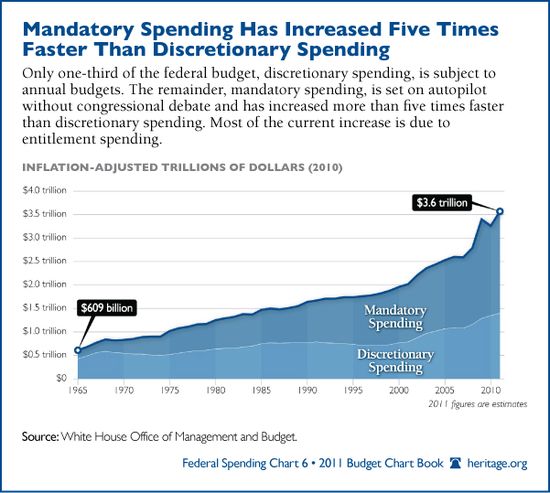
Mandatory-discretionary-spending-600
by Maisie Allison

Byron York previews the GOP's (misleading) talking points on the deficit:

The bottom line is that with baby boomers aging, entitlements will one day be a major budget problem. But today's deficit crisis is not one of entitlements. It was created by out-of-control spending on everything other than entitlements. The recent debt-ceiling agreement is supposed to put the brakes on that kind of spending, but leaders have so far been maddeningly vague on how they'll do it. Should Republicans base their platform on entitlement reform, or should they focus on the here and now — specifically, on undoing the damage done by Obama and his Democratic allies? In coming months, the answer will likely become clear: entitlements someday, but first things first.

His colleague Conn Carroll pounces, arguing that entitlement reform should be at the forefront of the Republican platform in 2012. Another colleague Philip Klein sides with Carroll. York responds. Yuval Levin complicates York's false choice, and concludes that it is "absolutely essential that the Republican presidential candidate next year is willing to make a case for some real reforms." Noting that it "certainly would be a mistake to duck the issue," Jennifer Rubin leaves the question to her readers. 

(Chart: Heritage Foundation, via Carroll)

Where Poverty Comes From, Ctd

by Patrick Appel

A reader writes:

Seth Masket effectively exposed the logical fallacy of French's argument, but I want to point out the harmful nature of the argument itself.

I worked hard and got a good education, yet I am poor. I have no money and haven't worked in years, and if it weren't for my parents letting me stay with them I would be homeless. The notion that poor people are just lazy isn't new. People have been asserting that Randian trope for years. French adds a claim that religious attendance (if this were true, Nigeria should be an economic superpower) and moral depravity are also to blame.

The problem with this argument is that I believed it.

It may seem obvious to others that someone who completed an undergraduate double major in three years and graduated from a top ten law school can't really be described as "lazy" but it took *years* of therapy before I could even contemplate the idea that it wasn't my fault, I am not lazy or a bad person, but that I am suffering from depression. It is still sometimes difficult for me to accept that this isn't my fault, but French seems to have no problem assigning that blame.

I wonder how this affects other people who are living in poverty. It seems like if you tell people that they are poor because they are lazy and immoral, the message that you're sending is that there is no hope. Unless you believe that the poor have just decided that they would prefer to be lazy and depraved and they can wake up one day and simply choose to become virtuous hardworking citizens.

I started receiving food assistance last December after hearing about the program from a neighbor. My parents would be struggling financially even if they weren't paying for my therapy and medication, so I figured it would help a lot if they didn't have to feed me as well. I get $200 a month which can only be used to buy unprepared food. A few days after I started receiving this I happened to hear my state's new House Speaker, Jase Bolger, talking about plans to limit the program I had just joined. He made it clear that he was doing this to *help* people on assistance:

“Michigan should help its citizens break the cycle of dependency, not create one for them,” Bolger said.

Really? $200 a month for food is going to create a cycle of dependency? People would go out and get a job but they just don't want to give up that free six and a half dollars a day of food? The minimum wage in Michigan is $7.40/hr, and you think people are not working because you're giving them less than that a day in food assistance? If there really are people with such an epic level of laziness I would suggest that the threat of starvation will not magically turn them into hardworking, moral citizens.

I like capitalism. I believe it is very effective and I value the freedom that it brings. But free markets are not bags of pixie dust that can be sprinkled on all of societies problems, and all of the failures of the market cannot be blamed on the moral failings of the less fortunate.