by Zack Beauchamp
Barry Eichengreen gives a lucid explanation of why calls to go back to the gold standard are so misguided.
by Zack Beauchamp
Barry Eichengreen gives a lucid explanation of why calls to go back to the gold standard are so misguided.
by Patrick Appel
Mark Yzaguirre asks what sort of Democrat Rick Perry was:
[W]hen and why did Rick Perry come to believe that Social Security and Medicare are public policy blunders and are probably unconstitutional? The reason I ask is because Rick Perry used to be a Democrat. While one can change one’s mind on issues and parties, it seems like Perry’s explanation for why he changed parties is a variation on President Reagan’s famous statement that “I didn’t leave the Democratic Party. The party left me”. The thing is, Reagan said that before Medicare was enacted and after some major ideological soul-searching that still didn’t call for a complete repeal of the New Deal. While Perry was a Democrat, support for Social Security and Medicare were well-established parts of mainstream thought throughout the party.
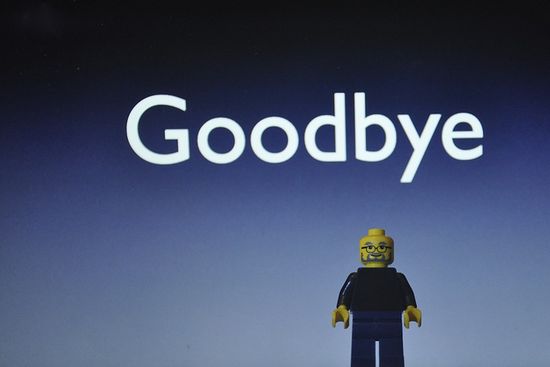
Today on the Dish, Steve Jobs resigned from Apple, Wilkinson wondered why we don't resent his wealth, and we explored the new CEO's status as the most powerful gay man in the world. Steve Benen pounded in Perry's involvement in the execution of an innocent man, and we dissected Perry's lead over Romney. We had hoped Perry would embrace Texas' smart immigration policies, Karl Rove hit a nerve in Palin's thin skin, and climate scientists still agreed on climate science so politicians should follow suit. Raising the age of Medicare eligibility won't save us money, McArdle supported welfare reform, and poverty is a hard cycle to break. Fareed wondered if it was time to turn Congress into a parliamentary system, and Chuck Norris needed a gun to fight bad guys.
In Libya, rebels found Qaddafi's scrapbook of Condoleezza Rice but no Qaddafi. Mohammed Bamyeh downplayed tribal ties in Libya, while we found out Saif Qaddafi could have supported the protesters. Douthat allowed mild celebrations about Qaddafi's imminent fall and Drezner didn't want the Libya intervention to become the blueprint. Our foreign policy has been militarized, entrepreneurs could help rebuild the Libyan economy, and Jonathan Raab tried to explain why he needs to go back to war zones. In other international news, Japan decorated their manhole covers, China's porn industry thrived, and readers left a final round of kind messages about Jack Layton.
Groupon still isn't viable, rats bigger than cats terrorized Brooklyn, and toads can predict earthquakes. Heat doesn't make us violent, it just puts us into contact with more people which does, organ donors should get priority for organs, and we should have sympathy for the poor telemarketer. Readers nerded out on some more infinity, we underestimated the total number of species to be 8.7 million, and marijuana makes us more creative.
VFYW here, MHB here, and FOTD here.
–Z.P.
(Photo by Flickr user minifig)
by Patrick Appel
Tim Cook is Apple's new CEO. Felix Salmon asks why journalists are ignoring a key aspect of his identity:
[S]urely this is something we can and should be celebrating, if only in the name of diversity — that a company which by some measures the largest and most important in the world is now being run by a gay man.
Nicholas Jackson, on the other hand, argues that Cook "won't be a role model for the LGBT community until he confirms the rumors and comes out of the glass closet he is assumed to be living in":
Apple is widely regarded as a gay-friendly company (a survey of consumers conducted a few years ago found that Apple was ranked as one of the gay-friendly companies, second only to the Bravo network) and those at the top, when asked, said they would continue to support Cook if he came out. But they also worry that a gay executive could harm the perception of Apple's brand, according to Queerty. Would an openly gay CEO — not a bad product, not a flawed program — hurt the house that Jobs built?
by Chris Bodenner
A reader writes:
While there are many different types of parliamentary systems in the world, I would certainly hope we don't ever consider the Canadian model. Without being able to cast a vote directly for the prime minister, the public can only vote for the local candidate representing the party of their desired PM. In the last election, that meant that anyone wanting to vote for Jack Layton had to vote for whomever the NDP candidate was in that riding, regardless of their qualifications. As a result, a number of university undergrads became MPs. There is also the more prominent story of the young lady who worked at a college pub who got elected despite never having been to her riding, not being fluent in the language of her constituents, and spending part of the campaign on vacation in Las Vegas.
It's hard to blame the voters, for if they wanted to support Jack Layton's bid to become prime minister, they didn't have any other choice. The irony is that with the sad and sudden passing of Jack Layton, the man most people were truly casting their vote for, is no longer around, but the undergrads and pub workers that actually got elected still are. And given that elections are not held on a regular schedule, who knows how long they'll be in office?
I think its a very silly (and dangerous) thing to force voters to combine their local and national votes into one single party-based vote. This is precisely why I do not support repealing the 17th amendment (an idea that has been discussed frequently as of late). I'd much prefer to vote separately for my senator than to combine my vote for my desired senator with my vote for who will represent me in my state's legislature. They're two different people holding two different positions! It only makes sense that I should get two different votes.
Angus Johnston wrote just after the election:
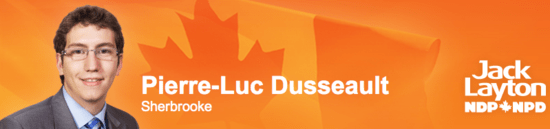
The youngest of the six new student MPs is Pierre-Luc Dusseault, 19, who is doing a degree in applied political studies at the Université de Sherbrooke. Unlike many of his fellow winners, Dusseault stumped strenuously in his district, which is home to the university he attends. (He also reportedly made extensive use of Twitter in his campaign.) Desseault, a first-year student who co-founded the Université de Sherbrooke NDP club just months ago, calls himself a “political junkie” and had planned to spend the summer working at a local golf course if he didn’t win.
Dusseault is the youngest Canadian MP ever, in fact.
by Zack Beauchamp
Politico lets Chuck Norris vent about how Obama's creeping erosion of gun rights via the U.N. Arms Trade Treaty. Diana Wueger explained back in June why this "worry" is, er, misplaced:
In reality, the Arms Trade Treaty will have no impact on domestic legal arms sales in the United States. This is something that the United States insisted upon as a condition of joining the talks. In October 2009, Secretary of State Hillary Clinton personally championed the insertion of a provision in a General Assembly resolution about the ATT that gave countries the exclusive authority to regulate arms within their borders.
by Zack Beauchamp
Dan Drezner worries the Administration is taking Fareed Zakaria's ideas too close to heart:
Ceteris paribus, burden-sharing and local support are obviously nifty things to have. I guarantee you, however, that the time will come when an urgent foreign-policy priority will require some kind of military statecraft, and these criteria will not be met. The Obama administration should know this, since its greatest success in military statecraft to date did not satisfy either of these criteria. There is always a danger, after a perceived policy success, to declare it as a template for all future policies in that arena. Pundits make this mistake all the time. Policymakers should know better.
Drezner's argument is based on this Josh Rogin interview with Ben Rhodes, where Rhodes suggests that "Obama's strategy for the military intervention in Libya will not only result in a better outcome in Libya but also will form the basis of Obama's preferred model for any future military interventions." One shouldn't overstate the point – learning from historical experience is obviously integral to good policymaking – but Drezner's right to worry about trying to graft every aspect of the Libya strategy onto different issues. Policymakers have something of a fraught history when it comes to the overuse of historical analogies.
by Maisie Allison
Douthat says Libya skeptics should enjoy the raw significance of Qaddafi's fall:
Qaddafi’s defeat doesn’t necessarily promise a happy outcome in the long run, but at the very least it guarantees that we will spared that particular worst-case scenario, while holding out the possibility of a Libya unified and at peace — rather than a Libya partitioned and perpetually patrolled by Western forces, which is where we seemed to be headed a month ago. Declarations of victory are ridiculously premature, but for a country and a White House starved for any sort of good news, the fall of Qaddafi should be cause for (suitably restrained) celebration.
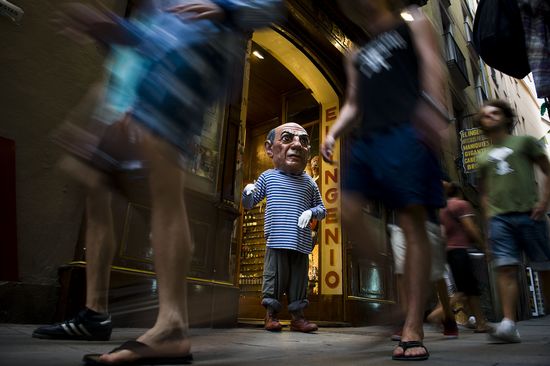
A Pablo Picasso papier mache 'huge head' mask, known as 'Capgros' in Catalan, is displayed at the entrance of the 'El Ingenio' shop on August 23, 2011 in Barcelona, Spain. 'El Ingenio' (The Ingenuity) has been making and selling papier mache giant masks and huge heads for Catalan popular festivals since 1838. The 'La Merce' festival will be held on September 24 to observe the feast day of Our Lady of Mercy, patron saint of Barcelona. By David Ramos/Getty Images.
— C.B.
by Zoë Pollock
Joe Carter draws a distinction between limited and big government:
Our founding fathers recognized the threat of a powerful central government and instituted checks and balances in order to limit its effect on individual states. However, at the time of our country's founding, the population was roughly three million souls. Today, that many people live in the greater Cleveland area. What the crafters of our system were unable to foresee was that the state governments they cherished would one day grow to a size that would dwarf the governments of other countries (including our own in 1789).
 The Dish