Rick Perry’s Immigration Problem

GT_PERRYFLAG_110824

by Maisie Allison

Erica Grieder highlights Rick Perry's dangerously moderate record on immigration in Texas, where "deep-rooted economic pragmatism…tends to trump all other ideologies." Tom Tancredo's screed against Perry's "unconservative" policies captures the criticism from the right. Grieder's conclusion:

[I]t's clear that migrants have been good to Texas, and it's also clear that Texas has been fair to migrants. This points to the great bipartisan upside of Perry's candidacy: even if you hate his platform, even if his accent makes you queasy, having the governor in the race has prompted a closer look at what Texas is like and why. There are issues where the state lags behind the nation and there are areas where it leads. Immigration is one of the latter. 

As Grieder notes, Perry has an opportunity to defend some of his more pragmatic policies in business terms, based on real experience. Instead (perhaps unsurprisingly), he is quickly reversing his positions. His bizarre, "emergency" posturing on the issue of sanctuary cities this year seems to mark an intentional shift.

Scott Keyes points out that flip-flop aside, Perry's scare tactics on border security represent a deliberate distraction from real reform. Texas State Rep. Rafael Anchia warns that Perry has clearly "demonstrated a willingness to scapegoat Latinos" and would take issue with Grieder's assessment. 

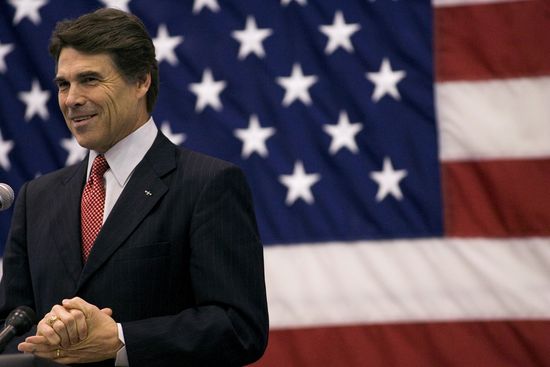
(Photo: Texas Governor Rick Perry waits during his introduction before addressing Austin's largest naturalization ceremony at the Delco Activity Center on May 11, 2007. More than 1,000 area residents representing 85 countries took the Oath of Allegiance to become United States citizens. By Taylor Jones/Getty Images)
The Giant Gambian Rats Of Brooklyn

by Chris Bodenner

Holy crap:

Naomi Colon, head of the Marcy Houses Tenant Association, said there have been sightings of the outsize rat [killed today] for at least six years. "The residents have told me that they've seen it running around with other rats." … Tenants fear that the Gambian rat has been breeding with the Norway rats and spawning a super-breed of rodents … . Residents say that while the monster-sized rat may be the stuff of horror movies, the run-of-the-mill rats are an even bigger nightmare at the project where Jay-Z grew up. "Even the cats are afraid of the rats. They get together and gang up on the cats, said resident Stephanie Davis, 44.

There is a photo of one skewered on a pitchfork, if you must.

Quote For The Day

by Chris Bodenner

"I never said [Palin] is going to declare..I’m mystified. Look she is all upset about this, saying I’m trying to sabotage her in some way. And how dare I speculate on her future. If she doesn’t want to be speculated about as a potential candidate, there’s an easy way to end the speculation: say ‘I’m not running.’ … I’m saying the schedule leads me to believe she is going to be a candidate. I’m not privy to her thought-making process. It is a sign of enormous thin skin (that) if we speculate about her she would be upset," – Karl Rove. Apparently Fox News censored the transcript of his critical comments.

Mourning In Canada, Ctd

by Chris Bodenner

Some final thoughts on Jack Layton before closing the thread:

As an American who has lived in Toronto the last five years, I've greatly enjoyed the coverage from your readers on Jack Layton. It would be difficult to to underestimate the loss of Jack, especially for young Canadians. I thought it would be nice to share with you one of the more light-hearted memorials of Jack, a collection of his appearances on "This Hour Has 22 Minutes", a Canadian political satire show.

Another writes:

Lest you get too carried away with Jack Layton hagiography, here is a link to a Christie Blatchford column for which she has taken a LOT of heat.  Christie is an award-winning author and fabulous columnist IMHO. And here's a supporting post by Jonathon Kay. The line in the now-famous deathbed letter about "restoring Canada’s standing in the world" is the part that irked me the most.  It is a standard NDP leftist trope that we have become something of a rogue state under the Conservatives, an assertion that has no basis in fact. 

Mainly it comes from the global-warming people and Guardian readers.  North Korea doesn’t like us anymore because we refuse to participate in the UN sham disarmament committee under their esteemed leadership.  As our Foreign Minister said, he considers their disapproval  "a badge of honour". Arabs don’t like us so much because we are tilting more towards Israel and we compete with them in energy.  So what?

Look at recent history.   Canada came through the financial crisis better than any G7 country and is widely respected for that. (Considerable credit for this belongs to Liberal government of the '90s and especially then-Finance Minister Paul Martin.  We had a debt downgrade of our own.) Our current Finance Minister, Jim Flaherty, is apparently highly respected in G7-G20 circles.   We acquitted ourselves very well in Afghanistan, Haiti etc.   A Canadian general is in charge of Nato efforts in Libya, etc.

Anyway, I think it was a cheap political shot.  It is troubling that they actually seem to believe their own propaganda and would stick it in a "deathbed letter". That being said, I did appreciate Jack Layton’s phenomenal performance in the last campaign and his positive message.  As your correspondent noted, the stirring of the political pot in Quebec is going to have very interesting and profound ramifications.

Another:

Jack Layton was a decent man who regretfully passed away far too early, but his beatification by a media sympathetic to his policies – and your reader who describes him as "[giving voice] to our better angels" – should not be used as an excuse to slam Harper with cheap political digs.  Harper granted Layton a state funeral (something he wasn't required to do) and was elected to a majority by Canadian voters. [Update from reader: "Try 39.62%.  Layton got 30.63%.  Nobody had a majority."] Calling him an "unfailing political opportunist" – what politician isn't? – and attacking him for espousing conservative policies is unfair. It's not Harper's fault that the opposition parties are in total disarray or that one of their leaders has been felled by cancer. Give me a break. 

Ending on a high note:

Thought I'd send this Flickr link to an incredible photo of Toronto's City Hall, where people have left messages of grief, condolences and hope for Jack Layton written in chalk. It has been incredible to witness such public displays of emotion for a politician, especially in an age where they are not well regarded.

Is Groupon Doomed?

by Patrick Appel

Rob Wheeler believes so:

Groupon's fundamental problem is that it has not yet discovered a viable business model. The company asserts that it will be profitable once it reaches scale but there is little reason to believe this. The financial results of Groupon's traditional business continue to deteriorate, especially in mature markets, and new ventures such as Groupon Now also have failed to drive profits. And unlike the very few successful companies that scaled before they were profitable (think Facebook or Amazon), Groupon's business model does not benefit from significant network effects.

Jeff Bercovici concurs:

Could the fastest growing company in history sputter out just as quickly? At this point, the better question may be: How could it not?

Why Don’t We Resent Steve Jobs’ Wealth?

by Patrick Appel

Wilkinson has a theory:

It seems small to begrudge the great man the sum of our eager ritual offerings. So who gives a fig if he doesn't shower his billions upon worthy causes, or write self-flagellating op-eds demanding to pay more in taxes? Never mind the patent thuggery. Never mind the miseries of Foxconn. An iPhone is a small enchanting comfort in a harsh, disenchanting world. We'll make Mr Jobs even richer, if he gives us a chance.

But what about the guys who get rich digging oil out of the ground so we can charge our iPhones? Stick it to 'em, the greedy bastards.

All of which is to say, our intuitions about economic desert and fair distribution are…complicated.

Daddy Issues On The International Stage

GT_SAIFQADDAFI_110825
by Zoë Pollock

Philippe Sands has an extensive report on Saif Qaddafi's involvement in Libya's crackdown. Saif's mentor, Mohammed al-Hawni, recounts the main points of the speech Saif could have given, supporting the protesters:

“He had the chance to destroy his father, and he did not take it,” al-Hawni said. And why was that? “He wants to show that he’s strong, to prove to his father that he is up to the problem.” He did not know what passed between father and son that day, but believed that it had “changed everything.” From Khamis Qaddafi, al-Hawni learned later that Saif had met with his father and then gone straight to the television studio. It was not politics but family, “between father and son.” Saif chose “family . . . the father and the leader.”

Sands' interview with Luis Moreno-Ocampo, the I.C.C.’s chief prosecutor, complicates that version of events:

Did Moreno-Ocampo buy the notion that Saif was at a personal crossroads, that the speech could have gone a different way? “No, that is not what my evidence is saying. The information shows that he was involved well before that, that he was involved from the beginning, in the planning before the 15th of February.”

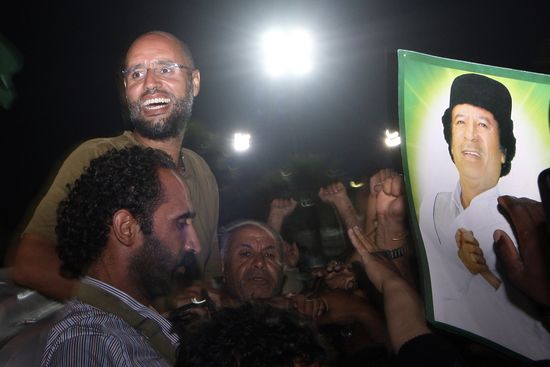
(Photo: Saif al-Islam Qaddafi, son of Libyan leader Moamer Qaddafi, is surrounded by supporters and journalists at his father's residential complex in the capital Tripoli in the early hours of August 23, 2011. Seif al-Islam, wanted by the International Criminal Court for crimes against humanity, claimed the insurgents had suffered 'heavy casualties' when they stormed Qaddafi's Bab al-Azizya compound in Tripoli. By Imed Lamloum/AFP/Getty Images.)

Don’t Focus On Tribes

by Zack Beauchamp

Mohammed Bamyeh warns against overemphasizing the importance of tribal ties in shaping post-war Libya:

As a matter of fact, in Libya, actual tribal allegiance, understood as the loyalty that members of one distinct tribe have to their fellows, has never been unconditional. Just as during the Italian occupation of Libya from 1911-1943, contemporary tribal discourse blends with and is clearly subordinate to a collective patriotism, which forms the root of the current national struggle.

Since the current uprising began, Libya’s various tribes have issued numerous statements about the situation, which largely reflect the patriotism that pervades these groups.  My personal examination of a sample of 28 tribal declarations, issued between February 23 and March 9, 2011, reveals that the vast majority highlighted national unity or national salvation rather than tribal interests. These declarations also demonstrate that Libya’s tribes are not homogenous entities, but rather are comprised of diverse members with varying social and economic backgrounds. This reality reflects the nature of Libyan society as a whole, which has a 90% urban population and in which inter-marriages across tribal lines are common.