by Chris Bodenner
A reader writes:
For most of my adult life, I have been periodically plagued with what I have termed  "infinity dreams". They appear to be instances where my id tries to understand infinity while I am in a dream state. The manifestation is my mind traveling through the universe; trying to grasp infinity. It's a horrific experience. The depth of horror regarding it may not be describable, but it can be put into perspective.
I have died in my dreams … my kids and my wife have died in my dreams; I have been in a mall with both my kids and lost them … and spent the rest of the night not being able to find them again … that is the worst horror I can imagine awake … and, nothing has compared regarding the actual affect and lingering psychotic pain after an "infinity dream". It is staggering in a way that I can not put into words.
I had a similar crippling feeling when seeing the above book cover as a kid. Another reader:
You have a great discussion going. I wanted to make a quick correction. Your reader wrote: "Eventually came Godel's first Incompleteness Theory, which, simplified, says that *every* logical and consistent system will have assertions which can not be proved." Though I like the connection to Godel, this is not quite true.
As a counter-example, the standard logical system one learns in any introductory logic course is probably both sound and complete. In other words, the system's rules are consistent and, pace your reader, all theorems of the system can be proven using the system. The proof is a bit complex but it works and one version can be found here.
The problem is that introductory logical systems are very simple and have lots of limitations. One such limitation, simply put, is that though you can talk about math, but you cannot speak math. This is like a tourist who knows everything about the language of his destination country except how to speak it. So logicians supplement such systems with more rules and tools in order to make them 'speak math'. There was a lot of hope that this would do for all of math what Euclid did for geometry (axiomatize it). But Godel ate their lunches. What he showed is that any logical system sophisticated enough to 'speak math' will have true consequences that cannot be demonstrated using only the logical rules within that system. The 'within the system' constraint matters a lot because many of these truths are otherwise demonstrable. Though Godel crushed a lot of nerdy dreams, it was a lot like crushing the dreams of Ptolemists in that there emerged new and enticing possibilities in the world of mathematical logic.
I know this isn't as sexy as "there are truths about math and logic forever and mysteriously inaccessible to us" but it does have the advantage of being true.
Another:
Those "different sizes of infinity" that a previous reader mentioned, even worse, in no way square with what we usually think of as "size." Imagine the number line, from negative infinity to positive infinity. Pick any two points on that number line: 1 and 5, .0000000001 and .0000000002, e and ?. It is easy to intuit that there are infinitely many numbers between those two points, no matter how closely you have selected them. What's not so easy is that the "size" of the infinity between those two points is actually the same size of the infinity of the number line. In the way we perceive it, the "length" of the number line between those two incredibly close points is the same "length" as the entire number line. Infinity hurts your brain, indeed.
Another:
Most people are only aware of one, perhaps two of Zeno's paradoxes, but there are four (well, nine, but several of them demonstrate the same principle) paradoxes in total–the Dichotomy Paradox (you always have half the distance yet to be covered,) the Arrow Paradox (because at any given moment an arrow is exactly where it is, it cannot ever be moving,) Achilles and the Tortoise (in order for Achilles to ever pass the tortoise, he needs to first reach the point the tortoise is currently at; since they both move continuously, the tortoise will always be some small amount ahead of Achilles,) and the Stadium Paradox (the least famous, because it's difficult to explain in a pithy fashion; it does some funky stuff with the notion of the divisibility of time that I'm not really qualified to try to explain in a small space)
The fact that there are four is significant, because if you assume that time and space can each be either finitely small or infinitely small, there is exactly one paradox that cannot be solved given the four permutations of these assumptions. For example, if you assume that time and space have no "smallest unit", then Achilles can never catch the tortoise, but you can make other paradoxes work. Taken together, though, there will always be one paradox that breaks the premise.
This is the true beauty of Zeno's Paradoxes: not that you can't walk across a room, but that combined, they break logic.
Another:
As a math major I do agree that the concepts of different infinities can get complicated and previous readers have explained this concept very well. However, as a physics major, I'm going to have to complain that the video posted about ten dimensions, while very well done, is wrong in crucial ways. based on his other videos, the person appears to be a crackpot, albeit a well spoken one.
Any person with knowledge of string theory knows that the extra spatial dimensions have absolutely nothing to do with extra paths the universe can take in its evolution. Something like that is along the line of extra temporal dimensions, an idea thought about in physics but not seriously studied. Extra spatial dimensions are simply what they sound, different ways we can move in spacetime, the difference being that the shape of the these dimensions is vastly different from the three we all know.
These dimensions are compactified and small, but otherwise the same as ours. You can imagine that something small enough, say a closed string (which is on the planck scale) moving in these extra dimensions just like it would move in any other dimension. The man in the video had the right idea in the beginning, but somewhere he got lost with the whole "all possibilities of the universe are in the 10th dimension". In other videos he talks about the extra 7 spatial dimensions being somehow
built off/reliant on the structure of the time dimension, which is simply ridiculous. If there are extra spatial dimensions they have to be independent of the dimensions we know, 3 space and 1 time.
Finally, I'd like to clear up one misconception that's often propagated. When dimensions are curved 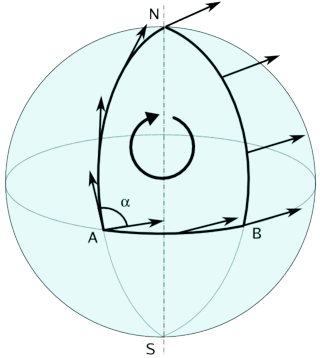 or folded they are NOT folded or curved in some higher ambient space. There is no need to say something is folded through a higher dimension. For example, the sphere is curved. We view the sphere as a shell embedded in a 3 dimensional space, but the sphere itself is 2 dimensional (if we zoom in enough it looks like a flat plane and we only need two coordinates to describe any point a la latitude and longitude). The curvature of an object is intrinsic to the object, it doesn't matter on what space we embed it in, whether the embedded space is 3 dimensional or higher. This is important to keep in mind when you read that General Relativity says our four dimensional space time is curved and that's what accounts for gravity. Its curved but not in any 5 dimensional space.
Curvature in the mathematical sense is defined in how if you take a vector around a closed loop, its orientation will be changed. If the space is flat, the vector will return to where it was in the same position. If the space is curved, it will be rotated. The picture above demonstrates the curvature of the sphere well where the vector is taken from A to N to B and it's obvious that its orientation is changed.
In conclusion, extra spatial dimensions have nothing to do with extra paths for the universe, you don't need to fold something through an extra dimension, and for your devoted readers, keep crack-pottery off the site. Especially for us physicists who have to deal with enough of it as is.
And another:
I'm a logic student at UChicago in the mathematics department. I just wanted to correct a statement made by a number of people in the thread on infinity (including one who claimed to be a mathematician). They said that the continuum hypothesis stated that aleph_1 is the smallest infinity bigger than the natural numbers, and that the proof of the independence of the continuum hypothesis by Godel and Cohen meant that this was undedicable by the ZFC axioms of set theory. This is false. In fact, aleph_1 is the smallest infinity bigger than the natural numbers by definition, and then aleph_2 is the next biggest, then aleph_3 and so on. The continuum hypothesis states that 2^aleph_{0} = aleph_{1} – in short, this says that the size of the set of subsets of the natural numbers is the smallest infinitybigger than the natural numbers. If the continuum hypothesis were true, it would follow that there is no infinite set with size strictly between that of the natural numbers and the real numbers, for example. The independence of the continuum hypothesis means that 2^aleph_0 might be, for example, aleph_6. Interestingly enough, the independence of the continuum hypothesis never stopped professional set theorists from making judgments about the size of the continuum as it stands in the 'platonic universe of mathematical objects.' For a long time, the smart money among set theorists assessed the size of the continuum to be aleph_2! (For this last argument, there's a nice write-up by Hugh Woodin in these two pdfs.)
Another:
Thanks for this thread; it is nice to be reminded that there are people even nerdier that I am. I know I'm taking gigantic liberties here, but taken together with the Heisenberg uncertainty principle, I've always felt that the message is that no matter how cleaver we humans are, there will always be room for God.
Another:
When I was an undergraduate, I decided to take our school's "Math for Poets" class. The first chapter of our textbook was simply titled "Counting." That's how remedial this was. But I ended up loving the class, and one of the things I will never forget was working through Georg Cantor's fascinating and elegant proofs of multiple cardinalities of infinity. My chemistry and econ major roommates – all more versed in mathematics than me, a lowly humanities student – were consistently amused by me that quarter. But no more so than when for a week and a half my jaw was perpetually glued to the floor as I discovered how staggeringly beautiful and elegant the notion of infinity can be.
When you have infinity, you almost don't need weed.



 The culprit behind American militarization is domestic politics and those who would use foreign policy as a means of settling parochial scores. Thus McCarthyism, having emasculated and demoralized the nation’s diplomatic core, left the country with no one to debunk the canard of a Sino-Soviet bloc, the irrational fear of which consumed security planners and red-baiters alike until as late as 1968, when Russian and Chinese troops were skirmishing along the Ussuri River. Another enabler of militarization is the habitual failure among American leaders to listen to their area experts – diplomats, military attaches and spies – about the nature of threats perceived or concocted by political tribes in Washington. While researching the book I was struck at how often the White House, having neglected its eyes and ears on the ground, not only reached for the military option but in doing so foreclosed on opportunities for a lasting peace.
 The Dish