Welfare, Revisited, Ctd

by Patrick Appel

McArdle, contra Klein, defends welfare reform because it has encouraged Americans to escape poverty. Among her other reasons to support it:

[C]hanging the structure of welfare has eroded much of the opposition to it.  As long as people felt like welfare was a way for people to simply live off of tax dollars without working, there was bound to be a lot of opposition to the program.  Restructuring it as temporary assistance for those who are overwhelmed by unexpected circumstances has essentially whittled that opposition down to nothing. When was the last time that welfare came up in an election?

In a follow up post, McArdle considers the downsides to reform:

[F]ew program changes are entirely win-win, and this was no exception.  Even as many families have climbed out of poverty, some families have plunged deeper into it; as I understand it, mostly those headed by women with severe mental illness, drug and alcohol problems, or personality disorders.  Before, if your mother was smoking crack, she could at least still collect her welfare check. Cutting off the check after five years, or cutting benefits as some states did, didn't mean she stopped smoking crack.  It just meant there was less money around the house.
Looking At Porn In China

GT_PORNCHINA_110824

by Maisie Allison

James Griffiths interviews Katrien Jacobs about the state of pornography in China. Despite new clampdowns, the Chinese have developed an "impressive porn industry and progressive sex cultures." Many students say pornography is their only sex education:

There are several statistics that show the net-porn industries are surviving and flourishing despite the ban. It seems indeed that porn cannot be banned and that the PRC government is perhaps even secretly letting it into the country. But besides their bombastic cleanup campaigns, they also censor web communities that stand for sexual freedom or queer identity.

It seems as if sexual minorities, sex artists and activists are much more vulnerable than those involved in mainstream commercial porn, especially at this moment when film festivals are being shut down and human rights activist are being tortured and detained. These are the dark times of China’s civil right and sexual creative outlet, but there is still so much porn and sex entertainment available that we can see it as safer outlet.

Griffiths also provides a brief history of Chinese porn and erotic art. 

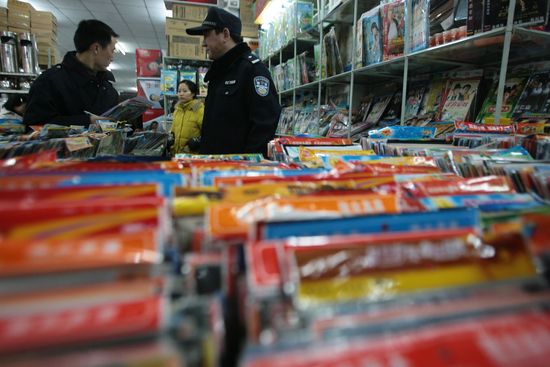
(Photo: Officers of cultural departments confiscate piracy and pornographic DVDs during a raid to shops in Nanjing of Jiangsu Province, China. Photo by China Photos/Getty Images)

“Why Do You Want To Go Back?”

by Patrick Appel

Jonathan Raab has difficulty explaining to civilians why he would return to a warzone:

How can I say that I would feel guilty if I did not go, or, even, the full truth, I would hate myself if I did not go again, to someone who has never worn combat boots? How can I make a statement about my own choices about war, risk, sacrifice and death, without making an inherent value judgment about their own?

I have taken to saying that I am going back because “chicks dig the uniform.” It is simpler that way.

Have The Rebels Found Qaddafi?

By Zack Beauchamp

Both Reuters and Sky News are reporting that the rebels have surrounded an apartment containing Qaddafi and his sons. No word on how the rebels know Qaddafi's in there, so we should take this report with numerous salt grains. But, as Scott Lucas notes, they appear to have come close yesterday as a result of combined efforts with some Arab states' intelligence organizations, so this could be the real deal. While we're waiting for confirmation, go have a look at some photos from Qaddafi's scrapbook about Condoleezza Rice.

A Way To Solve Organ Market Woes?

by Zack Beauchamp

The Freakonomics guys note a new proposal (pdf) on how to fix the glut of demand and limited supply:

Organ donations from deceased donors provide the majority of transplanted organs in the United States, and one deceased donor can save numerous lives by providing multiple organs. Nevertheless, most Americans are not registered organ donors despite the relative ease of becoming one. We study in the laboratory an experimental game modeled on the decision to register as an organ donor, and investigate how changes in the management of organ waiting lists might impact donations. We find that an organ allocation policy giving priority on waiting lists to those who previously registered as donors has a significant positive impact on registration.

Weather And War

by Zack Beauchamp

Carl Prine is impressed by a new study (gated) in which the authors "directly associate planetary-scale climate changes with global patterns of civil conflict by examining the dominant interannual mode of the modern climate, the El Niño/Southern Oscillation." Carl's causal hypothesis:

I humbly submit that one key reason for the increased violence might be the very number of dry, sunny days. Criminologists have realized for quite some time that summer is more violent than the colder months not because people get all hotted up to commit homicides or aggravated assaults by the sun.  Rather, it’s because warm and dry days mean people are out and about more, and as they come into contact with more and varied souls they’re more likely to try to shoot each other.

The Cheerful World Of Japanese Manhole Covers

Manhole cover

by Maisie Allison

Michelle Aldredge introduces us to a minor feat in public art:

One of my favorite book discoveries this summer is Drainspotting by Remo Camerota. The book celebrates an array of fascinating manhole cover designs from Japan. According to Camerota, nearly 95% of the 1,780 municipalities in Japan have their very own customized manhole covers. The country has elevated this humble, practical object to its own art form. The designs depict everything from local landmarks and folk tales to flora and fauna and images created by school children. Camerota explains the evolution of these custom covers in Drainspotting:

“In the 1980s as communities outside of Japan’s major cities were slated to receive new sewer systems these public works projects were met with resistance, until one dedicated bureaucrat solved the problem by devising a way to make these mostly invisible systems aesthetically appreciated aboveground: customized manhole covers.”

(Photo by Flickr user m-louis

How Many Species Are There?

by Patrick Appel

The Economist summarizes a new paper on the question:

A paper just published in PLoS Biology uses a novel statistical approach to arrive at a figure of around 8.7m distinct species. But there are some important caveats: it counts only the eukaryotes, that is, critters with relatively complex cells. That means leaving out the bacteria, which are ubiquitous but for which the concept of 'species' is rather problematic, and the archaea, the third great class of Earthly life. So the number arrived at by the researchers almost certainly underestimates the planet's true biological diversity.

The Creative Drug

Green
by Zoë Pollock

A recent study refuted the argument marijuana impairs your longterm learning or memory, because they finally controlled for factors like education and gender. Jonah Lehrer examines the creative claims made about marijuana. A different study looked at semantic priming, or our ability to connect related words (pairing dog with words like cat or pet):

Interestingly, the scientists found that marijuana seems to induce a state of hyper-priming, in which the reach of semantic priming extends to distantly related concepts. As a result, we hear “dog” and think of nouns that, in more sober circumstances, would seem rather disconnected, such as “leash” or “hair.” This state of hyper-priming helps explain why cannabis has been so often used as a creative fuel, as it seems to make the brain better at detecting those remote associations that lead to radically new ideas.

(Photo: "Going Up to Alaska.” 2009, by Maureen Drennan. Her photo essay, “Meet Me in the Green Glencaptures life on a California marijuana farm.)


Keep Talking About Willingham

by Zack Beauchamp

Steve Benen reminds us about Perry's extensive history of executing people and the facts of the Cameron Todd Willingham case:

The Texas Forensic Science Commission, created to consider the competence of those who offer forensic testimony, hired an actual arson expert, to consider the evidence and report on his findings. He was scheduled to discuss what he found in early October 2009. Rick Perry, who was governor when the state killed Willingham, was apparently afraid of what the truth might show. In the 11th hour, the governor started firing members of the Forensic Science Commission, ensuring that the panel couldn’t hold a meeting to discuss the case. Even for Perry, this was brazen. He was so panicky that the facts would show Texas killed an innocent man, he went to ridiculous lengths to prevent the truth from coming out. Nearly two years later, the facts still haven’t been presented.

Benen concludes by wondering what the impact on the election might be, but I think we should be highlighting the Willingham case for a different reason. I doubt, sadly, that the Willingham case will have much of an influence on Perry's chances. The real reason to talk about it is to point out the absolute insanity of a situation where someone with Perry's record can be thought of a "serious" candidate. The man was complicit in covering up the truth about the execution of an almost-certainly innocent man. That's outrageous, and should be disqualifying. But it's not, which says a hell of a lot about American political culture. This problem – whatever its source – is something we ought to be highlighting.