An American Parliament?

5038507120_be2637ab03_b

by Zack Beauchamp

Fareed Zakaria thinks it's time to replace Congress:

The political battle surrounding the debt ceiling is actually impossible in a parliamentary system because the executive controls the legislature. There could not be a public spectacle of the two branches of government squabbling and holding the country hostage. If we’re in for another five years of this squabbling in the U.S., we are going to make presidential systems look pretty bad indeed.

Pete Wehner counters, but mostly with some rote anti-Obama rhetoric. Scott Galupo defends Zakaria:

Wehner asserts that the “debt ceiling debate had a resolution. The two parties did arrive at an agreement, and default was avoided. The process may not have been pretty, but it worked.” Yes and no: A default was avoided. But a credit downgrade wasn’t—and that was Zakaria’s point. Moreover, credit rating company Standard & Poor’s statement on the downgrade fingered the very political dysfunction that Zakaria decries

Wehner's colleague Emanuele Ottolenghi looks at the dysfunction in some European parliamentary systems.

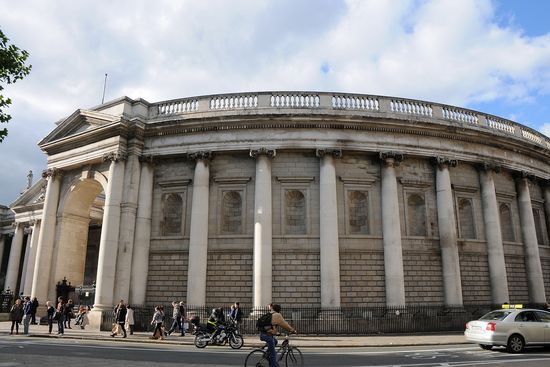
(Photo: Irish Houses Of Parliament by flickr user Joachim S. Müller.)

The Daily Wrap

Today on the Dish, a rebel commandeered Qaddafi's hat, Muammar was still nowhere to be found, and Yglesias invoked Francis Fukuyama’s The End Of History. Factionalism among the rebels represented the next stage in the battle, Larison defended his use of stalemate in describing Libya, and Zack lobbied for humility in arguments. Fareed outlined a new model for intervention with an emphasis on local involvement, we kept an eye on revitalized revolutionaries in Syria and Yemen, and Wikileaks made McCain and Butters look just a tad hypocritical. Around the rest of the world, we ignored Iraqi agency in understanding the surge, Leonard Spector feared chemical warfare in Syria, the world car population passed one billion, and readers recalled Jack Layton as a defender of gay rights in the 80s. 

On the campaign trail, the GOP continued its search for a "consensus conservative," Perry pulled ahead of Romney in the polls, and Patrick pinpointed the dangers of a Ron Paul presidency. We debated how much importance to give to politicians' scientific views, we exposed Peggy Noonan's pundit tricks, Maisie wondered if a black swan political event loomed in the US future, and the internet schemed about how to get Palin out of the spotlight. In other national news, we examined whether Clinton's welfare reform succeeded, education boomed even in poorer countries, and Stephen Rose offered perspective on just how bad the economy is. We tried to get to the bottom of the GOP's payroll tax cut position, and readers defended the USPS. The sports world garnered another marriage equality convert, a reader took issue with our drug arrests graphic, and telemarketers hit a nerve with readers.

We peeked inside Roger Ebert's new memoir, Sam Harris argued we'll reach a point where we'll all want wealth redistribution, and no one likes a moral crusader. We appreciate over-used positive words to talk about ourselves, one reader wished telemarketers stuck to the script, and men and women sleep differently. Marriage may cause weight gain among other hazards, asexual readers considered dishonesty cheating, and pronouns have a psychology all their own.

VFYW here, MHB here, and FOTD here.

–Z.P.

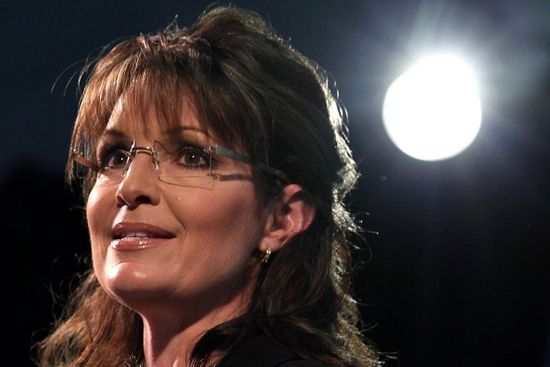
How Do We Shove Palin Out Of The Spotlight?

Palin-spotlight

by Patrick Appel

Steve Kornacki has a plan:

[T]hose who just want her to go away should consider a Palin presidential campaign an investment: You'd have to deal with a few weeks (or maybe even months) of saturation coverage, but there'd be a good chance it would all end with Palin's presence in our lives severely and permanently diminished.

John Sides fights this notion:

[H]ere’s another way to make Palin disappear: have a presidential election in which she is not a candidate.  The surest way to sideline any prominent Republican politician between now and November 2012 is for them not to enter the race.  Indeed, even those that do enter the race will be sidelined by not winning.  The candidates, and then the ultimate nominee, will suck up virtually all of the oxygen.

Steven Taylor doubts "it is possible for Palin to alienate her core audience." Jonathan Bernstein moderates the debate:

[S]hould she back off this time and the Republicans lose, the tease will start again right around the time that the polls close on the west coast, and it won't let up for the next three years. Losing this time around — not informally through testing the waters and backing off, but with a solid defeat at the polls in Iowa and New Hampshire — is the best way to prevent that. Well, other than having a different Republican in the White House.

(Photo by Mark Wilson/Getty Images)

The Postal Service On The Precipice, Ctd

by Chris Bodenner

A reader writes:

I can’t believe some of the abuse that is thrown at the USPS. When you look at their average annual compensation ($64k/year), they are clearly not overpaid. And when you compare the price they charge for the service they provide, it is the best in the world. In the world. About the cheapest rate you can find for mailing a letter in other countries is 98 cents, while most other industrialized countries are in the $1.20 range. Most countries don’t offer Saturday delivery like the USPS does. And the USPS delivery times average more than 20% quicker than other countries.

The reason the USPS is having trouble is because Congress won’t let them succeed. They insist on providing certain service levels (like Saturday delivery) and yet they won’t let the USPS charge what they need to charge to provide the service.

Another cites a reader in the previous post:

I think "[we] would be far better off if the USPS were shut down tomorrow" is an absurd statement. The USPS employs around 574,000 people. UPS and FedEX combined employ around 541,000 people, and they are international companies, so only a portion of those people are the US.

They also aren't designed at the moment to deliver mail and pick up mail from almost every single household in America on a daily basis, as well as from various offices and boxes currently spread around the city and far flung communities. Our local UPS guy doesn't even pause between throwing my package on the porch and jumping back in his van to see if I'm here. I'd hate to see what his life would be like if he also had to stop at every single house around my neighborhood on top of his current work load.

Saying "FedEX and UPS clearly have the infrastructure in place to carry mail as well" is technically true, but they clearly don't have the infrastructure  to deal with volume and magnitude of work that they'd have to take over if the Post Office closes its doors, unless we sell the whole venture to them. You could argue whether that'd be worthwhile, but the USPS is doing a lot more than nothing at the moment.

Another piles on:

Your reader wrote: "FedEX and UPS clearly have the infrastructure in place to carry mail as well and would do it far more efficiently than the US Government." Except they don't. There are many rural areas that FedEx and UPS do not reach. In fact, they contract with USPS to deliver packages to those areas.

Then there are the other disadvantages. If a package or letter that needs to be signed for cannot be delivered to my home because I am not in, I can retrieve that package at my local post office, usually no more than 30 minutes away. I know where my local post office is. If the same thing occurs with a FedEx or UPS package, I have to ask for them to attempt delivery again. Of course, that means I have to be home when they arrive … and they won't give me a delivery window. Alternatively, I can go to their delivery hub – usually at the local airport, which is far from my home.

Another:

There is absolutely no chance that UPS or Fedex could service the millions of miles of RFD (Rural Free Delivery) routes in this country at anything close to post office rates. These people would just drop off the map, and be isolated from mail service altogether. They would indeed be abandoned by civilization. Recall that RFD in a very real sense MADE this country; not just the back-and-forth of ordinary correspondence, business and personal, but the ritual of ordering from Sears. A very large number of the HOUSES in rural areas arrived by US Mail.

Mail delivery is a basic service of government. Thoughtless free marketers don't know what they're talking about.

Another:

There may be good reasons to keep post offices open in rural or low population areas, but keeping them because they are "lifelines" is not one of them. Post offices that serve a small population, like anything else,  must be subsidized by the income generated from larger population areas.  I have no problem with this model – it has served our country well since its founding.  However, we are now told by many people that we can no longer afford to carry the people the who don't pull their own weight, and that surely applies to rural people.  If offices are closed throughout Alaska and the hinterlands, the people have a choice to either do without or move to a place where there is a post office.  Don't like those options?  Welcome to the real world, where the rest of us have to move to get a job, receive good health care, or enjoy abundant water supplies.

It's this cognitive dissonance that Americans believe that they should be able to live where ever they choose, and that everyone else has to subsidize their choice with new roads, infrastructure, post offices, cheap utilities, affordable housing, free quality schools, and everything else.  But they don't believe in "handouts" or raising taxes to pay for the things they refuse to pay for themselves.  It isn't even a matter of socialism – it's a matter of doing the best for all concerned, and they are the beneficiaries.  But they can't understand the concept that if they benefit, so should others, and everyone needs to pay something towards it.   Are people really that ill-informed?
Awkward.

GT_MCCAIN_08242011

by Zack Beauchamp

Wikileaks released a cable appears that Senators McCain and Butters, along with several others, had a very chummy meeting with Qaddafi almost exactly two years ago. Money quote from Stephen Webster's writeup:

Sen. John McCain (R-AZ) promised to help former Libyan dictator Muammar Gaddafi obtain U.S. military hardware as one of the United States' partners in the war on terror…The cable does not mention anything about the senators pressing Gaddafi for democratic reforms.

Worth noting because, as Chris has highlighted, the two used Qaddafi's fall to bash Obama for not going after the Great Loon sooner and harder. The NATO effort may have been a tad bit more stymied if the good Senators had their way.

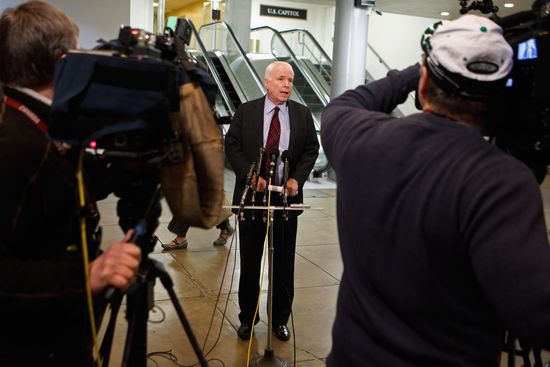
(Photo: Senate Armed Services Committee ranking member U.S. Sen. John McCain (R-AZ) (C) talks with reporters after a closed committee meeting in the U.S. Capitol March 4, 2011 in Washington, DC. McCain and other committee members were briefed by officials from the Pentagon about the current military situation in Libya. By Chip Somodevilla/Getty Images.)

The GOP Hates Taxes – Unless They’re On The Poor, Ctd

by Zack Beauchamp

Greg Sargent attempts to clarify Grover Norquist's position on letting the payroll tax cut expire. Jonathan Bernstein wonders how voters interpret this kind of rhetoric:

[F]or all I know low-income folks hear the "half of people don't pay income taxes" rhetoric and believe that it's about how working class people do pay taxes while the rich find ways to get out of it. And I say "for all I know" — but you can be sure that someone is polling and focus-grouping this stuff, so Republicans who are pushing this line are working from evidence. Class warfare, indeed — but class warfare in which Republican politicians manage to align themselves with virtually everyone who is listening to them, against an unspecified "them" who is getting away with something.

Some interesting attempts to explain the GOP's behavior from Steve Benen, Kevin Drum, and Jon Chait.

Where Cars Are Headed

by Patrick Appel

The world car population just passed one billion. Brad Plumer looks ahead:

According to the International Transport Forum, the global vehicle population could reach 2.5 billion by 2050. Daniel Sperling, a professor at UC Davis’s Institute of Transportation Studies, put out a useful presentation last year running through what that two billion cars would mean. Take energy: Right now, the world produces about 87 million barrels of oil per day, and most of that comes from conventional sources. A world with two billion—or more—cars will likely require boosting that to 120 million barrels per day or beyond, Sperling argues. And, given that production from conventional wells is expected to flatten in the coming decades, getting to that level will mean relying on unconventional sources like the tar sands in Alberta.

The Reality Of Telemarketing, Ctd

by Chris Bodenner

A reader writes:

Many years ago my mother found the answer this problem.  Whenever a telemarketer called and started out with the standard, "Good morning Mrs. R, and how are you today?", she replied,"Oh, I'm so glad you asked …", and proceeded to start spinning a story about various physical ailments, family problems, etc.  She just kept going and going with it. I don't know how she managed it – when telling about it later she would just start laughing uncontrollably. The poor telemarketer (and when was the last time you really felt sorry for one?) was just sputtering by the end and couldn't wait to get off the phone.

Another writes:

Listen, I understand how intrusive and annoying it is to be interrupted during personal time in one's home by someone who has an agenda to sell you something.  I'm a mom with four kids and they always seem to catch me when I was giving someone a bath – or even worse, having the rare quiet moment to myself.  But guess what: I was once the person making those calls.

My younger sister and I briefly worked for a telemarketing company in high school.  We only lasted a few weeks because it absolutely sucked having people yell at you.  I'll never forget the hostility and the yelling and the lecturing from the people I called.  I was constantly on the edge of tears. Meanwhile, I had a manager who was on me to run through call lists and convince people to come to a presentation – it was one of those "win a free trip to Florida if you sit through a presentation on time shares" deals, and as a 17 year old I was not really in a position to evaluate if it was a scam or not.  I was just a timid young woman making minimum wage.

Bottom line is: register with donotcall.gov if you don't like telemarketing calls.  And try to feel some compassion for the telemarketer should they reach you.  It's just so silly to get angry with these people – it's like yelling at the lowest person on the totem pole.  And it doesn't cost a thing to kindly but firmly say no.

Another:

Why am I still getting so many telemarketing calls when I'm on the Do Not Call List? These companies are flagrantly violating the regulation, and I assume, risking incurring fees. Are they getting pay-offs? Why would they call someone who puts themselves on the Do Not Call List? It seems like they would be very unlikely to respond to a telemarketing call.

A "practical tip" from a former telemarketer:

Hang up on a telemarketer without so much as a "not interested" and the thick-skinned telemarketer will not think, "Oh, gee, I guess they don’t want it."  They'll know that.  They'll just keep calling you back to punish you.

A New Model For Intervention

by Zack Beauchamp

Fareed Zakaria heralds it:

The new model does two things: First, it ensures that there's genuinely a local alliance committed to the same goals as the external coalition.  This way, there is more legitimacy on the ground. And if there is anything Afghanistan and Iraq have taught us, it is that local legitimacy is key. Second, this model ensures that there is genuine burden sharing so that the United States is not left owning the country as has happened so often in the past.

Jack Goldstone counters, partially:

The real test of whether we are in a new era of US policy will be, first, will the actions of the US and other allies help Libyans build a stable democratic state, or will Libya fall into sectarian violence, civil war, and terrorism, as did Iraq and Afghanistan?  And second, will the same kinds of actions Zakaria points to — burden sharing with our allies, reliance on indigenous leadership, and a more modest supporting role — be effective in the task of state construction in the wake of Gadhafi’s fall? There are reasons to be hopeful.

Both posts are more than worth your time. I do think Goldstone in the above excerpt is running together two issues that should be treated separately. The first is the best model for conducting the immediate intervention, and the second is how best to keep the peace and rebuild the state after the first (and hopefully last) stage of the conflict is over. The approach to both need not necessarily be the same – a multilateral NATO intervention using airpower could be followed up by a unilateral American post-war stabilization force, a U.N. peacekeeping operation, a number of non-military development models, or simply no external involvement at all. The best way to take action in the second stage doesn't necessarily follow from how the first was structured (and vice versa).

As such, I think it's wrong to extrapolate a whole new approach to the entirety of an intervention, let alone the entirety of U.S. foreign policy, from the success of the Libyan operation in toppling Qaddafi. Plus, as I've argued, the model we used in Libya isn't all that new – it draws heavily on a well-known American foreign policy tradition, liberal internationalism.