Imagining A Ron Paul Presidency, Ctd

GT_RONPAULSUPPORTERS_110824
by Zoë Pollock

Patrick makes some good points about the real dangers of putting Ron Paul in the White House. Pareene itemizes his fears, including this pretty big one:

A Ron Paul presidency could very well mean the end of legal abortion in the United States.

Serwer's critique of Paul's larger philosophy is spot-on:

While Paul isn't a vocal member of the GOP's homophobia wing, preferring to leave such questions to the states, his vision of freedom comes across as terribly limited to constituencies whose individual freedom, throughout American history, has come from the intervention of the federal government. It's impossible to imagine black people or women having the freedom they have today without the Civil Rights Act.

For gays and lesbians, who are hoping to secure their own fundamental rights, Paul's  federalism would give individual states the right to violate those rights by a show of hands. Paul-style libertarianism too often comes across as an agenda of individual freedom for straight white men.

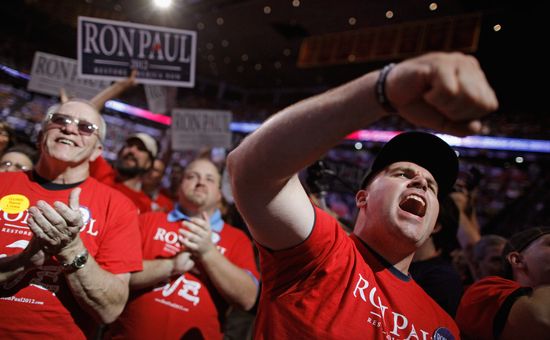
(Photo: Supporters of Rep. Ron Paul cheer for the candidate during the Iowa Straw Poll on August 13, 2011 in Ames, Iowa. By Chip Somodevilla/Getty Images)

Stupid Pundit Tricks

by Patrick Appel

Nyhan goes after Peggy Noonan for baseless speculation about Obama's mental state:

[T]he entire column is built on mind-reading — I had to excerpt half of it just to collect all the examples. It's a great example of how the novelization of the presidency works. Like Maureen Dowd, Noonan's talent for making up pleasing stories about political figures have made her a highly regarded pundit for one of the nation's top newspapers. Too bad those stories are largely fiction.

Are We On The Verge Of A Black Swan?

Flickr black swan

by Maisie Allison

Peter Daniel Haworth applies Nassim Taleb's theory of black swan events in history to some hypotheses about the immediate future of the U.S.:

Could the United States radically change via another constitutional convention, experience a new civil war, split into multiple confederacies, and/or engage in a massive foreign war in order to preserve its cohesion? ….When considering Americans’ apparent skepticism about the legitimacy of their government, it is appropriate to question whether a “black swan” political-event (like one of the above) is in the making. 

Deriving its name from the surprising discovery of the first black version of a swan in Australia (after millenniums of the Old World believing all swans to be white), a black swan event is one that most people consider highly improbable, that is often associated with and catalytic for major paradigm shifts in the course of history, and that people tend to make retrospective explanations for so as to hide (often for the sake of maintaining peace of mind) its outlier status…Ignoring the possibility of outlier events (like the ones discussed in this essay) is unwise, for they are frequent within and largely mold human history. 

(Photo: Black swan, birds in outdoor fenced enclosure. Lincoln Park Zoo, 1900. From the Field Museum Library on Flickr)

A Chemical War Nightmare

by Zack Beauchamp

Leonard Spector worries about the deadly weapons' use in the event of a Syrian civil war:

If anti-Assad insurgents take up arms, the chemical sites, as symbols of regime's authority, could become strategic targets. And, if mass defections occur from the Syrian army, there may be no one left to defend the sites against seizure. This could lead to disastrous outcomes — including confiscation of the chemical weapons by a radical new national government, or sale of the weapons as war booty to organized non-state actors or criminal groups. In such chaos, no one can predict who might control the weapons or where they might be taken. With these chemical weapons in the hands of those engaged in a possible civil war, the risks that they would be used would increase substantially.

Terrifying. Luckily, Erica Chenoweth sees signs that the opposition plans to stay peaceful. Whether or not that's enough to restrain Assad isn't clear, as Spector notes. That Syrian protestors face the prospect of chemical chemcial on top of the bombs and guns already being used for mass murder makes one appreciate their tremendous bravery all the more.

The New Frontrunner

by Patrick Appel

Gallup finds Perry leading Romney 29% to 17% nationally:

Perry's official entry has shaken up the Republican race, making him the new leader for the party's nomination. Gallup also finds Perry generating strong positive intensity among Republicans familiar with him, suggesting he has a strong initial base with potential to grow, given his below-average recognition. Still, he, like Romney before him, rates as a weaker front-runner than those in prior GOP nomination contests.

PPP has Perry at 33% and Romney at 20%:

Romney continues to lead with the small portion of voters describing themselves as moderates at 27% to 20% for Bachmann and 15% for Perry. But Perry gets stronger and stronger as you move across the ideological spectrum. With 'somewhat conservative' voters Perry leads by 15 points with 38% to Romney's 23% and Bachmann's 11%. And with 'very conservative' voters the advantage expands to 22 points with him at 40% to 18% for Bachmann and 14% for Romney.

Chait believes Perry has upset the logic of Bachmann's campaign. If her supporters continue to flock to Perry, Romney is cooked.

Von Hoffman Award Nominee Ctd

110568167

by Zack Beauchamp

Daniel Larison responds to my critique of his post:

Yes, I repeatedly referred to a stalemate in Libya. That is what the Chairman of the Joint Chiefs called it on July 25, and it was only very recently that this description became inaccurate. Libyan war supporters never liked the word stalemate, perhaps because it weakened public support for the war, but for much of the spring and summer it was the appropriate word to use. Admiral Mullen said, “We are generally in a stalemate.”

But Mullen immediately followed that statement with "although Qaddafi forces continue to be attrited," a number of other arguments as to why the current campaign was succeeding, and concluded that "in the long run, I think it's a strategy that will work… (toward) removal of Kadhafi from power." Larison, you'll see, was using the term to suggest precisely the opposite of Mullen's conclusion: Qaddafi wasn't going anywhere. That's why he got the Von Hoffman.

First, the reason that Libya war supporters "never liked" the term stalemate was because it wasn't accurate when used to suggest the conflict was going to drag on. As Juan Cole argues:

There was a long stalemate in the fighting between the revolutionaries and the Qaddafi military. There was not. This idea was fostered by the vantage point of many Western observers, in Benghazi. It is true that there was a long stalemate at Brega, which ended yesterday when the pro-Qaddafi troops there surrendered. But the two most active fronts in the war were Misrata and its environs, and the Western Mountain region. Misrata fought an epic, Stalingrad-style, struggle of self-defense against attacking Qaddafi armor and troops, finally proving victorious with NATO help, and then they gradually fought to the west toward Tripoli. The most dramatic battles and advances were in the largely Berber Western Mountain region, where, again, Qaddafi armored units relentlessly shelled small towns and villages but were fought off (with less help from NATO initially, which I think did not recognize the importance of this theater). It was the revolutionary volunteers from this region who eventually took Zawiya, with the help of the people of Zawiya, last Friday and who thereby cut Tripoli off from fuel and ammunition coming from Tunisia and made the fall of the capital possible. Any close observer of the war since April has seen constant movement, first at Misrata and then in the Western Mountains, and there was never an over-all stalemate.

This comports with Mullen's view that the status quo strategy was ousting Qaddafi and, as I noted, several other analysts' views at the time. These people argued that Qaddafi's regime was doomed because the longer term trends favored the rebels. Lynch, June 18th:

This is a good time to realize that the war in Libya was very much worth fighting and that it is moving in a positive direction.  A massacre was averted, all the trends favor the rebels, the emerging National Transitional Council is an unusually impressive government in waiting, and a positive endgame is in sight.

Goldstein, July 18th:

Back in June, I wrote that the Libya war could be over before the end of the month. I was wrong about that; it’s been slower. But I still think the situation is not a stalemate or quagmire, but one that moves continuously in one direction, albeit slowly — toward Gaddafi’s collapse.

Damningly, Larison wrote a post disparaging precisely these arguments on July 26th:

Despite the claims that “all trends favor the rebels,” the rebels in Libya remain as far from their goal as ever. It is absurd to continue refusing a cease-fire in the vain hope that there will be a breakthrough, which the onset of Ramadan makes even less likely.

It seems fairly clear in that post that Larison was predicting that there would be no breakthrough, and that the trends didn't favor the rebels. Larison argues that, in the other post cited in the Award, he was simply saying NATO didn't have an alternative plan in case the bombing didn't work. But "we are no closer to finding a means by which Gaddafi would be forced to 'go' than we were four months ago" can only be read in that fashion if one assumes that the current strategy wasn't a means by which Qaddafi would be forced to go. As is clear in context of his other post, that was precisely Larison's assumption. That turned out to be quite wrong.

He also could have made an argument that no one could have seen this coming at the time, so he wasn't making a prediction, just stating a supposed fact:

When I wrote, “We are no closer to finding a means by which Gaddafi would be forced to ‘go’ than we were four months ago,” that was informed by reports earlier in the month that the rebel military leadership had no expectation of a rapid rebel advance on Tripoli. C.J. Chivers wrote in one of his reports that “expectations of a swift rebel advance out of the mountains toward Tripoli are unrealistic, barring a collapse from within of the Qaddafi forces blocking the way. The rebel military leadership has admitted this much, too. A force equipped as they are, they say, cannot expect to undertake an arduous open-desert march against a dug-in, conventional foe with armor, artillery, rockets, and more.” What changed? Gaddafi’s forces collapsed, and they collapsed so quickly that the speed of it reportedly startled NATO officials. At the time that I wrote that line, it was a fair description of the situation, and it seemed a reasonable response to vague demands to “finish the job” that included no explanation for how that was to be done. It doesn’t matter very much, but it wasn’t a prediction.

The Chivers post only supports his position if one accepts that we couldn't have predicted, based on a reasonable reading of the evidence, that Qaddafi forces were going to collapse. Not only do the expert predictions I've cited belie that, but so do U.S. and European intelligence reports from the time. From Joby Warrick on July 12th:

While the momentum has generally favored the rebels for weeks, Western analysts are seeing troubles escalate on the loyalist side, possibly explaining the surge of interest in finding a negotiated end to the fighting, according to two senior U.S. officials who have seen the assessments. “There has been a shift,” said one of the officials, who insisted on anonymity in discussing the classified reports. “The situation is looking much better [for the rebels] than it was just a month ago.”

There were a number of reports of lack of money, fuel, flagging morale, etc. on the loyalist available at or around July 26th that could have led one to conclude the Qaddafi forces were going to collapse. That's what led people like Lynch and Goldstein to say "all trends favored the rebels." Larison interpreted the evidence differently. That's a reasonable disagreement – as I've said, Larison is a very smart guy, an excellent commentator, and a wonderful check on my own generally interventionist tendencies. But it doesn't make his prediction that no "breakthrough" was coming or that the NATO plan would prove inadequate towards collapsing Qaddafi any more correct. That other Washington Post article about the speed of collapse doesn't really help his case either, as he flatly predicted that NATO'S strategy would not produce a breakthrough, not that it would take a really long time.

I'm engaging in this exercise because I think it's valuable to point out when people got things wrong. I've made a number of wrong predictions in the past and almost certainly will again, on matters trivial and not. I should hope someone points them out. It's worthwhile to do so because the reasons I or anyone else got things wrong could potentially be useful as data points for the future. Understanding why the Libya intervention succeeded in ousting Qaddafi (which relate to the factors discussed above) can help judge the prospects of any similar intervention to succeed at stopping mass violence and/or regime change. That Larison got it wrong this time isn't a mark against him especially – it's simply something worth noting.

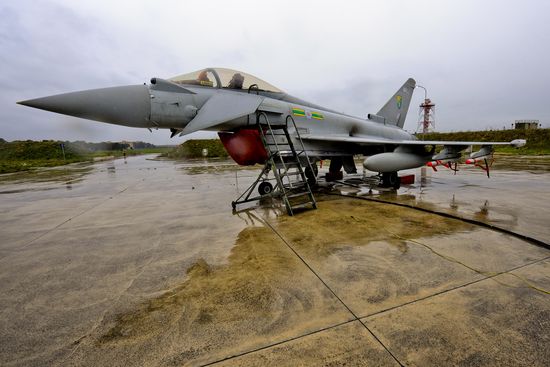
(Photo: Royal Air Force Typhoon aircraft prepare as part of Operation Ellamy, the British action in support of the UN security resolution to enforce a no-fly zone over Libya on March 21, 2011 in Gioia Del Colle, Italy. By SAC Neil Chapman/MoD via Getty Images.)

The Politics Of Science

by Patrick Appel

Kevin Williamson is getting pilloried, mercilessly, for saying that we shouldn't care about politicans scientific beliefs because they aren't qualified to hold scientific opinions. For example, Williamson writes that are "lots of good reasons not to wonder what Rick Perry thinks about scientific questions, foremost amongst them that there are probably fewer than 10,000 people in the United States whose views on disputed questions regarding evolution are worth consulting." Chait fillets this argument:

Williamson argues that the "real" debate is whether "the policies being pushed by Al Gore et al. are wise and intelligent." Well, that is one debate. Another debate is whether we should pursue a different set of policies to fight climate change. It's true, as Williamson argues, that one could accept climate science and argue that doing anything to stem climate change is simply too expensive. Yet this position clearly represents a weaker commitment to the values of the conservative movement than full-out climate science denial. One could argue that the costs of climate change are X and the costs of mitigating climate change are Y. But that's a view that implies that if X rises, or Y falls, perhaps we should consider a different answer. Perry is convincingly demonstrating to the right that he will never make that kind of calculation because he denies the entire empirical basis of climate science.

Drum piles on. Williamson, ignoring the portion of Chait's post I've quoted and Drum's questions, digs in. Jim Manzi focuses on the stronger part of Williamson's argument and improves it. Manzi calls out liberals for attempting "to drape the label 'science' over assertions that do not have the same reliability as physical science in order to create political advantage":

[S]cientific findings in some area are used to justify some related political or moral opinion. Key examples are exactly the topics you touch upon: global warming and evolution. In one example, the indisputable scientific finding that CO2 molecules redirect infrared radiation is used to argue that “science says” we must implement a massive global program of emissions mitigation, when in fact, the argument for this depends upon all kinds of beliefs about the growth of the global economy, Chinese politics, technological developments and so on for something like the next couple of hundred years. In the other example, the incredibly powerful scientific paradigm of evolution through natural selection is used to argue that “science says” we have just eliminated the need for God in the creation of the human species, when in fact, as a simple counter-example, the genetic operators of selection, crossover and mutation require building blocks as starting points, and therefore leave the classic First Cause argument unaddressed.

Mourning In Canada, Ctd

by Chris Bodenner

Some remaining thoughts on Jack Layton:

In the early '80s, when the AIDS crisis was in full bloom, when Toronto was shocked and saddened by the rape and murder of a 12-year-old boy committed by three men, and when the vice squad was raiding gay bathhouses, Jack Layton – then a young city counsel member – spoke up in defense of the baths and the Toronto gay community, just because that was the right thing to do. For years he was one of the few straight political figures at any level who'd march in the pride parade and campaign in the baths and bars. He was a remarkable man.

Another writes:

I’ve experienced a surprisingly intense emotional reaction to Jack Layton’s passing.  He was truly one of the most authentic politicians that Canada has produced in my lifetime (one of the others was another federal NDP leader, Ed Broadbent) .  My father was never really a party guy – he always encouraged me to vote for the person, not the party – but had he still been alive he would have voted NDP in the last election regardless of who they ran in his riding because of Jack Layton.  He gave voice to our better angels, gave us hope, and resonated as a real person (especially next to the aloof leaders of the Liberals and Conservatives).

What has motivated me to write is the piece submitted by the reader from Quebec.  He/she sure hit many nails on their heads with his assessment of Layton’s remarkable breakthrough in Quebec in the election, but it was this comment that help put words to some of the emotions I’ve felt in the last few days:  "And leaving the left decapitated in front of the most conservative and ideological government Canada ever had."  

I frequently joke with my American colleagues and friends that they’d be better off with a parliamentary system. "At least then the party in power could get something done instead of this consistent gridlock," I'd say.  Well, I fear that those words will haunt me now with Layton's passing. The Conservative PM, Stephen Harper, will now face a parliament where none of the opposition parties have a leader – a situation unprecedented in Canadian history.  An unfailing political opportunist, he will not let this one pass without exploiting it to the fullest.  Harper has been hell bent on moving Canada to the right, through undercutting funding to the opposition parties, recasting the entitlement structure that funnels money from richer regions (the ones his party overwhelmingly represents) to poorer (the ones the current opposition parties overwhelmingly represent), even returning "royal" to the names of the branches of the military, to name but a few examples.

What I suspect I and many other Canadians are reeling from is not only the passing of a truly remarkable Canadian, but the dread that our nation may be on the verge of a change we don’t want and that will irreparably damage the character of our country.

The Psychology Of Pronouns

by Maisie Allison

James Pennebaker reads between the lines:

In an attempt to better understand the power of writing, we developed a computerized text analysis program to determine how language use might predict later health improvements. In other words, I wanted to find if there was a healthy way to write.

Much to my surprise, I soon discovered that the ways people used pronouns in their essays predicted whose health would improve the most. Specifically, those people who benefited the most from writing changed in their pronoun use from one essay to another. Pronouns were reflecting people's abilities to change perspective. As I pondered these findings, I started looking at how people used pronouns in other texts — blogs, emails, speeches, class writing assignments, and natural conversation. Remarkably, how people used pronouns was correlated with almost everything I studied. For example, use of first-person singular pronouns (I, me, my) was consistently related to gender, age, social class, honesty, status, personality, and much more. Although the findings were often robust, people in daily life were unable to pick them up when reading or listening to others. It was almost as if there was a secret world of pronouns that existed outside our awareness.