by Chris Bodenner
Dan Savage spots the sports world's latest convert to equality. (Other examples from the summer here, here and here.)
by Zoë Pollock
Anya Kamenetz measures it:
In 1900 about half a million people worldwide were enrolled in colleges. A century later the number was 100 million. According to a 2009 report by the United Nations Educational, Scientific and Cultural Organization (UNESCO), 150 million students are now enrolled in some kind of education beyond high school, a 53 percent increase in less than a decade. That number represents more than one in four college-age young people worldwide. The growth has touched even the most impoverished and war-torn countries.
Sub-Saharan Africa, the world’s poorest region, has 5 percent of its population enrolled in higher education, and this is the lowest participation rate on the planet. UNESCO concluded that there’s no foreseeable way that enough traditional universities could be physically built in the next two decades to match the demand. Young people worldwide are caught between the spiraling cost of college and an apparently bottomless hunger for it.
by Chris Bodenner
A reader vents:
Portraro claims that "telemarketing is based on a script. Veer away from the script, and you’ll get a serious talking-to by your supervisor. You begin with the same introduction every time, “Hello, this is Name calling on behalf of Newspaper X. How are you today?”
Ha, I wish the telemarketers who called me were always this pleasant! The vast, vast majority begin the phone call by asking "Hello, is (name) there?" No introduction at all, but an immediate demand to speak to a specific person. This is beyond rude when you're calling a complete stranger's number.
Call me old-fashioned, but even when I call my family, and they can clearly see my name/number on their cell phone screen, I still say "Hey, it's Mark." Whenever telemarketers call my house and say "Hello, is (name) there?," I wait about 3-5 seconds, hoping they state who they are, before replying very sternly, "Would you mind if I ask who is calling?" before hanging up after their introduction.
If there is indeed a script for telemarketers, I'm only hearing the lousy and rude one. I'd be less inclined to hang up on them if they had any sense of phone manners. Otherwise, they are simply wasting my time … and my number is on the Do Not Call list!
by Patrick Appel
Robin Hanson explores over-used language:
Many words, like “excellent”, “genius”, “rude”, or “tyrant” have ambiguous borderlines, so that it isn’t clear to what cases the concepts do or don’t apply. In such borderline cases, we should expect people to choose their words strategically, to make they and their allies look good, and to make their rivals look bad. That is, we expect people to try be especially generous and loose in order to let themselves apply positive words to themselves or their allies, but to be specially strict and stingy in order to avoid applying such words to their rivals.
Hanson theorizes that the meanings of positive words broaden their meanings faster, because we talk more about ourselves and our allies than we talk about our rivals.
by Zack Beauchamp
The Guardian liveblog summarizes the latest developments:
Tripoli is mostly under rebel control and the government of Muammar Gaddafi seems to be at an end – but Gaddafi himself is still nowhere to be found. He put out an audio message last night calling on his supporters to attack the rebels and saying he had been out and about in Tripoli "discretely" and he "did not feel that Tripoli was in danger" (see 8.41am). Fighting continues between pro- and anti-Gaddafi forces in his Bab al-Aziziya compound, much of which – but not all – is now in rebel hands (see 11.13am). In his audio message, Gaddafi said he had left his compound as a "tactical move". The rebels say 400 people have died and 2,000 injured in the battle for Tripoli so far (see 9.42am). There are concerns about the humanitarian situation in Tripoli and the lack of medical supplies at hospitals (see 11.14am).
AJE also thinks Qaddafi is out and about in Tripoli – probably in the al-Hadhba al-Khadra area. English translation of the deposed despot's audio message (via James Miller) after the jump:
by Zoë Pollock
Stanford psychologist Benoît Monin has identified why "overtly moral behavior can elicit annoyance and ridicule rather than admiration and respect." It's called anticipated reproach:
Argue on behalf of an environmental cause, and non-environmentalists, anticipating your moral reproach, will think you're stuck-up and self-righteous. Often, the anticipated reproach — driven, as it is, by fear — is exaggerated and caricatured: vegetarians, Monin finds, aren't nearly as judgmental of meat-eaters as meat-eaters think they are. Unfortunately, one or two genuinely judgmental do-gooders can put everyone else on a hair-trigger, twisting discussion about moral issues into a vicious circle, in which both parties anticipate reproaches from one another, and put each other down in advance.
by Zoë Pollock
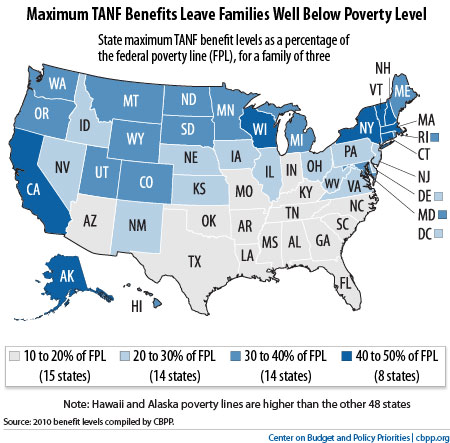
It's fifteen years since Clinton signed welfare reform, also known as Temporary Assistance for Needy Families (TANF). Ezra Klein tries to gauge whether it's been a success:
In the late-1990s, when the labor market was very tight, there’s strong evidence that welfare reform was helpful in pushing people into the job market. In the Aughts and, in particular, since the recession has hit, it’s a lot less clear that welfare reform is increasing employment rather than simply limiting support for the unemployed.
LaDonna Pavetti runs the numbers on the poverty rate since the recession:
While the poverty rate among families declined in the early years of welfare reform, when the economy was booming and unemployment was extremely low, it started increasing in 2000 and now exceeds its 1996 level. The increase in deep poverty has been especially large. The number of families in deep poverty rose by 13 percent between 1996 and 2009, from 2.7 million to 3 million.
Jake Blumgart has more.
by Zack Beauchamp
Joel Wing reviews two new studies on the impact of the Surge in Iraq:
The Surge has gone through a lot of mythologization and simplification over the last couple years. U.S. military tactics, leadership, and soldiers have been emphasized by many as the reasons for Iraq’s turn around. Americans reading and writing about Iraq obviously tend towards Americancentric views like these. Thiel and Ollivant challenged many of these beliefs.
Thiel found that troop numbers alone were not enough to explain why violence went down in Iraq. Ollivant tried to change people’s focus from America’s actions, to those of Iraqis. Iraqi agency he argued, is often ignored. When he looked at them, he found the roots of the end of the sectarian war before and during the Surge. The Sunnis’ decision to give up their fight with the Shiites, and the Shiites realization that they were safely in power, both of which happened before the Surge started, were more important for Ollivant than anything the Americans would later do. Together, both believed that the U.S. had a role in ending the Iraqi civil war, but they were not as a paramount as others have argued.
Previous coverage of Ollivant's paper here. His point about Iraqi agency is important, and extends to the Iraqi ability to reject al-Qaeda in Iraq's rule. AQI's theologically mandated bruality played some role in the collapse of its popular support. Indeed, one the best reasons to be optimistic about the coming collapse of radical Islamism is that, whenever it gets the opportunity to govern, its repugnant agenda manages to undermine its own authority.
by Chris Bodenner
Some findings for thought:
Women tend to have more deep sleep and awaken fewer times during the night than men do. They also weather some of the effects of a lack of sleep better than men, according to recent studies. Still, men overall say they are more satisfied with the amount and quality of their shut-eye than are women.
Getting enough sleep is an important factor in maintaining overall health. Scientists are increasingly focusing on gender differences in sleep, seeking clues about why women are more likely to suffer insomnia, for instance. Some researchers suggest that differences in sleep patterns could help explain why women live longer than men.
by Patrick Appel
Sam Harris contemplates it:
[T]here is no reason to think that we have reached the upper bound of wealth inequality, as not every breakthrough in technology creates new jobs. The ultimate labor saving device might be just that—the ultimate labor saving device. Imagine the future Google of robotics or nanotechnology: Its CEO could make Steve Jobs look like a sharecropper, and its products could put tens of millions of people out of work.
What would it mean for one person to hold the most valuable patents compatible with the laws of physics and to amass more wealth than everyone else on the Forbes 400 list combined? How many Republicans who have vowed not to raise taxes on billionaires would want to live in a country with a trillionaire and 30 percent unemployment? If the answer is "none"—and it really must be—then everyone is in favor of "wealth redistribution." They just haven’t been forced to admit it.
Bruce Bartlett, in a related post, argues persuasively that the rich can afford higher taxes.
 The Dish