by Chris Bodenner
"It wasn't really hard. I just went inside his room, Qaddafi's bedroom," – a Libyan rebel, explaining how he obtained the dictator's famous hat.
by Chris Bodenner
"It wasn't really hard. I just went inside his room, Qaddafi's bedroom," – a Libyan rebel, explaining how he obtained the dictator's famous hat.
by Zoë Pollock
Roger Ebert offers a glimpse of his memoir, out in September:
One of the rewards of growing old is that you can truthfully say you lived in the past. I remember the day my father sat down next to me and said he had something he wanted to tell me. We had dropped an atomic bomb on the Japanese and that might mean the war was over. I asked him what an atomic bomb was. He said it was a bomb as big as a hundred other bombs. I said I hoped we dropped a hundred of them. My father said, "Don't even say that, Roger. It's a terrible thing." My mother came in from the kitchen. "What's terrible?" My father told her. "Oh, yes, honey," she told me. "All those poor people burned up alive." How can I tell you what they said? I remember them saying it. In these years after my illness, when I can no longer speak and am set aside from the daily flow, I live more in my memory and discover that a great many things are safely stored away.
by Zack Beauchamp
Matt Yglesias makes a provocative point:
Reading about the serious problems facing Libya’s sundry rebel groups as they try to put a unified political structure together I’m struck by the extent to which the past couple of years have vindicated Francis Fukuyama’s The End of History thesis. Historical events, of course, continue to occur. But each and every one of them re-enforces his 1989 point about the “the total exhaustion of viable systematic alternatives to Western liberalism.”
Amitav Acharya, in an interview we featured recently, disagrees:
I speak here as an IR scholar, not as a specialist in those regions. What has been happening in Tunisia, Egypt and elsewhere in North Africa and the Middle East does attest to the universality of the desire for freedom as you suggest. Though the question I ask is what kind of universalism or whose universalism is it? In the United States, some George W. Bush era neo-cons are celebrating that this is a vindication of their democracy promotion agenda of the kind that gave us the war in Iraq. Others see the uprisings confirming Fukuyama’s ‘end of history’ thesis. Both claims are ridiculous and if this is the kind of universalism we are talking about we are really doomed. One of the things about the Arab Spring was that it was a bottom up process; it was sought by the people of those states and societies. Its origins were local. They were not the outcome of the end of the Cold War or any other major global shock. This is what I mean by subaltern universalism.
A. McE looks at how far Fukuyama has moved from his own ideas.
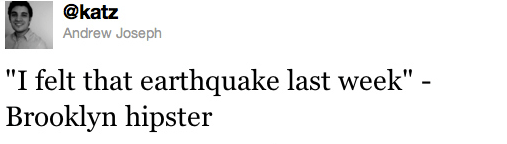
Today on the Dish, a big earthquake shook the Eastern US. On the Libyan front, Saif al-Qaddafi reemerged to give conflicting accounts about government forces on the rebound, and then rebel forces took over Qaddafi's compound. We weighed whether our intervention worked and Zack duked it out with Freddie deBoer over our Von Hoffman awards. We revisited the success curse and whether this war was really a war, and Qaddafi lived up to his narcissistic dictatorship tendencies. Ben Dunant questioned Robert Kagan's view of superpower suicide, and we wondered about the dissolution of trust in the Middle East.
In the political alley, Maisie tackled the GOP for catering to nostalgic white voters, Fallows bashed the GOP's allergy to taxes unless they're taxes on the poor, and libertarians still wanted to build their own island. Steve Kornacki charged Huntsman with copying McCain's campaign style, and Rick Perry challenged the Republican Party to decide whether they are Establishment or tea-vangelical. We poured over Obama's summer reading list, and a Quebecois reader remembered the great Jack Layton. Dale Carpenter debated whether the case against Prop 8 has sapped support for a repeal, and Simon Rippon made the case for not banning twin reduction.
In other international news, Felix Salmon proposed a more mobile, global workforce, and Ken Menkhaus tracked al-Shabaab's implosion in Somalia and advised us not to intervene. Peter Ackroyd argued rioting is a London tradition, Haiti hasn't been able to use all its recovery funds, and terror could kill the tent protests and move Israel to the right.
Chris explored intimacy in the asexual world, most women masturbate without feeling guilty about it, and one reader was ready to nix the postal service. Giving presents to coworkers makes us feel better, we learned how voice recognition works in computers, and the law-school-is-a-scam scandal escalated with the exposure of the man behind the blog. Scientists accepted their own mistakes, telemarketers follow the script, and readers boggled our minds some more on infinity (and beyond).
Hathos alert here, MHB here, FOTD here, VFYW here, and winner #64 here.
–Z.P.
(Tweet via JP Moore)
by Chris Bodenner
The thread gets surprisingly popular:
I have an explanation for Zeno’s paradox that makes it easy for your readers to understand the infinite sum. Zeno's paradox arises from *stopping* an infinite process and declaring on that basis that the process can never finish, i.e., you never cover 100% of the room’s length because you stop at some point and say there is some distance that has yet to be covered, and conclude that it therefore *never will be*. An easier way to picture this infinite process, at least for me, is to arrive at the result backward.
We know that the room has a length. Let’s call it L. We also know that we can divide the room's length into two equal halves, call them A and B. (A + B = L by definition.) We can repeat this process on the second half, that is, we can divide B into two equal halves. These two halves must add up to B. Now imagine carrying out this process infinitely. Is it not obvious that the grand total of all these lengths must add up to the room length L? The only difference between my "backward" approach and Zeno’s approach is that you can stop mine at any time and see that the total must equal L. However, the two approaches are, mathematically, exactly the same sum. Therefore, one can conclude that Zeno's approach, if carried out to infinity, would allow one to cross the room and touch the farthest wall.
Another reader pulls from the previous post:
Another needs a translator:
Hilbert's example only uses countable infinity, or infinity where there is a one-to-one correspondence with whole numbers, or positive Integers. This is only the first order of magnitude (cardinality) of Infinite Sets, dubbed Aleph-Null (ran outta Greek letters and went to Hebrew). Next order of magnitude would be Aleph-one – the set of Real Numbers for example (provable depending on the Axiom of Choice and other stuff I don't quite remember), which includes the irrational numbers like pi, e, SQRT (2), etc. Go here, here and here for some fun (well, for some of us, anyway) reads. A bit easier to figger out: Zeno's paradox, explainable with calculus (convergent infinite series).
You rang?
This is actually my favorite piece of math to explain to laymen. It's mindblowing and quite understandable with a little effort. (Although I've included a couple "bonus" facts in this email that I didn't really prove and don't expect anybody to fully understand.)
First fun fact: there is a "one-to-one correspondence" between the natural numbers (1,2,3, …) and all the integers, meaning in a certain sense there are no more of one than there are of the other. I'll show you that correspondence right now:
1 2 3 4 5 ….
0 -1 1 -2 2 ….Any time a set of numbers can be placed in one-to-one correspondence with the natural numbers, we call it "countably infinite." That's because one-to-one correspondence is exactly how we normally count objects: "This is apple number 1, this is apple number 2. Oh look, we're out of apples. There must be only two apples." As your previous reader pointed out, the symbol for "countable infinity" is Aleph-null. (That's Hebrew letter "Aleph" with a subscript of 0).
Okay, that was an easy one. Here's something a little more mindblowing. The set of all rational numbers (fractions of integers) is still countable! It's no "larger" than the set of natural numbers, in this sense … in spite of the fact that there are infinitely many fractions between any two natural numbers! The proof is easy, but to save space I'll just throw in a link. Its diagram tells the whole story:
Just follow the arrows and number the fractions in order as you go. (Okay, this diagram only covers the positive rational numbers, but that could easily be rectified.)
So by now you'd probably be surprised if I told you there IS something so big it isn't countable! Well, there is: for example, the set of real numbers (i.e. anything that can be represented as a decimal, infinite or non-infinite).
I'm going to prove that the real numbers between 0 and 1, alone, are so numerous that you can't put them in one-to-one correspondence with the integers. The way I'm going to do this is a little sneaky. I say, "You show me a list of real numbers in one-to-one correspondence with natural numbers, and I'll show you a real number that isn't on your list. No list you give me can possibly be complete! It's impossible!" So let's get to it. Here's an example list:
1: 0.14260000…
2: 0.36378423…
3: 0.55922342…
4: 0.12345678….
etc.To find my counterexample, I'm going to take the first digit of the first number, the second digit of the second number, etc.:
0.1694….
and add 2 to each one (turning 9 into 1, etc):
0.3816….
Now, this infinite decimal I've constructed isn't "decimal number 1": it has the wrong first digit! And it's not the second number in the list either: it has the wrong second digit! In fact, it isn't ANY of the numbers on your crappy list! And I can do this no matter what list you give me. There are just too many real numbers for you to try this game with me.
Evidently the collection of real numbers is larger than the sets we've been dealing with before. We'd like to give a name to this new type of infinity. We could call it "Aleph-1" but that seems to imply that there are no sizes in between this and Aleph-0. So maybe we should first decide whether that is true or not? Rather fascinatingly, it all depends: you can actually construct entire logically-consistent systems of math where it either is or is not true. Of course this means that even if there's a set smaller than the real numbers but larger than the natural numbers, it is impossible for me to explain to you which numbers are in that set and which aren't! That would constitute a proof of its existence, and yet its existence can't be proven without breaking those mathematical systems in which it doesn't exist!
Anyway to close out this explanation, I'll recall that another reader pointed out that there are infinitely many different sizes of infinity. But wait, that's not good enough for us anymore, is it? Are there countably many types of infinity, or more? Could we call them all "Aleph 0," "Aleph 1," "Aleph 2" and so forth, or would that only scratch the surface? Turns out the answer is "It's not countable. In fact, it's larger than any "size" of infinity that we can possibly construct."
If your brain isn't fried at this point, another:
As a mathematician, I must point out the error in the previous post about infinities which you said "needed a translator". The writer points out that there are indeed different "sizes of" infinities. (I present a "humanized version" of the argument below). But he's wrong when he says that the next infinity after Aleph-Naught is ("assuming some other things") provably Aleph-One.
Math is a study which begins with axioms and then derives logical conclusions (theorems) based on those axioms. The question is, "What are the most fundamental axioms?" Euclid put forward his five (the famous Parallel Postulate among them), but these aren't used any more. Peano put together his, but these are also not used any more as a basis of mathematics. Instead, the standard set of axioms were laid down by Zermelo and Frankel and concern the question of "What is a set?", the most basic of all mathematical objects. To illustrate why you have to think carefully about this question, ponder Russel's Paradox (invented to dispatch Frege's attempt at axioms), which begins: consider the set S of all sets which don't contain themselves. Then S belongs to S if and only if S does not belong to S. That is, "if it does, then it doesn't, and if it doesn't, then it does." This, being pure logic and not a debate among politicians, is impossible.
As you can see, this level of math gets rather mindbending very fast, and almost all mathematicians eschew the study of such things. Most of our definitions are at a level of abstraction much further up than these "basic considerations" (partly because we don't understand them). Indeed, it is here that your reader made a mistake. The statement that the "next infinityafter Aleph-Naught is Aleph-One" goes by the name of the Continuum Hypothesis. Godel and Cohen have shown that this statement is independent of ZFC, the standard set axioms. That is, assuming these axioms don't themselves contain a contradiction, it can be neither proven nor disproven from these axioms alone.
As this is where my head starts to hurt, I'll leave you with humanized version of Cantor's diagonalization argument:
Suppose there were two infinite hotels next to each other, the Hilbert Hotel and the Cantor Hotel. At the Hilbert Hotel, the rooms are labeled by the natural numbers: 1, 2, 3, 4, …. At the Cantor Hotel, the rooms are labeled by the real numbers, which include the natural numbers, the rational numbers (fractions), and all the irrational numbers such as the square root of 2, pi, e, the logarithm of almost anything, etc. Further suppose that Hilbert's hit on hard times so his hotel is empty. But Cantor's struck it rich and every single room is currently occupied. That is until a massive fire burns down the entirety of Cantor's Hotel. Everyone survives, and so they ask Hilbert if he has room for them all. Does he?
Well, suppose he did. Then there is a correspondence between the tenant's room number at the Hilbert Hotel and their room number at Cantor's Hotel. It's hard to write down real numbers, but we know that every real number has a decimal expansion (pi = 3.1415926…, e = 2.718281828459045…). So for our labeling purposes, let's forget about the stuff to the left of the decimal (the "whole part" or "floor") and just worry about the stuff to the right of the decimal (the misnamed "fractional part"). So the correspondence between room numbers looks something like:
1 —> ….2547348….
2 —> ….3453839….
3 —> ….2837384….
4 —> ….3824935….
…Now to show that Hilbert *cannot* hold all of Cantor's guests, we just have to find one person who's out in the stables. So let's try to find someone (who we will identify by their room number at Cantor's Hotel). We construct a number as follows: it will have 0 whole part. The first decimal digit of its fractional part will be any digit other than the first decimal digit of the fractional part of the first person on our list. That is, person ….2547348…. So we choose any number other than 2, say 3. The same goes for the second digit of our new number: we choose any digit other than the second digit of ….3453839…., say 3.
We continue in this way for every room at Hilbert's Hotel and we get the number 0.3343…. Now whoever was in this room at Cantor's Hotel is not in Room #1 at Hilbert's Hotel (since 0.2547 does not equal 0.3343), or at Room #2 (since they differ in their second digits by construction) or Room #3 (the third digit differs) or #4 (the fourth digit), etc. That is, this supposed correspondence between rooms at Hilbert's and Cantor's Hotels is missing 0.3343….
Conclusion: Somehow Cantor's Hotel is bigger than Hilbert's Hotel.
Time for a mental health break:
A smaller bite to chew:
And we can take Cantor and Hilbert and take it one step further! As you're currently reading Gödel, Escher, Bach, you'll appreciate this. As a prior reader noted, there are an infinity of infinities, denoted as aleph-null, aleph-one, etc. That lead to the next obvious question: how do we know that there are no infinities between aleph-null and aleph-one?
Mathemeticians couldn't prove it one way or the other, but they were able to at least get halfway there, and proved the following: if we assume there are no infinities between aleph-null and aleph-one, it wouldn't violate any axioms. But then somebody proved the opposite: if we assume there *are* infinities, between aleph-null and aleph-one, it wouldn't violate any axioms.
So, then came Godel who looked at the statement: "the statement that there are infinities between aleph-null and aleph-one is unprovable" and wondered: what else is unprovable? Eventually came Godel's first Incompleteness Theory, which, simplified, says that *every* logical and consistent system will have assertions which can not be proved. This is a great example of how math moves forward – discovering things, asking questions about it, generalizing on it, and repeating the process.
A math major writes:
Sometimes people who are really good at math tend to be crazy. Gödel himself was an example. I was a good math student, at the top of my college classes, but not someone who was destined to go out and make new discoveries. I am a little crazy sometimes, though. I think it has to do with pattern recognition. I imagine a system in people's brains that makes connections between patterns in one context and patterns in another. People who are really good at math tend to have the volume knob on that system turned up a little higher than other people do. This is great for spotting things in the theory, but it also tends to cause them to imagine connections in the world at large that aren't always there.
Another:
The one that gets me is hearing Dr. Neil deGrasse Tyson talk about infinite space. I first heard him on this topic on NPR's Science Friday, but can't quickly get my hands on that link. Here is video of him discussing it on ABC (this topic comes up at 3:45, earlier he mentions the different kinds of infinity your reader wrote about). My head asploded when he said that if there are a certain number of ways that particles could be arranged, and space is infinite, then what we think of as "parallel worlds" (say, another Earth but one in which I'm not sending you an email but went for more coffee instead) are physically out there. Travel far enough and you will run into the same patterns of particles with slight variations over and over. For infinity.
Yet another:
I am sure you are aware of this, but D.F. Wallace has a great book on this subject, specifically George Cantor's proof, A Compact History of Infinity. I have read it several times, and while the math is a bit out of my range, the writing and explanations of the complicated mathematical concepts are great, as is typical of DFW's nonfiction.
Almost done:
You might want to mention that the late and so-much-missed David Foster Wallace wrote a very enjoyable little book on the history of the mathematics of infinity. Everything and More is eminently readable, easily comprehensible to someone with only a smattering of calculus, and contains the usual nuggets of Wallace's profundity and humor.
A reader sent the above video:
While Cantor's take on infinity is interesting, I remember the headache it gave me when I took my first course in set theory. Another way your readers may enjoy contemplating the concept of infinity is to watch this video on imagining 10 dimensions. It's meant to help understand some of the concepts of multi-dimensional space as used in thing like string theory, but touches on the concept on infinity and how there can be different infinities.
The gist of it is to realize that for any given starting point of the universe (say a particular set of laws, like how strong gravity is, or what the speed of light is), there are an infinite number of ways that universe could play out. The next step is to realize that there are an infinite number of different starting points, each with an infinite number of outcomes. That is, there are an infinite amount of infinities.
I think the video does a nice job of building this up from the very simple starting point of just imagining a single dot. Some people may get a little lost as it gets into the higher dimensions, but after a few viewings, most people should be able to understand it pretty well. Plus, it shows that once you imagine all the possible branches of all the possible time lines of all the possible universes (ie, an infinite amount of infinities), you eventually do hit an end to this train of logic. That is, the brain finally is able to get some rest upon realizing that there is, in some sense, an end to the endless.
by Patrick Appel
Janet Reitman checks in on Haiti. Felix Salmon, who begged donors to give unmarked funds at the beginning of the disaster, has been vindicated:
The first thing to note is that most of the money given to Haiti hasn’t even started to be spent yet: a whopping $11 billion was pledged by donor countries and financial institutions in the wake of the earthquake, but if you take the US as a good example, it’s so far managed to spend just $184 million of the $1.14 billion allocated to the country. Even the Red Cross is barely halfway into its $479 million fund — all of which has been earmarked for Haiti, and none of which can be spent elsewhere, no matter how much better it might be put to use in some other context.
Tyler Cowen calls the Reitman piece "mostly good" but contends that the article "is wrong, and arguably insane, to criticize the development models of Haiti’s past as too 'business friendly.'"

by Zoë Pollock
How was the quake felt from the Carolinas all the way to Canada? Alexis chalks it up to the fact that "East Coast crust isn't the same as West Coast crust":
Most strong quakes occur deeper in the earth's crust. The depth of a quake has a direct relationship with how intense humans at the surface perceive its shaking to be, although that depends on a lot of other things, too. Still, relative to a deeper quake, this 5.9 tremor was felt more strongly than you'd expect. … That's probably because East Coast crust is "older and colder," which makes it a more efficient transmitter of seismic energy.
Like Patrick, I also grew up in California, but my memories are of the LA quake in 1994.
The kitchen was covered in food that had fallen from the fridge, our dogs ran away to pee in a neighbor's car, and a bookcase fell on the pillow where my brother's head should have been. He was luckily having a sleepover in another room. It feels odd to have this moment weeks before the ten-year mark for 9/11, when we'll all go through the "where were you when?" stories again. Amy Davidson had similar thoughts.
by Zoë Pollock
Anna North reflects on the mission of Dirty Girls Ministries, an attempt to cure women of masturbation or pornography habits:
Dirty Girls appears to draw on a particularly female stereotype — that any sexual thoughts that aren't about penile-vaginal intercourse with a male partner are somehow dirty or warped. Some of Renaud's clients may be gay, some may be bisexual, some may fantasize about BDSM or kink, and some may be quite vanilla but nonetheless feel guilty about the strength or frequency of their desires. In all of these cases, acceptance might allow them to lead satisfied sexual lives. Instead, they're being forced to pit their sexual desires against stigma, shame, and external notions of what it means to be unclean.
Jill Filipovic takes issue with the "treatment" as a way to deal with past trauma:
Most women masturbate. Tons of women who have never survived experienced trauma masturbate. Tons of women who have survived trauma, sexual or otherwise, masturbate — not because they’re broken, but because they’re human beings who feel sexual urges despite having gone through some bad shit. … Capitalizing on trauma — shaming women for natural urges and for enjoying what’s between their legs even after someone did harm to their body and their spirit — is cruel and sick and evil.
In an interview from April, Dirty Girls founder Crystal Renaud levied this charge, which sounds inflated to me:
81% of women, who frequent pornographic websites, will eventually escalate their addiction to in-person encounters because of their desire to be close to someone.

by Zoë Pollock
John Heilemann spots an upside to Perry's entry:
What was needed … was a clear contest between the Establishment and tea-vangelical wings of the party. … What [Perry] brings to the race is a welcome clarity, and the prospect of a kind of challenge to Romney that has been lacking until now. How Romney handles that challenge will tell us all we need to know about him. And how the Republican electorate ultimately judges them will tell us everything we need to know about the party.
And, on cue, Perry surges ahead in Iowa. Alex Roarty and Beth Reinhard shed light on Romney's hands-off approach:
Directly engaging Perry would turn the campaign into a two-candidate race at the expense of Rep. Michele Bachmann. Right now, the Minnesota lawmaker is positioned to take many social conservative and evangelical votes away from Perry. … If Bachmann fades, however, it would force Romney’s campaign to directly engage Perry on substantive policy differences, and there aren’t many clear lines of attack that would appeal to conservatives. Raising questions about the high percentage of Texans without health insurance, for instance, won’t resonate in a Republican primary.
(Photo: Republican presidential candidate and Texas Governor Rick Perry signs a campaign poster at the Iowa State Fair August 15, 2011 in Des Moines, Iowa. By Chip Somodevilla/Getty Images)
by Chris Bodenner
A reader veers from the others:
The United States Postal Service has a MONOPOLY on mail delivery and still can't get it right. The only reason people stand in long lines at the post office is that it is illegal for other carriers to carry mail at comparable rates. The world would be far better off if the USPS were shut down tomorrow. The void would be filled almost immediately and service would be better and cheaper than what is currently available. FedEX and UPS clearly have the infrastructure in place to carry mail as well and would do it far more efficiently than the US Government.
Another differs:
State Representative Alan Dick (R-Stony River, Alaska) predicts severe impacts if proposed post office closures are implemented.
Rep. Dick's represents Alaska House District 6, which covers a huge swathe of the state. The USPS proposes to close half of the district's post offices, which are a lifeline to the villages, as described in Rep. Dick's August 19 opinion piece in the Anchorage Daily News. Here (pdf) is a map of District 6 after the 2000 census (may change with the new redistricting).
Another:
As a development director for a smallish, localized non-profit, we rely on snail mail solicitations for the vast majority of our membership income. We also send email solicitations, accept donations through our website, announce campaigns through our Facebook page and utilize QR codes to generate on-demand donations through smartphones, etc., but none of them come close to the amount we bring in with a hand-signed letter highlighting a specific need.
Furthermore, a large portion of our membership is aging and are not nearly as reachable through email, if they even have email. I’ve also worked at other, much larger non-profits, and know that many of them rely heavily on mail solicitations as well. The closing of USPS would force most non-profits to find new ways of generating income, but in the meantime would totally disrupt the way we raise money for our programs. It underscores the need to find new ways to connect with donors, but it scares the crap out of me at the same time, because there is little that is as personalized and effective as a hand-signed letter. Likewise, there is little that is as impersonal, and as easily ignored, as an email blast. Shudder.
Another:
I'm a bit surprised that no one has pointed this out, but what about absentee voting? Washington State has an "all absentee" voting system now. As you can see here, we had a voter turn out rate of 71.24% in an off-year election! Is there a state that is able to better this record for a better price per voter with a more conventional system?
This is the reason, more than anything else, that the Postal Service must be preserved. It simply increases access to our democracy. It means that those who are undecided can spend a quiet evening researching their decisions or avoid having to skip work or risk waiting in a line that is too long.

 The Dish