Face Of The Day

121933653

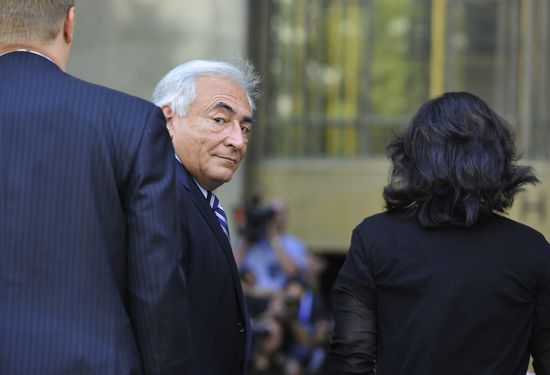
The former International Monetary Fund chief Dominique Strauss-Kahn accused of sexual assault and his wife Anne Sinclair arrive at the Manhattan Supreme Court building in New York on August 23, 2011. Dominique Strauss-Kahn was set to walk free Tuesday after New York prosecutors said they could no longer prove sexual assault beyond a reasonable doubt due to the alleged victim's alleged lies. By Mladen Antonov/AFP/Getty Images.

— C.B.

Will Terror Decamp The Tents?

by Zack Beauchamp

Michael Walzer worries:

The terror attack near Eilat and the rockets falling on Ashkelon and Beer Sheva have silenced the protests—literally. Two nights ago there was a silent march with candles from the tent city on Rothschild Boulevard to the sea, not a protest but a memorial for the people killed in the south. The protests will resume, and the chanting too—so the leaders say. But the way forward, never easy, will be much harder now. Terrorism strengthens the Right. I suppose that isn’t a necessary truth, but it is certainly true in Israel.

There's some empirical evidence (pdf) that butresses Walzer's fears. One can't emphasize enough the immense moral catastrophe it would be if terrorists succeed yet again at separating Israelis from their better angels.

Huntsman Apes McCain?

by Patrick Appel

Huntsman's new ad:

Steve Kornacki believes Huntsman is trying to copy McCain's 2000 campaign strategy:

[T]here are some crucial differences between what McCain did in 2000 (and why he was able to do it) and what Huntsman's strategy is likely to produce. One is that McCain wasn't actually that far off the GOP reservation.

His main break with the GOP establishment was over campaign finance reform, an issue that mattered for nothing to most Republican voters but that mattered a great deal to the party's interest group establishment.  To them, McCain's crusade was proof that he wasn't a team player, and they mobilized to stop him once he pulled off his New Hampshire win. Beyond that, McCain presented himself as a devout Reagan/Goldwater conservative. Huntsman, by contrast, now seems to be defining himself mainly as a man who's willing to say the same things about the GOP that Democrats say: It's why the DNC followed up his ABC interview with a glowing press release.

Adam Sorensen doesn't buy the Huntsman 2016 talk:

What’s more likely: that Huntsman’s engaging in an elaborate five-year-long moderation political dance or that he overestimated his own appeal in the race and is now looking for some way to make an impression?

Von Hoffman Award Nominee, Ctd

by Zack Beauchamp

A reader writes:

I wanted to take issue with the Von Hoffman Award nomination that was bestowed on Matt Yglesias on August 22nd. Matt does not deserve a nomination because he is ineligible: the campaign that NATO conducted against Qaddafi’s forces does not qualify as strategic air power. For the most part, the operations that NATO carried out could better be described as "tactical bombing."

NATO sorties did target command and control centers, but the traditional idea behind strategic bombing is to destroy the economic and industrial power of a state in order to compel them to surrender or at least come to the bargaining table. There is a second method of strategic bombing as well: inflicting pain directly on a state's civilian population to accomplish the same goals. Obviously we were not going to do that… the whole reason NATO got involved in Libya in the first place was to prevent civilian atrocities.

Obviously it will be quite some time before we can step back and do a full postmortem of this war. However, two things are clear. First, most of NATO's success seem to have come from attacking Qaddafi’s ground forces, which historically has been more successful. Second, air power alone did not win the war, rebel troops on the ground did. They could not have won without NATO assistance, but NATO bombing alone probably would not have driven Qaddafi out.

So Matt is wrong: what NATO did in Libya does not really seem to qualify as "strategic air power." He is correct concerning one thing: strategic air power still does not work.

The Legality Of The Libya War, Ctd

by Maisie Allison

"So this is our war?" Amy Davidson asks for some clarity:

Will it make a difference, if Qaddafi falls tonight, if we called this war a war? (Apart, but one hopes never so far apart, from the rule of law mattering, that is.) Maybe more than ever: if we are not honest about our role, then how will we assess our responsibility for whatever regime takes Qaddafi’s place? Our vagueness about what we are doing encourages a certain incuriousness about whom we are doing it for. The impolite fiction about “no hostilities” might have been sustainable, in a public-relations sense, when the Libyan war was in a stalemate. Now, with armies on the move and cities falling, it has to be reckoned with.

More on the serious legal issues surrounding the Libyan intervention here.

Romance Without Sex

by Chris Bodenner

Tracy Clark-Flory explores the complex world of asexuals:

Many asexual people masturbate — in fact, one study found that asexual people masturbate as often as everyone else. [Advocate David] Jay says some asexuals fantasize while pleasuring themselves, while others simply view it as a strictly physical thing (or as a researcher referred to it in the documentary [(A)sexual], "cleaning the pipes"). Ironically enough, Jay says he finds that his talking about asexuality often makes people with low sex drives feel more sexual. "There's something about really getting into talking about the experience of not being sexual that makes people see themselves as sexual in a way they never have before." Like I said, the lack of a sexual appetite can highlight the nuances of desire.

It can also make you reconsider how we define our connections with other people. If it isn't sex that makes a romantic relationship different from a friendship, then what does?

"The language that we use to talk about intimacy in our culture is deeply, deeply sexualized," Jay tells me. "For a lot of sexual people, especially straight people, there's this image of what intimacy should look like and how you're supposed to connect with other people. A lot of that is based around the idea that you're supposed to form a really intimate connection with one person that lasts for your entire life and involves sex."

I wonder then: What do asexuals consider cheating? Kissing, cuddling? Ironically, it's easy to imagine infidelity as more rampant among asexuals, since the bar for physicality is so much lower and easily crossed in moments of weakness. Or maybe, because the danger of sexual trysts aren't in the picture, asexuals are more likely to be non-monogamous, as Jay suggests in that last sentence. Any asexual Dish readers out there? Tracy's two cents:

[Jay] might overstate his case, but even as a "sexual," I can see truth here: We do use sex as a shortcut to intimacy, and often very ineffectively.

Some footage from the (A)sexual documentary here.
The Reality Of Telemarketing

by Patrick Appel

Daniel Alexandre Portraro pulls back the curtain:

The general perception is that telemarketers have lousy or menial jobs; as I’ve said, people constantly mistreat them, or slam the phone in their faces. But as a telemarketer, you realize there’s something else that gnaws at you whenever you come into work: you’re expected to be a machine.

Telemarketing is based on a script. Veer away from the script, and you’ll get a serious talking-to by your supervisor. You begin with the same introduction every time, “Hello, this is Name calling on behalf of Newspaper X. How are you today?” and continue until the customer cuts you off, or, more often than not, turns you off. In the former case, he’ll respond with something along the lines of “I read the news online” or “I already subscribe to another paper.” But don’t worry! You won’t have to think up an answer! Because in such circumstances, the script provides the telemarketer with the appropriate, company-decided response.

Regardless of how feeble it may seem to you, or however you think you can improve on it, you’re made to follow it. There is no room for creativity or individualism in telemarketing; I’m not exaggerating when I say a machine could do this job—and in many cases, now do. After a couple of shifts, you won’t even need the script anymore; the words are burnt onto your tongue.

Qaddafi’s Fall And “The Success Curse” Ctd

by Patrick Appel

Jonathan Chait counters Matt Welch:

This is a persuasive argument if you oppose all military interventions. If you don't, it basically boils down to the proposition that a successful military operation is bad because it will lead to unsuccessful military operations.

But the scale of military successes and failures matter. A "win" in Libya, where the US has few interests, doesn't cancel out the enormous failures of Iraq. And if the Libyan War, by further empowering the executive branch, leads America to another Iraq-scale disaster then "the success curse" will be validated. Wilkinson is less dismissive of Welch. Ackerman reminds us that "the war isn't over yet":

Leave aside the really relevant question of a potential revanchist insurgency. The rebels don't have Saif Gadhafi, they don't have Moammar Gadhafi, and they haven't demonstrated they can hold Tripoli. How can we draw lessons from an unconcluded war?

Dispatches From An Alternative Reality

by Zack Beauchamp

"Perry is off to a strong start. Recall that this was supposed to be Michele Bachmann’s week, when her upstart victory in the Ames straw poll catapulted her onto the front pages and the top tier of the GOP field. Instead, Perry stole Bachmann’s thunder, and dominated the political conversation." – Marc Thiessen. It's true that Perry "dominated" the conversation, but not all domination is good domination. Given his views on torture, though, I'm not sure Thiessen is aware of that fact.