Correcting Bad Science

by Zack Beauchamp

Gareth Cook celebrates a recent spate of corrections in scientific journals:

Between 2001 and 2010, the number of retractions increased more than 15-fold, according to a recent investigation by the Wall Street Journal. There were 22 retractions in 2001, and 339 last year, according to the Journal, over a period of time when the number of publications increased by only 44 percent.

It would seem a grim development, this sudden scourge of epic sloppiness and outright fraud in the halls of science. But it’s actually news we should all welcome: We are not witnessing an explosion of misconduct, but a new openness about it.

Mourning In Canada, Ctd

by Chris Bodenner

The death of Jack Layton has really struck a chord with readers. One writes:

First of all, a caveat: I’m a French-speaking Quebecer and it’s the first time I write a political comment in English. So I want to apologize in advance for the incoming grammar and syntax errors and gallicisms. (Oh, and another one: I didn’t vote for the guy. I’m not a party hack either; I’m an independent.)

There’s a huge something left unsaid in the passing of Jack Layton, either in your reader commentary or Mr. Horgan’s. It’s the impossibility of Layton’s career that makes him so remarkable as a person. This man was what we call in Quebec a “maudit anglais” – a damn Englishman. A scion of one of the great colonial families that ruled Canada from the Golden Square Mile in Montreal, whose forebears were ministers for the Conservative Party. He became a leftist in the ’70s and surged as the leader of the NDP (the Canadian version of the Labour) in the last decade. In the last election he gave the NDP its best results ever AND was able to beat the nationalist Bloc Quebecois on its own turf. He ended the career of the most popular politicians in Quebec, Gilles Duceppe, son of the great Quebecer actor Jean Duceppe. He broke the back of the Liberal Party (which was still called the Natural Ruling Party of Canada three years ago).

This is awesome. This is incredible.

The political pundits in Canada were still wrapping their head around this when Jack Layton passed away. The only way I could explain that is by offering two weak analogies: imagine in the UK a charismatic Protestant defeating Gerry Adams and winning almost the Catholic ridings in Northern Ireland PLUS giving the Labour such a beating that it would fade in third party status. Or imagine a Castillan becoming the popular leader of the Basques. It doesn’t make sense!

In all the history of Canada, Quebecers NEVER gave a majority of their votes to an  ethnic English party leader (and a Protestant to boot, even if religion doesn’t hold much sway anymore in Quebec politics). Never. Irish, Scots – rarely. English, ha! People say that politics are civil in Canada. They don’t know Quebec, Layton_Parliament-highreswhere the toxicity level is quite high and identity politics and class warfare are part of the game (it’s not Arizona, but frequently things are said here that would give the creeps to many pundits).

But the guy had this super smile, and said things like “When I’m Prime Minister, I’ll hold China accountable for its treatment of Tibet” with a willful look. And people tended to believe him because he got results, however seemingly impossible the objectives. He also had dignitas without unnecessary gravitas.

So this idealist (quixotic?) bloke from uptown, who speaks a hesitant French, with a moustache and a cane, changes the face of politics in the spring and dies by the summer, leaving us with a dream of purpose and appealing to our better selves. And leaving the left decapitated in front of the most conservative and ideological government Canada ever had.

I’m still shocked.

I tried all day to find an historical character to give a reference to a stranger to Canada. Perhaps a mix of Wilberforce and Zola, with a touch of RFK? A Gracchus without the anger? A Nick Clegg with a spine? Al Gore for the principles but without the stiffness, Ted Kennedy for the political acumen but without the sleaziness, likeable like Joe Biden but with speech discipline (for lack of a better word) and facial hair.

I hope this gives some perspective on this remarkable man.

Another writes:

Thank you for covering Jack Layton. Here is an image I made on Parliament Hill today.  (Some further info about the drawing.)

No Novels For Obama

by Zack Beauchamp

Tevi Troy is upset that the President's reading list is mostly fiction. Josh Barro takes his colleague to task. Alyssa Rosenberg thinks "condescending" is too nice a descriptor:

President Obama, and any person who holds that office, consumes vastly more non-fictional material than the average American, and doesn’t even have the benefit of reading it in engagingly-written histories or argumentative volumes. The idea that a novel or two, in the midst of all the briefings and reports, might somehow dilute his concentration is a direct heir to the idea that novels will rot delicate ladies’ brains, and deserves to be taken precisely as seriously.

Earlier thoughts on Obama's reading list here.

The East Coast Quake

by Patrick Appel

I'm a native Californian and the earthquake that hit DC about an hour ago was among the stronger I've felt, but it was nothing compared to the Loma Prieta earthquake of 1989 that shook my childhood home. Thoreau, another Californian, snarks:

At least under socialist Hussein Obama the earthquake burden gets spread around rather than concentrated.

Jill at Feminste pokes fun at New Yorkers, who felt the Virginia wake as 2.2 tremor:

If there’s ever a real earthquake in New York, at least we know Twitter will be on it, since #earthquake is the #1 trending topic right now and everyone is sharing their stories of survival against all odds.

TPM is live-blogging more serious coverage.

In Defense Of The Right To Abort One Twin

GT_ROEVWADE_110420

by Zack Beauchamp

Simon Rippon of at Practical Ethics makes a good point about the outcry against the Times' story on "twin reduction:"

If we think that a fetus is not just a clump of any old cells, and that it deserves some degree of respect and deference in virtue of being a potential human person (even if not the full rights of an actual person), we will probably conclude that Jenny’s mistaken assessment of the reasons that she has leads her to do something positively morally wrong in having an abortion. We may then worry that twin reduction can never be justified. Yet we need not conclude from this that abortion is always and everywhere wrong, nor that it should be banned, nor even that the procedure of twin reduction specifically should be banned.

 To take an analogy: In standing up for the principle of freedom of expression, we endorse the principle that everyone should have a legal right to say what they will; in doing so we need not, of course, morally endorse the saying of everthing that is in fact said. We stand up for free expression not because we believe that every act of expression it permits is good or valuable or morally permissible, but because every alternative to that legal principle would be worse. Similarly, in the case of abortion, we can remain stalwart in our endorsement (perhaps limited by stage of pregnancy) of a woman’s legal right to choose and a doctor’s right to assist based on whichever reasons she sees fit, because we may reasonably think that every alternative principle would be worse. On those grounds we need not, and should not, morally endorse every woman’s decision, for whatever reasons, to have an abortion. The questions of which abortions are right and of which principles for regulating abortions are right are separate questions, and neither pro-choice nor anti-abortion partisans should confuse them.

Full disclosure: I used to blog at Practical Ethics.

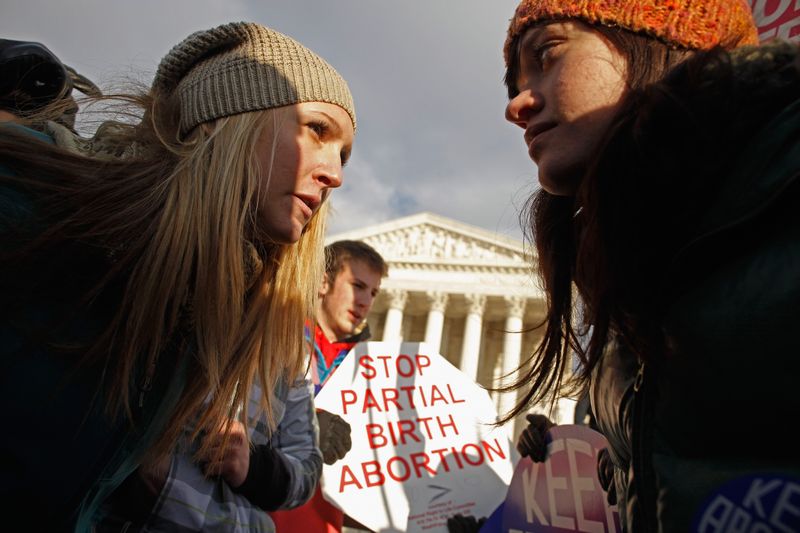
(Photo: Anti-abortion and pro-choice demonstrators argue in front of the Supreme Court during the March for Life January 24, 2011 in Washington, DC. The annual march marks the anniversary of the landmark Roe v. Wade decision by the court that made abortion legal in the United States. By Chip Somodevilla/Getty Images)

A Question

by Zack Beauchamp

Will everyone who said that liberal interventionists "lost all credibility" after the Iraq War, and hence should never be listened to again, renounce their own credibility after predicting Qaddafi would fall? I'm not holding my breath, but I really hope pundits will think twice about essentially calling for other writers to be shunned by all right-thinking people based on one data point. Let's judge ideas on their merit, not the identity of the person propounding them.

Conservatism And Nostalgia

White_And_Popular_Vote

by Maisie Allison

Defending Rick Perry against an egregiously weak charge of racism, Reihan Salam makes a larger observation: 

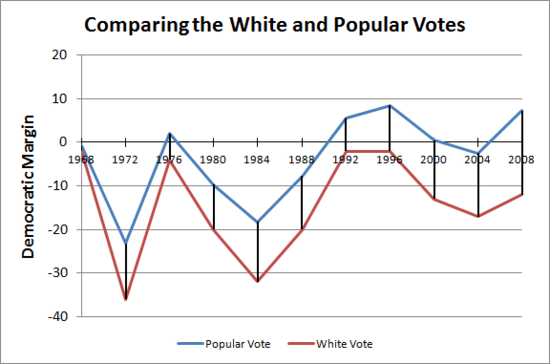
One thing that is undeniably true is that American conservatives are overwhelmingly white in a country that is increasingly less so. As the number of Latinos and Asian-Americans has increased in coastal states like California, New York and New Jersey, many white Americans from these regions have moved inland or to the South…These white voters are looking for champions, for people who are unafraid to fight for the America they remember and love. It’s unfair to call this sentiment racist. But it does help explain at least some of our political divide. 

Yglesias pounces, recalling John Boehner's assertion last year that Obama and the 111th Congress were "snuffing out the America that I grew up in." Isaac Chotiner goes further:

My question for Salam is this: how racially insensitive does one have to be to prefer an America with segregation because he or she saw other advantages to 1950s society? What possibly could outweigh the disgusting racial status quo of the 1950s (I am leaving out the status of women and gays)? To wish for a return to that America, I would argue, one has to be so racially insensitive that bigoted seems like an apt descriptor. The alternative answer, of course, is complete solipsism.

Friedersdorf disputes the notion that culturally conservative nostalgia is inherently bigoted and instead attributes it to the tendency to romanticize childhood or the past. My question for Salam: Are "white voters" looking for "champions" or are the demagogic champions (Fox News, Bachmann, Perry, Palin, etc.) looking for white voters? 

The more important question is the latter. The "my country is fading away" sentiment that Salam detects in sections of the electorate is a pretty unexceptional phenomenon, which occurs across generations and geography. In this sense, it is insignificant. Indeed, cultural conservatism naturally lends itself to some sort of "political divide," but as a source of antagonism, it has been needlessly aggravated and even exploited by elements of the Republican Party. In a cynical way, the GOP often caters to this emotional impulse, and even serves to validate and reinforce it. As a party it has lacked the vocabulary and vision that would broaden and elevate the worldview of these voters. 

As Salam notes

This bias against efforts to speed up social change has led to a number of horrible misjudgments, including the opposition of conservatives like Arizona Senator Barry Goldwater to the Civil Rights Act of 1964 and, more recently, the almost universal opposition among national conservative politicians to letting the states decide whether or not to grant same-sex couples the right to marry. 

As the political theorist Peter Berkowitz argued in 2005, “the American constitutional order speaks the language of freedom,” and causes that run counter to the spirit of freedom are, in the long run, doomed to defeat. That could explain why the idea of economic freedom retains such a powerful appeal for Americans, and it also explains why a certain kind of cultural conservatism — the kind that fuels opposition to same-sex marriage — is dying out among the young.  

The healthy conservative bias against manufactured "efforts to speed up social change" is not a mandate to ignore or suppress or fear reality. This leads to the GOP's strategic problem: the nostalgic white voters are becoming irrelevant (by Salam's account, they are old and in retreat). And the GOP is neglecting everyone else. For instance, Michael Barone warns of the demographic disaster facing a GOP that refuses to "evolve" with the electorate on gay marriage:

The Republicans’ problem is young voters. Huge majorities of them favor same-sex marriage, and for most of them it’s simply a no-brainer. They must have been turned off if they were watching the Republican presidential candidates vie with each other in opposing it in the Fox News/Washington Examiner debate in Iowa.

Here, it's the regrettable solipsism of the Republican Party that matters. Chart from FireDogLake.

“Inside The Law School Scam” Ctd

by Maisie Allison

Paul Campos has confirmed that he is author of the unsparing blog. His apology followed this seething invective from Brian Leiter: 

ScamProf is the failed academic who has done almost no scholarly work in the last decade, teaches the same courses and seminars year in and year out, and spends his time trying to attract public attention, sometimes under his own name, this time anonymously… After we called him out Monday, ScamProf pulled back a bit, and switched gears and stopped projecting his own failures on to all his professional colleagues and started actually writing about the economics of legal education…When his identity comes out, there will be additional ironies that will warrant comment. 

The drama has really struck a nerve in the legal academy (and blogosphere): Paul Caron has reax here, and David Lat has more updates here. William Jacobson raises questions about anonymity and intolerance. Paul Horwitz takes issue with Campos's approach. Bruce MacEwen mounts a defense of the blog, and laments the legal academy's missed opportunity: 

Exposed as never before to sincerely felt discourse (factually misguided, inconveniently timed, or otherwise–let that debate begin!) in the open air of the online community, the Academy has chosen denial, distraction, and blaming the messenger. One could argue that the appearance of someone like LawProf "had to happen" given the conscience-shocking distortions of some law schools about employment prospects and other issues (auto-destructing merit scholarships, for example), but even if the Academy could not have been expected to see this coming, the amazingly blinkered response to date–from extremely bright and articulate people who can surely do better–is, so far, an enormous missed opportunity.

Noting that Campos is far more popular among law students and practicing lawyers, Scott Greenfield holds out hope that the controversy will lead to real debate: 

[M]aybe this airing of harsh words will end up producing a wee bit of honesty about how the Academy has completely screwed the pooch on law school. 

Wherein Freddie DeBoer Calls Me Names

Benghazi celebration

by Zack Beauchamp

So apparently Mr. DeBoer did not appreciate some of my posts yesterday. I won't engage with the ad hominem invective that makes up the bulk of the post, except to note to the irony that in a post consumed by casting aspersions on my background and my ability to care for the welfare of Libyans he has the gall to call one of my posts "uncommonly terrible." I suppose I should clarify, for the record, that I am not related to Tina Brown (though that would be cool, as I could probably afford better groceries), nor am I a True Blood character (though if Freddie would like to lobby Alan Ball to name one after me, I'd be happy to go visit the set with him).

However, there are two arguments in his piece about yesterday's Von Hoffman awards that I would like to engage with, as I think Freddie is quite wrong on both points.

First, he argues that this award to Matt Yglesias misunderstands Matt's arguments about strategic airpower:

Now, far be it from me to make Yglesias's argument for him. In fact, I don't have to, as he's written on strategic air power on several occasions. Not in short, off-the-cuff quotes of news reports like what is linked to here, but in substantive posts– the kind with actual arguments that you actually have to rebut, rather than hide behind a fatuous and tired awards gimmick and the considerable institutional authority of a blog whose reputation you've done nothing to build. Here's a briefer one regarding Iraq and the fact that the media-ready good appearances of lower US casualties meant little for achieving the strategic aims of the Iraq campaign. If I would put my own gloss on it, I would say that Matt consistently argues that strategic air power is fine for blowing shit up but very limited in achieving the large host of strategic and diplomatic goals we tend to have in foreign affairs. That attitude has not been remotely challenged by recent events. Blowing the shit out of Qaddafi's military is the easy part. Building a democratic society, a humanitarian success, and a functioning post-Qaddafi civic infrastructure is what actually matters.

Now Matt has made that argument in other places, but it doesn't follow that he's making an identical argument here. Here's Matt's post in full, as part of Freddie's critique is I that took a misleading excerpt:

Strategic Air Power Still Doesn’t Really Work

By Matthew Yglesias on Jun 15, 2011 at 2:29 pm

Will air power advocates ever learn?

Almost three months into the campaign of air strikes, Britain and its Nato allies no longer believe bombing alone will end the conflict in Libya, well-placed government officials have told the Guardian.

No surprise to anyone who’s seen this movie before, but apparently when you get put in charge of military aircraft all recollection of history vanishes.

Now it should be clear from that excerpt that Matt's endorsing the Guardian article's argument that "bombing alone" will not end the Libya conflict as evidence for one of his own claim about air power. And the Guardian authors don't mean by that "bombing won't be able to produce a just post-war order" – they mean NATO will not be able to produce a military solution. From the next two paragraphs after the one Matt quotes:

Instead, they are pinning their hopes on the defection of Muammar Gaddafi's closest aides, or the Libyan leader's agreement to flee the country.

"No one is envisaging a military victory," said one senior official who echoed Tuesday's warnings by Admiral Sir Mark Stanhope, head of the navy, that the bombing cannot continue much beyond the summer.

Read the whole article yourself. There's only one mention of the post-war period, and it's certainly not talking about the ability of strategic bombing to acheive important strategic objectives like "building a democratic society." By citing THAT article approvingly as evidence that air power advocates are wrong about some cliam, Matt is making the claim that NATO's bombing will not produce a pure military victory in LIBYA. That specific prediction turned out to be wrong, hence the Von Hoffman.

(As an aside, several readers have written in to say Matt shouldn't have been eligible – Libya was tactical bombing, not strategic bombing. I'll post one of those emails later today.)

Freddie also takes issue with the award given to Larison:

Larison is here reacting to an actual overture made by the actual Libyan rebels, which seemed then and seems now like a curious and out of character move that suggested conflicting principles within that organization. This post (which is about a month old) is trying to make some sense of a rebel movement which has at times operated in the peculiar way that large, shaggy, and complex military groups do when they lack clear leadership, unanimity of principles, and clearly articulated political goals. Now, I wouldn't put this particular maneuver on equal footing with their history of assassinating one of their own generals or targeting sub-Saharan Africans as Qaddafi's mercenaries without evidence (little bits of nuance that escape the commentary of Mr. Beauchamp), but I think Daniel had a right to read about this information and question their capacity to take Tripoli, or even their will to.

I have no issue with "trying to make sense" of the rebels' organization, but it's analytically distinct from making predictions about how the war would turn out. And of course Larison had a "right" to making his prediction, but that was never in question. It has turned out that he was quite wrong. Von Hoffman Awards are given solely to indicate "stunningly wrong" predictions, not bad analysis. It turned out to be "stunningly wrong" to say "We are no closer to finding a means by which Gaddafi would be forced to 'go' than we were four months ago." As it happened, we had already found a means – military operations.

It's also not like the correct prediction was impossible at the time. Joshua Goldstein, though wrong on the timeframe, got the mechanics of the conflict right. Marc Lynch was spot on. Hell, even little 'ol me was closer to right than Larison. It was possible to read the evidence at the time and think we were, in fact, closer to finding a way to oust Qaddafi than we were four months ago. Given that Larison had repeatedly called Libya a "stalemate," among other things, I felt it was justified to point out that his predictions were quite wrong. That quote was a convenient way for me to do so.

Now, I know I'm new to blogging, so I don't mean to be stepping on anyone's toes or calling anyone an idiot. Far from it – I'm criticizing three very smart, very keen observers here! The intent is merely to explain my initial rationale and why I think Freddie's critique was off-base. Without any namecalling.

(Photo of celebratory fireworks in Benghazi during the rebel entry into Tripoli via Flickr user Tom[le]Chat.)


Some Perspective On The London Riots

by Maisie Allison

Peter Ackroyd can't be bothered

I can't get at all worked up about these most recent phenomena… I don't like those commentators who keep on saying that London will never be the same again. London is always the same again. I remember those comments were made very loudly after the [July 2005] terrorist attacks – 'London will never be the same again, London has lost its innocence' – it was all nonsense. London was exactly the same again the following day. Rioting has always been a London tradition. It has been since the early Middle Ages. There's hardly a spate of years that goes by without violent rioting of one kind or another.