Qaddafi Forces Reemerge

by Zack Beauchamp

Last night, Saif al-Qaddafi, a son thought captured by rebels by the ICC, made a trimpuhant public appearance yesterday. The rebels claimed he escaped. Thomas Erdbrink and Liz Sly worry about what this means for the rest of the capitol:

The BBC and CNN quoted him as telling reporters that government forces had lured the rebels into a trap and “broken the back” of the opposition army and that pro-Gaddafi forces are back in control of the city.

The confusion made the assertion impossible to confirm, but with gunfire and explosions echoing ominously through the streets and Gaddafi’s whereabouts still unknown, it was clear that the capital was far from secure.

Meanwhile, fighting continues outside the Qaddafi's Tripoli fort at Bab al-Azizya, though some reports claim rebels have breached the compound. Now is a good time to revisit Patrick's post about why continued fighting might not be all that bad. More updates as the news progresses.

The Creeping Threat Of “Preemptive Superpower Suicide”

by Maisie Allison

Ben Dunant has a profile in Robert Kagan's obliviousness. Kagan contends that "when we cut defense, then we enter decline":

With all this talk of “superpower suicide,” Kagan refused to entertain the notion that America might not, in fact, wish to remain a superpower – that it might think twice about maintaining indefinite military commitments overseas, and be periodically “obliged” to intervene in failed states and take sides in other people’s civil wars. American imperialism is, in Kagan’s discourse, something self-evident and inalienable – anything that threatens its reach and authority is a threat to America itself. Hence why cuts in the defense budget are synonymous with American decline.

Differently, what if America still wants to be a superpower, just not an overtly reckless one? 

Did We Use The Right Amount of Force?

110023685

by Zack Beauchamp

Fred Kaplan, in a timely review of Rory Stewart and Gerald Knaus' new book Can Intervention Work? last week, defends our role in Libya:

While many criticized Obama and NATO for doing too little, too late, I suspect that, in the end (which now seems imminent), the effort will seem about right: assisting the rebels with air support (and probably more "training and equipping" by special-operations forces than is acknowledged) but not taking the lead—and, therefore, not getting lassoed with responsibility for determining, or fully funding, the new Libyan order afterward. It's an approach that the authors of Can Intervention Work? probably appreciate.

Shadi Hamid differs:

That said, we should be careful not to overstate the strategic benefits of President Obama's chosen course of action the past six months. Foreign Policy's Blake Hounshell argues that the administration's strategy of "leading from behind" now "seems utterly vindicated." It is unclear why this would be so. If anything, it could be argued, as I did in March, that Obama's excessive caution made a bad situation even worse. If the U.S. and the international community had intervened sooner — rather than at the very last moment when rebels were making their final stand — Qaddafi would have fallen sooner and without such loss of life and destruction.

Steve Kornacki sides with Kaplan.

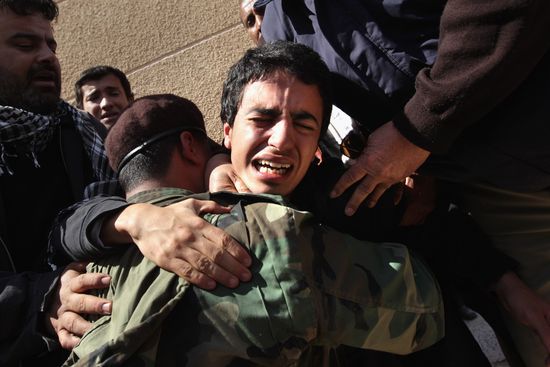
(Photo: Family members grieve at the funeral of rebel fighter Emad al-Giryani a day after he was killed in frontline fighting with government troops on March 12, 2011 in Abdajiya, Libya. Al-Giryani, a petroleum engineer, was was of many rebel volunteers killed in early days of fighting government forces. Rebels had been losing ground as government troops loyal to Libyan leader Moammar Gaddafi pressed a counteroffensive to the east. By John Moore/Getty Images)

The Narcissism Of Dictators

by Patrick Appel

Keith Humphreys imagines Gaddafi's worldview:

It is a bizarre experience to interact with criminal narcissists. If you ask most murderers why they killed their victim, they will give some rationalization (e.g., “He shoved me — he asked for it”). But narcissists are more likely to be puzzled at your question: What do you mean ‘why did I kill him’, would you ask me why I sat on a chair? The most dangerous people in the narcissistic/psychopathic psychopathology cluster learn to act normal when it furthers their goals, but dictators don’t have to manipulate anyone to get what they want so they generally never develop “the mask of sanity”, as the highly-regarded psychiatrist Hervey Cleckley termed it. Col. Gaddafi and Sadaam Hussein are perfect examples of the naked, unbridled narcissism that is prevalent among dictators, and they raised their sons to be, if anything, even more psychopathic.

Infinity Hurts Your Brain, Ctd

by Chris Bodenner

A reader writes:

You think that's bad? You would think that infinity is just infinity, but you would be wrong. There are in fact different sizes of infinity – infinitely many, in fact. This was proven by Georg Cantor in the late 19th century, using one of the most beautiful and simple proofs in the history of mathematics (now known as Cantor diagonalization). When he published his results, he was viciously attacked on both religious and philosophical grounds, his opponents charging that his theorems called into question the existence of God.

Another needs a translator:

Hilbert's example only uses countable infinity, or infinity where there is a one-to-one correspondence with whole numbers, or positive Integers.  This is only the first order of magnitude (cardinality) of Infinite Sets, dubbed Aleph-Null (ran outta Greek letters and went to Hebrew).  Next order of magnitude would be Aleph-one – the set of Real Numbers for example (provable depending on the Axiom of Choice and other stuff I don't quite remember), which includes the irrational numbers like pi, e, SQRT (2), etc.  Go here, here and here for some fun (well, for some of us, anyway) reads. A bit easier to figger out: Zeno's paradox, explainable with calculus (convergent infinite series).

As it happens, the book I'm reading is Douglas Hofstadter's Gödel, Escher, Bach, which invokes Zeno's paradox in early chapters (and explains other complex concepts in a way that won't hurt your brain). A concise illustration from the reader's link:

Suppose I wish to cross the room. First, of course, I must cover half the distance. Then, I must cover half the remaining distance. Then, I must cover half the remaining distance. Then I must cover half the remaining distance . . . and so on forever. The consequence is that I can never get to the other side of the room.

As a little kid I had a similar thought while looking at my index fingers: they can never truly touch, since no matter how much closer they get to one another there will always be an infinitely small distance to go between them.

(Above is a live-action version of M.C. Escher's "Waterfall". Behind-the-scenes explanations here.)

Envisioning A Mobile Workforce

by Patrick Appel

Felix Salmon asserts that if "we want to maximize long-term growth, eradicate global poverty, and give everybody in the world the opportunity to achieve their potential, then a vast improvement in global labor mobility is top of the list of prescriptions":

Improving labor mobility is not easy. Italy, for instance, has been a unified country with a single language and a single currency for 150 years, but it still has minimal labor mobility from the south to the north. The lack of labor mobility has been one of the biggest macroeconomic problems facing the Eurozone; again, the millions of unemployed people in the south are not filling jobs in the north. (There’s a bit more mobility from east to west, but not much more.) And globally, discrimination on the basis of one’s country of nationality is the one universally-condoned form of discrimination still in existence: every country in the world puts up significant barriers to prevent foreign nationals from living and working within its borders.

Give It Away

by Zoë Pollock

Dan Ariely says we're wrong when "we assume that we will be happiest and most motivated when we earn money to spend on ourselves." One experiment offered bank employees vouchers to donate to the charity of their choosing. They reported being happier:

The second experiment took the concept of prosocial incentives a step further by directly comparing people who were asked to spend money on themselves (a personal incentive) with those who were asked to purchase a gift for a teammate (a prosocial incentive). … While neither sales nor sports teams improved when people were given money to spend on themselves, Norton and his colleagues found vast improvements for those who engaged in prosocial spending.  While they were purchasing a gift for a teammate, they also became more interested in their teammate and were happier to help them further in multiple other ways.

The Daily Wrap

5591597887_7c33636025_b

Today on the Dish, we tracked the surrender of Qaddafi's sons overnight, everyone wondered where Muammar was, and we gathered the reax to his imminent downfall. The right twisted itself into contortions parsing the president's success, and McCain and Butters praised everyone but Obama, even though they were shaking Qaddafi's hand two years ago. Zack likened Obama's "leading from behind" to a global police chief, and didn't want us to try and seize the Lockerbie bomber right off the bat. We parsed the curse of success and what it will mean for future "interventions" or illegal wars, and wondered whether Qaddafi and his sons would be tried in Libya or at the International Criminal Court. James Traub kept his faith in the Arab Spring, even if loyalist forces have some fight left in them, and the Von Hoffman awards were flying off the shelf for predictions gone awry.

In campaign news, the right was still ignoring Huntsman as prophet, Maisie cataloged the arguments for and against Paul Ryan's run, and then he officially dropped out. Perry distanced himself from his own policies as stated in his (less than a year old) book and presidential candidate Bachmann referred to the IRS as the enemy. Nate Silver assured us the 2012 field isn't set yet and Palin's Iowa video either means she's running or she's the world's largest narcissist. Maxine Waters ordered the Tea Party to go straight to hell, Stephen Moore took another beating on Obama's economic policies, and military families fought against the neocons' empty support of the troops. An 8-year-old helped swing New York marriage equality into reality and the camo closet was finally about to let some sunlight in when DADT ends September 20th.

Chris weighed whether the iPhone could ever really replace a congregation's connections, and environmentalism took the backseat in war zones. Immigration remained vital to our economy, and Canada mourned for a lost politician. Yodeling started with monks in Tibet, we contemplated Korean reunification, Thomas Jefferson was originally skeptical of patents, and Brazil's poor pined for plastic surgery. Complex human societies developed in conjunction with high density living, everything we order on the internet is delivered by USPS, and minorities still bear the brunt of marijuana arrests. And in home news, Andrew's taking a breather so we're running the show while he's gone.

Email of the day here, chart of the day here, FOTD here, MHB here, VFYW here, and view from your airplane window here.

–Z.P.

(Photo by Flickr user Joe Marinaro)