Mourning In Canada

by Chris Bodenner

A reader remarks on the news from up north that broke this morning:

Given the Dish's interest in political conduct, it's a shame that (so far) there has been nothing written about the passing of Jack Layton, Leader of the Opposition in Canada, from cancer.  The response has been overwhelming: astonishingly decorous, remarkably decent and emotionally genuine.  Layton wrote a letter from his deathbed that has had newsreaders' voices cracking as they recited it on air.  There's a kind of muted poetry to the way the country, more or less to a man, is responding with shock, respect and sincere sadness, even from his most ardent political opponents.  It's a rather stunning reminder that politics needn't always be toxic: there can be admiration in dispute and nobility in purpose. 

It is perhaps too easy to say that politicians make people cynical, but perhaps the problem flows both ways, as the more cynical we become so too do the politicians.  Layton, for however one may criticize or traduce him, was anything but cynical: he was energetic and optimistic and these qualities made him immensely likable even to his foes.  Today, people are remembering the man and celebrating him as honourable.  It really is dulce et decorum est

A country is genuinely mourning a politician, believe it or not.  I wonder if this could happen for any politician in the UK or the US today without the cynical slime of insincerity and unspoken glee.  Maybe there's a greater lesson to be learned here.  Bertrand Russell famously said (forgive the paraphrasing), "Remember your humanity; forget the rest."  That seems to me very much what's happening in Canada today.  I can't help but wonder how much better our discourse and our politics would be if this tenet remained central to our thinking rather than a token of passing civility. 

Colin Horgan looks at Layton's legacy. The above video shows the MP shortly after his diagnosis with prostate cancer. Layton is later seen in this video much less vital, having beaten prostate cancer as promised but suffering from a spreading of the disease.
The Legality Of The Libya War

by Zack Beauchamp

Timothy Carney reminds us of an important point:

President Obama injected the U.S. military into Libya's civil war without ever seeking congressional approval, or leading a public debate. To square this clearly illegal action with the law and his previous statements about presidential war powers, his lawyers (who, like Obama, had fiercely attacked Bush's overreaches on war) argued that our air strikes in Libya did not count as "hostilities" as defined by the law.

Today, it looks like the rebels we've backed have succeeded in deposing Moammar Gadhafi, (which, you'll remember, was not the aim of our intervention). Setting aside the questions of the U.S.'s role in nation-building and peacekeeping, should we now forget about the fact that our President illegally launched us into a war?

Nick Gillespie and Greenwald have similar thoughts. The legal problems were always the strongest argument against the Libya intervention, as Andrew has repeatedly highlighted. I'm of the opinion that the looming humanitarian catastrophe forced Obama to act initially, and that was the right thing to do. After the 60 day War Powers Act deadline, the question of whether to keep U.S. assets in combat operations became substantially more complicated. I don't really think the violation was all that grievous, as since Bush it has been staggeringly apparent that existing legislation isn't nearly enough to restrain the Presidency. What this suggests, then, is that we need new legislation. A new law should contain a specific provision governing the special case of humanitarian intervention, as the time-pressures created by having to respond to impending mass slaughter are somewhat unique.

“Who Cares About The Environment In A War Zone?”

6014323056_7af238c46e_b

by Zoë Pollock

J. Malcolm Garcia reports that the trash pits used by military personnel in Afghanistan could be causing illness for them and local Afghans:

"Burning plastic bags is way bad," one American officer at Tereyzai acknowledged. "I don’t know why we can’t recycle. Probably too expensive. You’d have a hard time convincing anyone to put garbage convoys on the road, where they are at additional risk of IED ambush and put an additional strain on already limited tactical resources. In other words, burning was just the easiest and cheapest thing to do in a screwed-up, throwaway country like Afghanistan.

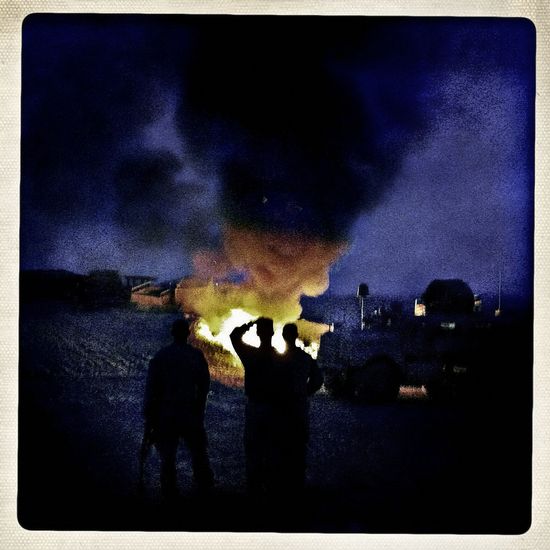
(Photo: Marines watch a burning trash pit at Combat Outpost 7171 in Helmand Province, Afghanistan on October 27, 2010, by Flickr user Balazsgardi)

Did We Win The Libyan War?

by Patrick Appel

Marc Lynch thinks Qaddafi's fall vindicates Obama's strategy:

Had [Obama] not acted, Qaddafi would have won and that would have been bad. He didn't panic as events unfolded, even as virtually the entire policy community decided that the campaign had turned into a quagmire, stalemate, or fiasco. He understood that while six months may seem like a century in Twitter time, it's actually not that long of a time for such a campaign. He correctly resisted demands for a more aggressive action such as a land invasion and occupation which would have radically changed the game in highly negative ways.

Greg Scoblete urges opponents of the Libyan war to let the powers that be declare victory:

[T]he U.S. and NATO have very little exposure on the ground – unlike Iraq and Afghanistan, they will not have to face the prospect of an ignominious withdrawal under fire. In other words, for those who objected to American intervention in Libya's civil war, the downfall of Gaddafi is a perfect excuse to extricate ourselves before it turns into a problem that the West cannot solve.

The “Jesus Phone” Ctd

by Chris Bodenner

A reader writes:

Bacevich argues that technology, most recently represented as the smartphone, has replaced Christianity as an organizing principle in our lives. This is grasping at straws.  Christianity didn't die as an organizing principle due to a discredited Church.  It did so because it has not remained sufficiently adaptable to be useful to people in the modern world.  It is full of prohibitions and offers few realistic prescriptions. The smart phone, if anything, represents interconnectedness.  In place of the Church as an organizing principle, we have turned to each other (to technology only as a means, not an end). What has replaced Christianity – full of prohibition, shame, etc. – is what one would have hoped replaced Christianity – our ability to support each other.

An atheist writes:

Your recent post about the idea of the iPhone as a talisman or amulet reflects a need to equate every secular impulse, trend, or habit to a corresponding religious practice which I find rather obtuse. (The implication being that secularists, skeptics and atheists need to somehow replace religion with "secular religion" – an oxymoron if I every heard one.) See, the iPhone is the complete opposite of a religious token or relic. Because the iPhone works.

It doesn't provide owners only with a sense of security and connectivity: it actually does connect people with resources, information, and each other in a real, repeatable, demonstrable and useful way. Using email is not prayer; surfing the Internet is not meditation. Bot activities have external results that can be read and copied and printed and shared. This is the complete opposite of the personal, internal revelations experienced by religious and spiritual people. By its very definition, the transcendent nature of spiritual or religious ecstasy is a private, unsharable and non-transferable experience.

iPhones are not replacements for rosaries or idols, in the same way that the Theories of Evolution, Abiogenesis, and the Big Bang are not replacements for creation myths, and modern medical science is not a replacement for exorcisms and sacrificial atonement. Modern science and technology provides measurable, useful results, while religious practices provide a spiritual solace, but little else.

I largely second the readers' sentiments, but they share a blind spot: church congregations, in a more tangible way than texting or Facebooking, provide a powerful means of connecting people with one another, regardless of any doctrine being preached. Listening to sermons or reciting scripture make some people feel connected to something bigger, but the peers in the pews offer a more reliable and immediate means of support and belonging.

For instance, I've never been a religious person, but one of the ways I tried to meet new friends and cute girls after moving to Georgia in the middle of high school was joining a Methodist youth group. There were occasional Bible discussions, but the group was mostly a way to hang out at the cool youth pastor's house and go on fun trips. For the believers, it offered a way to extend their church worship into less formal settings. For non-believers such as myself, the group provided a way to relate to and respect those with very different beliefs. Plus I got a few dates out of it.

Is It Too Late To Run In 2012?

by Patrick Appel

Nate Silver says the field isn't neccessarily set:

One seismic factor affecting Republicans’ decision is that Barack Obama is now exceptionally vulnerable for an incumbent president. If you’re a Republican and you think you can become president, that’s doubly important for you; not only does it mean that those aspirations are more likely to be fulfilled this time around, it also means that they’re less likely to be realized in 2016 or 2020 because there’s now more chance that some other Republican will already occupy the Oval Office by then.

Gallup's latest poll underscores Obama's vulnerability, but Jonathan Bernstein takes issue with Silver's larger methodology.

Face Of The Day

121705860

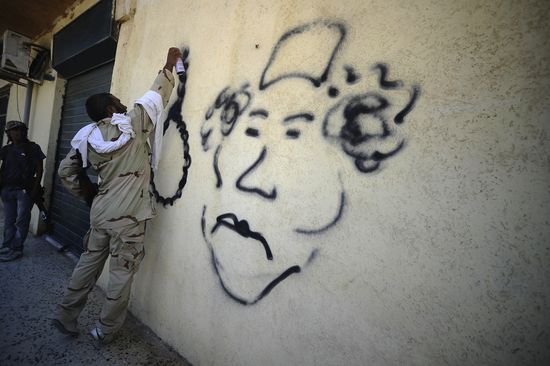
A rebel sprays graffiti depicting Col. Moamer Kadhafi on a wall in Gadayem, west of the capital Tripoli, on August 21, 2011. Explosions and gunfire rocked Tripoli as a months-long uprising pushed through the gates of the Libyan capital, with rebels insisting they are close to toppling Moamer Kadhafi. By Filippo MonteForte/AFP/Getty Images.

— C.B.

The Day The Camo Closet Opens

by Patrick Appel

JD Smith reflects on the end of DADT:

For the past few months the military has provided training to its forces in anticipation of DADT’s repeal. No words can explain how it feels to sit in a room and listen to a PowerPoint presentation about how people should treat you once this policy changes. I don’t believe anyone needed training to learn “how to deal” with me; they just needed to meet me and realize I am no different from them. I share the same aspirations, the same dreams, and the same desires to have a family and succeed in life. On Sept. 20, when DADT officially ends, my integrity and the integrity of thousands of other gay and lesbian military members will begin to be restored. The years I lost lying to my friends, family, and co-workers will begin to be repaired. … [O]n Sept. 20, America will realize the pain this policy caused to the very people that are fighting for their freedoms.

Chart Of The Day

Chart
by Zoë Pollock

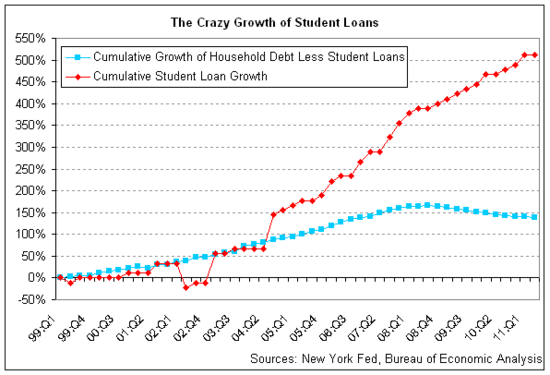
Student loan debt has ballooned by 511% since 1999. Daniel Indiviglio fears it could signal slower economic growth for the US as a whole:

As Americans grapple with high student loan payments for the first few decades of their adult lives, they'll have less money to spend and invest. All that money flowing into colleges and universities is being funneled away from other industries where it would have been spent in future years. Of course, this would be a rather unfortunate irony: higher education is supposed to enhance a nation's growth, but with such an enormous debt burden, graduates might not be able to spend and invest enough to allow that growth to occur.

Liz Dwyer notes that "the growth of student loan debt was twice as steep as the growth of mortgages and revolving home equity from 1999 to the peak of the housing bubble in 2008." Walter Russell Mead blames a broken system:

[I]ntelligent students should not be barred from a good education simply due to the poverty of their parents. These loans, however, pervert incentives for the schools: rather than forcing schools to compete by delivering a better education for a lower price, the abundance of loans guarantees a steady flow of students even as prices rise into the stratosphere.