Who Will Try Qaddafi?

by Zack Beauchamp

David Bosco tries to discern what will happen after the Great Loon is found:

One of the important plot lines developing as the Gaddafi regime collapses is what will happen to Moammar Gaddafi and his son Saif, both of whom have been indicted by the Hague-based International Criminal Court. ICC officials have said that they expect the Gaddafis to be handed over if they are taken alive, and court officials are apparently in talks with the rebels. But several reports suggest that the rebels want the chance to put the Gaddafis on trial in Libya. ICC statements suggest that the talks may continue for some time. As reported by Reuters, a court spokesman said "it is simply too early to talk about details of those discussions or timeframes. The situation is not fully clear or stable in Tripoli so that might take some time." Formally speaking, all Libyans are under a legal obligation – -imposed by the U.N. Security Council — to cooperate with the ICC.

The Postal Service On The Precipice, Ctd

by Chris Bodenner

A reader writes:

I guess folks who don't have computers and email (folks who are usually poorer, more rural, and/or older) just wouldn't get mail?  And for them and everyone else:  No more letters to family.  No more postcards from far away places.  No more Christmas cards or other greeting cards.  And what about bills?  How does a creditor establish that a bill was dispatched to the customer's legal address, with a presumption that you received that bill and, therefore, must pay by the due date?  Via email?  Would you be required to have email to get billed services such as electricity, gas, water?

There's a reason the Constitution requires a postal service.  I shudder to think that we will decide it is too expensive to maintain.  Perhaps we should first look to remove the USPS obligation to fund pensions for 75 years,  or stop subsidizing business advertisement with low postage rates.

Another writes:

I find the argument that the Internet makes the Post Office obsolete somewhat odd. Virtually everything I buy online comes to me via USPS.

When I buy something from Amazon, it's most likely going to come via Super Saver shipping and USPS. If I buy something from a small seller on Ebay or Etsy, it's also most likely to show up at my door via USPS. If I add some DVD's to my Netflix list, it's the postal service that is bringing them to me.

And it's not a coincidence that that's the case. All too often I've found something online and at the final stages of checking out canceled my order because I've discovered they only deliver by UPS Ground or some such non-sense, and that my $15 order would have a $8 shipping cost attached to it. Heck, sometimes I've had the shipping turns out cost more than item itself, particularly back when I lived in Hawaii.

The same goes for when I ship things out to people. I choose the USPS because it's just cheaper than any other option. And there's always a line when I go there because I'm not the only person that's come to that conclusion. I completely disagree with Maurice McTigue that the goal of the USPS should be to increase the speed of its deliveries. Trying to elbow into a market of express mail that's already being served seems silly when the entire market of slower and cheap delivery entirely depends on the USPS right now. I don't need my brother's birthday present to get there tomorrow if I plan ahead, but figuring out how I'm going to pay for that shipping if that service disappears is going to be a much more major problem to me.

The consistent thread here seems to point towards a more obvious solution to the Post Office's problems than dissolving or privatizing the whole whole venture: They could just raise prices till they are no longer losing money. I'm sure there are some interesting quirks that drive the workings of the Post Office that I'm unaware of, but their prices are so much lower than most other shipping, that I can't see an increase in their rates decimating their current near monopoly of things coming to my house.

Another:

Now I hear that USPS is planning to shut down one day of service, and the day they seem to be going after is Saturday. Why? Saturday sets the post office apart from FedEx and UPS. They don't charge extra for Saturday, we like getting mail on Saturday. It is part of their brand.

Consider an elimination of Wednesday instead. Most home users of the post office don't care much about Wednesday; we'd hardly miss it. Two days on, one off, two on, one off would be a nice delivery pattern. And businesses, who do care about Wednesday delivery, might just be willing to pay extra for it. The post office could offer Wednesday business delivery for an extra charge and bring in business instead of losing it.

What Are Pro-Qaddafi Soldiers Doing?

by Patrick Appel

Babak Dehghanpisheh fears that loyalist forces still have some fight left in them

Fierce clashes broke out around the Bab al Aziziyah compound, Gaddafi's Tripoli stronghold, early Monday morning, raising concerns that the pro-government forces were trying to launch a counteroffensive. There were reports of further clashes around the city later in the day. The worry is that the easy march into Tripoli may have been a ruse: loyalist forces may have gone to ground and could start guerrilla attacks against the rebel forces with or without Gaddafi's direction.

Joshua Tucker sees a possible silver lining:

From the perspective of the question of what happens to the Qadaffi security forces, the fact that there is renewed fighting in the capital today paradoxically might not be as bad a development as it seems. Last night, the big story seemed to be how the expected fights with Qadaffi loyalists in Tripoli were not materializing, suggesting that Qadaffi forces might be trying to melt away, i.e., take their weapons and quietly leave Tripoli. The problem with this scenario is the question of how you engage the existing security forces becomes much harder if you can not find them. And while it is possible that this would just lead to these people exiting the security game and trying to quietly make a new life for themselves in a post-Qadaffi Libya, experiences in Iraq show that the more likely scenario is that these are exactly the kind of people – armed, with military experience, and loyal to the previous regime – who could form the basis of an armed insurgency. Thus the fact that Qadaffi loyalists have not completely disappeared yet may have some positive long-term benefits, or, at the very least, may make certain negative scenarios slightly less likely to unfold

A View From Korea

2011-08-21_13.00.53

by Chris Bodenner

A reader writes:

Took this yesterday around noon while drinking beer on the roof of Kim Il Sung's former vacation home near Goseong, South Korea. The home was captured near the end of the war when South Korean troops waged a last-minute, all-in campaign to take as much land as possible before the armistace. As if happens, that campaign is the subject of Korea's summer mega-blockbuster, "The Front Line." See the trailer here.

Ben Birnbaum was recently in South Korea:

At the Hyundai Heavy Industries plant in Ulsan, I chatted with a 28-year-old employee, who asked that I not use her name. She told me that she once agreed with her parents on the matter. “When I was in school, like junior high or elementary school, I thought, ‘We have to have reunification, yeah!’” Upon entering the working world, though, she realized she had her own problems—and so did her country. South Korea already had too many destitute citizens who it couldn’t support. Why did it need 24 million more? “I feel sometimes guilty, because the people up there are suffering,” she said. “But they’re not really my family. Why should I care?” She laughed, then paused. “Am I too selfish?”

Qaddafi’s Fall And “The Success Curse”

by Maisie Allison

Matt Welch warns against premature end zone taunting: 

I'm happy to see Qadaffi on the run, but I'd be happier still if A) it had been accomplished and owned by the oppressed people of Libya themselves (which would have been less than easy, to say the least), B) if the action didn't require breaking U.S. law and lowering the intervention bar even further; and C) if the trend line in U.S. foreign policy dominance and spending wasn't continuing to drive us toward imperial bankruptcy.

E.D. Kain adds that he fears the Qaddafi's departure will "strengthen the hand of the neocons and hawks":

I won’t mourn the passing of the Libyan regime. Gaddafi is a monster. I’m sure new, lesser monsters will now attempt to rule over the Libyan people once the current monster is undone. And we will turn our gaze toward Syria and Iran, toward other monsters doing other monstrous things. We can work to end these horrors through freedom of trade and freedom of movement  and the persistent advocacy of civil liberties. Bullets are a lousy substitute.

Spencer Ackerman wants to know what comes next:

Getting rid of Gadhafi is the easy part. The last 10-15 years are a testimony to the hubris of considering an internal conflict concluded once a belligerent government has lost power. I'm not going to insult your intelligence by playing fake Libya expert. But the rebel coalition is united by the singular purpose of defeating Gadhafi, so its cohesive strength as a governing force is about to face its greatest test. Purge the government of Gadhafi loyalists and risk a backlash; let them remain under amnesty and risk fracturing the coalition. What will the military do? What are the prospects for a revanchist insurgency in Gadhafi's name — or, if he survives ouster, his command? How does NATO avoid post-Gadhafi intervention?

Greg Scoblete has related questions:

[W]hat is our obligation to secure the new regime against a potential insurgency? It's quite possible that the Libyan aftermath proceeds fairly smoothly, with minimal need for an outside stabilization force to restore order – and here's hoping – but if it doesn't?

And Freddie DeBoer isn't celebrating:

The next few days will be awash in an unseemly but profoundly American "party like Osama just got killed" revelry. The truth of life for your average Libyan won't settle for months or years.

Ryan Is Officially Out

by Zack Beauchamp

Stephen F. Hayes, who broke the story that Ryan was seriously considering running, explains:

Several sources close to Ryan tell THE WEEKLY STANDARD they were surprised at how close he came to running. Over the past several weeks, Ryan had talked extensively about running with select Republican party leaders, GOP strategists, and a tight circle of Wisconsin friends and advisers. In private meetings with fundraisers and conservative movement leaders he expressed skepticism that he could win, and raised concerns about the toll a race would take on his family. But he nonetheless made clear that he was open to running.

Bill Kristol is a very sad panda. Robert Costa has more on Ryan's thinking. Weigel insists the Ryan boomlet never made sense. Previous Dish coverage here and here.

How Immigration Makes Us Stronger

by Maisie Allison

James Pach dismantles the notion that the U.S. economy is "turning Japanese" (a case that has been made convincingly by John Judis, among others):

Take immigration, which ultimately is critical for the long term. It’s immigration that accounts most of the difference between US and Japanese population projections. The rapidly rising Hispanic and Asian populations allow the US business owner to anticipate long-term domestic market growth, and hence to invest. Higher immigration will eventually be vital for Japan, because a shrinking market deters the investment needed to produce the productivity breakthroughs that could offset population decline. Unfortunately, Japanese equate harmony with homogeneity, and see large-scale immigration as tantamount to an invasion.

This will be a particularly difficult debate. The government has made a small start by trying to boost the intake of foreign university students, especially from China, but that will not be enough on its own. Yet the longer Japan leaves this issue unresolved, the less likely it will be to attract immigrants from its preferred countries, like China, which are rapidly closing the opportunity gap.

In short, whereas without substantial productivity gains the default position of the Japanese economy is contraction, the U.S. still has an economic cycle and proven policy options.

Despite robust immigration, and in some ways because of it, American culture is also dominant – and resilient. It sustains us: American culture is tied to a free economy, but does not recede during economic downturns. Outsiders want to be a part of it for societal reasons as well as economic. And regardless of economic conditions, Japan does not draw aspiring citizens in the same way. Because assimilating and absorbing immigrants is a core advantage of the American economy, Jim Manzi sees an opportunity for a meaningful pivot to a skills-based immigration policy: 

[W]e should think of immigration as an opportunity to improve our stock of human capital. Once we have re-established control of our southern border, we should set up recruiting offices looking for the best possible talent everywhere: from Mexico City to Beijing to Helsinki to Calcutta. We should offer green cards to foreign students upon their completion of degrees in science and engineering subjects at approved universities. The H-1B visa program should be expanded and strengthened. On the other hand, we should de-emphasize family reunification for immigrants already in the United States. 

Who Gets Punished?

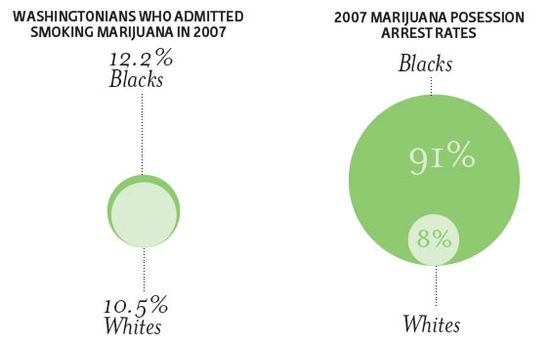
Marijuana_arrests

by Patrick Appel

Rend Smith highlights an injustice:

What’s clear from studying the stats and the arrest patterns is that who gets busted on marijuana charges basically comes down to where police are putting patrols, serving papers or making traffic stops—and who they’re stopping. Smoke a joint in the privacy of your Chevy Chase home, and the chances of a cop showing up to cuff you for it are practically zero. Spark a blunt while strolling down the street in Ivy City, though, and an officer who’s already in the area may well spot you.

In response, E.D. Kain fumes that the "war on drugs is a war on minorities and the poor." Adam Serwer, on the same page, looks at minority parents who smoke pot and lose their kids as a result.

Don’t Focus On Lockerbie Today

By Zack Beauchamp

Jeffrey Goldberg and Michael Rubin think we ought to use the collapse of Qaddafi to go get the Lockerbie bomber Abdelbaset Mohmed Ali al-Megrahi:

Megrahi is still alive, in a wheelchair but well enough to have been shown on Libyan television attending a pro-Qaddafi rally just last month. If Obama was sincere in his regret, perhaps the time is right to seize Megrahi and finally win justice for the American victims of Lockerbie.

Um, how would we "seize" him? Are Goldberg and Rubin advocating the deployment of U.S. troops to spirit away a man in a wheelchair? I don't want to minimize al-Megrahi's horrific crimes or comment on whether his time in Scotland was sufficient punishment, but this is a dangerous rhetorical route to go down. We should focus first ensuring a peaceful, democratic transition in Libya, and then, if we want al-Megrahi, we ought to negotiate with Libya's new government over the handover. Talk of "seizing" seems to me a fantastic way to poison America's relations with an incipient Arab democracy that could be our ally.