Is Palin Running?

by Patrick Appel

Palin super-fan Mark Levin expects her to run. As does Palin supporter Peter Singleton. Friedersdorf wonders whether she's leading her supporters on:

That video is a perfectly normal thing to produce and release if you're running for president of the United States. But if you're just a private citizen touring around Iowa, playing up the notion that you're just a regular person, it's perhaps the most extreme act of narcissism I've ever seen. And I've watched more episodes of The Celebrity Apprentice than I care to admit.

Along the same lines, Greg Sargent doesn't see Palin's new Iowa video as evidence that she's running but as "an effort to bolster the case that she’s worthy of continued media attention in her current role of celebrity-quasi-candidate."

The Little Lobbyist That Could

Little_Lobbyist

Laura Nahmias discovered "the 8-year-old boy [who] helped pass the same-sex marriage bill" in New York:

When [fathers Jeff Friedman and Andy Zwerin] started lobbying senators, they brought [their son] Josh along. One of the senators they spoke with was Shirley Huntley, a Queens Democrat who voted against same-sex marriage in 2009 and told The New York Times, "If they gave me a million dollars, tax free, I just wouldn’t vote for it."

Last winter, though, she decided she was undecided. And when Friedman and Zwerin brought Josh to Albany one day, the 73-year-old grandmother met with them with an open mind. "There was this cute little boy with a whole flock of curly hair," Huntley said. "He's a happy child… I guess it just got to my heart, because I could see this child was well-reared. Then they brought him up for me to meet the child, and I was just so happy to meet him." Josh, who is biracial, reminded Huntley of one of her own relatives, Friedman said.

The tearful conclusion here.

(Photo by Andrew Schwartz)

Is Social Security A Ponzi Scheme? Ctd

116929588

by Chris Bodenner

Ben Smith spots a Romney-esque flip from Perry:

Rick Perry wrote in his book, "Fed Up," that Social Security is unconstitutional. He hadn't really retreated from it as of last week, when he confirmed to me that he'd consider replacing it with a set of state pensions. But his communications director seems to be in full retreat, in a comment to Neil King:

… Ray Sullivan, said Thursday that he had “never heard” the governor suggest the program was unconstitutional. Not only that, Mr. Sullivan said, but “Fed Up!” is not meant to reflect the governor’s current views on how to fix the program.

Or not intended to be a factual book. Ben adds that "Perry now officially favors the same thing as everyone else: Strengthening the program."

(Photo: Texas governor Rick Perry signs copies of his book 'Fed Up' during the 2011 Republican Leadership Conference on June 18, 2011 in New Orleans, Louisiana. By Justin Sullivan/Getty Images)

The Right Squirms Over Qaddafi

Screen shot 2011-08-22 at 8.20.00 AM

by Zack Beauchamp

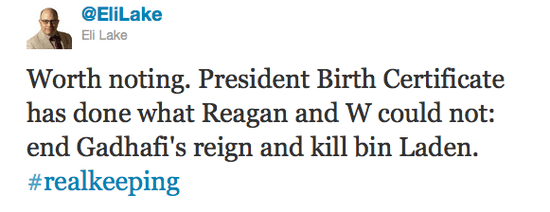
I almost pity the cognitive dissonance at play here.  Toppling Middle East dictators with the U.S. military is obviously good, but Obama did it, so it must be bad.  Hence the bizarre intellectual acrobatics in some of the excerpts you're about to see.

Barry Rubin:

As NATO jets bombed the military positions of Libyan dictator Muammar Qadhafi, the watching rebels cheered, “Allah Akhbar!” Now that is a common Muslim expression, not just used by Islamists, and yet there is something symbolic about it. Allah did not bring the rebels victory, the United States and Europe did. Nevertheless, Allah will get the credit. And that means the triumph will be attributed to the rebels’ piety rather than the West’s warplanes.

Andrew McCarthy:

The Libyan mujahideen (a/k/a the “rebels”) have reportedly entered Tripoli, captured at least one of Muammar Qaddafi’s sons, and are closing in on Qaddafi’s compound. It appears that those who wanted Qaddafi supplanted by an unknown that is known only to include virulently anti-American Islamists are about to get their wish. Here’s hoping that they are right and I am wrong about what happens next.

 Peter Feaver:

The most recent progress happened because NATO shifted course and stepped up military operations, especially American military operations, as critics had been calling for.  As the New York Times spells out, when the administration finally took the critiques on board and stepped up U.S. operations, the stalemate tilted in favor of the rebels.  The previous strategy of doing just a bit less than what was needed was not working and contributed to months of paralysis.

Feaver is one of the right's best thinkers on international politics, but that NYT article doesn't imply what he says it does. Max Boot:

With those caveats in mind, I think it is nevertheless fitting to extend tentative congratulations to the people of Libya–and to their defenders in the West. In particular to Prime Minister David Cameron, President Nicolas Sarkozy and President Obama: the three driving forces behind the NATO effort to prevent Qaddafi from preserving his regime by slaughtering his own people. As noted before, I wish they had done more, faster, but the fact they acted at all–in the face of considerable criticism–is to their credit, and to the credit of the countries they lead.

Impressively congenial. Walter Russell Mead:

In general, President Obama succeeds where he adopts or modifies the policies of the Bush administration.  Where (as on Israel) he has tried to deviate, his troubles begin. The most irritating argument anyone could make in American politics is that President Obama, precisely because he seems so liberal, so vacillating, so nice, is a more effective neoconservative than President Bush.  As is often the case, the argument is so irritating partly because it is so true.

But that's nonsense. Democracy promotion is not the exclusive province of neoconservatives, and Obama's distinctively liberal approach to the idea is dramatically different from Bush's rhetoric sans substance. Stanley Kurtz:

The damage done to the credibility of NATO’s defense capacity by months of unnecessary stalemate has been substantial. We may have narrowly escaped the disaster of a failed intervention, but Iran, Russia, China, South Korea, and other potential adversaries have taken note of the West’s weakness.

Uh-huh. Jonathan Tobin:

There are vast differences between the situation in Libya and those in other brutal and dangerous Middle Eastern dictatorships such as Syria and Iran. But the principle America has a right and a duty to intervene to topple governments that are a proven danger to both their own people and the rest of the world has once again been vindicated in Libya. The victory being celebrated in Tripoli does not constitute a license for endless war against dictators, but it ought to put both Syria’s Assad and the mullahs in Iran on notice there is no guarantee they won’t meet the same fate as Qaddafi. Those who would seek to exploit the natural reluctance of Americans to enter future conflicts in order to give them such a guarantee are having a bad day. When we hear their isolationist arguments in the future, let’s remember extending the reach of liberty is something very much in America’s best interests.

Michelle Malkin:

Freedom-fighters are celebrating across the Twittersphere, though the identity of the “rebels” on the ground is still somewhat murky as always with these revolts.

Finally, Big Peace writer "Niccolo Machiavelli:"

So what happens if Libya falls under the control of radical Islamists?  For one thing,  they will have plenty of money to throw at their dream of a global Islamic revolution.  Libya has the ninth largest oil reserves in the world,  estimated to be 41.5 billion barrels.  That will buy a lot of suicide bombers, advanced weapons,  and terrorist recruits.

It all makes sense now. That was Obama's plan all along!

Huntsman’s Great Opportunity, Ctd

by Patrick Appel

Thomas Lane explains why GOP establishment is clamouring for Ryan or Christie to enter the race while ignoring Huntsman:

[T]he problem Huntsman faces is exactly that he is already in the race. Unlike Christie or Ryan there are now real polls for Huntsman, and they show him failing to catch alight. If he was entering the fray right now he'd figuratively be wearing a halo and would be suffused by a glowing ethereal light while angels flutter around him, plucking away at harps.

Hertzberg thinks Huntsman has embraced defeat:

This looks to me as if Huntsman is not just letting go of any remaining pretense of having even an outside chance of getting nominated this time; he’s also not worrying all that much about 2016. Right now, he’s not campaigning for President at all, he’s campaigning to regain his self-respect. You can almost feel his relief. What the hell. He might as well have a little fun.

Michael Tomasky hopes that Huntsman can reform his party, but he isn't betting on it:

Maybe if Huntsman can survive a while on the stump—and since he can self-finance to a large extent there would seem to be no reason that he couldn’t—and keep after his opponents from the perspective expressed over the last few days, he can help create an atmosphere where come 2013, if Obama is reelected, some GOP senators who know better might be emboldened to behave more maturely.

The more likely long-term scenario is that Huntsman will have negligible impact on his party. Unless the GOP does something truly self-immolating next year, like nominating a Bachmann who goes on to win 120 electoral votes, the current trajectory will likely continue for the foreseeable future.

Earlier coverage of Huntsman's change in tone here.

Praising Everyone But The Commander In Chief, Ctd

Screen shot 2011-08-22 at 10.47.23 AM

by Chris Bodenner

Steve Benen is steamed by the partisan tone of McCain and Butters' statement:

Remember hearing about the "blame America first" crowd? Well, say hello to the "thank America last" crowd.

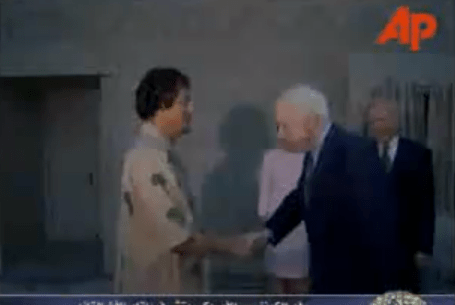
[…I]f McCain and Graham really want to complain about why “this success was so long in coming,” maybe they can talk more about their trip to Tripoli two years ago, when both McCain and Graham cozied up to Gaddafi, even visiting with him at the dictator’s home, discussing delivery of American military equipment to the Libyan regime. Both senators shook Gaddafi’s hand; McCain even bowed a little.

The Fall Of Qaddafi: Reax

by Zack Beauchamp

Juan Cole:

The Libyan Revolution has largely succeeded, and this is a moment of celebration, not only for Libyans but for a youth generation in the Arab world that has pursued a political opening across the region. The secret of the uprising’s final days of success lay in a popular revolt in the working-class districts of the capital, which did most of the hard work of throwing off the rule of secret police and military cliques. It succeeded so well that when revolutionary brigades entered the city from the west, many encountered little or no resistance, and they walked right into the center of the capital. Muammar Qaddafi was in hiding as I went to press, and three of his sons were in custody…The end game, wherein the people of Tripoli overthrew the Qaddafis and joined the opposition Transitional National Council, is the best case scenario that I had suggested was the most likely denouement for the revolution. I have been making this argument for some time, and it evoked a certain amount of incredulity.

Daniel Serwer:

Virtually overnight, the rebel leadership will need to shift its focus from fighting Qaddafi’s forces to protecting them. In the past few months, the local councils that have emerged in liberated areas have not generally allowed violence against regime supporters. But that is partly because many of Qaddafi’s loyalists have fled from newly liberated towns to Tripoli. Their concentration there and in his hometown of Sirte is going to make the challenge of transition much greater there than anyplace else in Libya.

John Quiggin:

The seemingly imminent downfall of Muammar Gaddafi may not represent “the end of history”, but, for the moment at least, it’s pretty close to being the end of tyranny, in the historical sense of absolute rule by an individual who has seized power, rather than acquiring it by inheritance or election.

Joshua Goldstein:

In mid-October, my article with Jon Western on the successes of humanitarian interventions will appear in the journal Foreign Affairs. We consider Libya a smart, successful intervention by a united international community, that stopped an imminent mass atrocity event as the regime prepared to flatten Benghazi.

Robert Farley:

The course of the war vindicates the “Afghan Model” as a military technique, if not as a political strategy. To review, the Afghan Model is based on the idea that airpower and special forces can help indigenous troops can win wars against numerically and organizationally stronger opponents.

Noah Shachtman:

The rebels did the vast majority of the fighting. So it’d be a mistake to give alliance air and sea power all the credit for Gadhafi’s fall. (Although you do have to wonder how many contractors and western intelligence operatives are on the ground, to add some veteran heft to the rookie rebels.)

Jeffrey Goldberg:

If it is true that Qaddafi is finally going, we will be able to mark this one down as a victory for NATO (a victory, of course, that also shown us some of the weaknesses of NATO, but more on that later); a victory for the Libyan people, many of whom possessed no serious fighting skills but very large hearts; a victory for the principle of humanitarian intervention (we'll never know if Benghazi would have been the scene of mass slaughter had NATO not intervened when it did, just as we'll never know if Saddam Hussein would have subjected Kurds and Marsh Arabs to another round of genocidal attacks, but we should be happy that now we don't have to know).

Issandr El-Amrani:

Personally, as happy as I am about last night’s developments, I fear that the fall of Qadhafi is already being spun to sanctify the principle of humanitarian interventionism, which I am against, after its misuse in Iraq.

Steve Walt:

Whether our intervention was necessary or wise, however, depends on how the post-Qaddafi Libya evolves. The danger is that we will have another "Mission Accomplished" moment, when French President Nicolas Sarkozy, NATO head Anders Fogh Rasmussen, President Obama, and their various pro-intervention advisors give each other a lot of high-fives, utter solemn words about having vindicated the new "Responsibility to Protect" (R2P) doctrine, and then turn to some new set of problems while Libya deteriorates.

Steve Negus:

The combination of foreign airstrikes — which rebels realize saved them, albeit without foreign ground forces which would inevitably antagonize people — gives the West leverage without creating a backlash. Foreign interference is not a dirty word here: one katiba member I met in Ajdabiya said that the first thing he wanted to do after victory was buy a sheep, and bring it to Sarkozy to slaughter in Sarkozy's honor. This means that proposals like bringing in the UN to help with the transitional process, as some Libyan politicians have proposed, is probably going to be broadly acceptable.

Michael Georgy:

The biggest question that will be asked as the endgame appears to be nearing in Libya — is there one unifying figure who can lead Libya if the rebels take over? Right now the resounding answer seems to be no.

Brian Whitaker:

The next few months in Libya are not going to be easy – only a fool would imagine that – but nor are the grimmest predictions likely to be fulfilled. Libya is unlikely to turn into another Iraq, let alone another Afghanistan. The first encouraging sign is that the National Transitional Council – a diverse alliance forged out of necessity – has begun making the right noises.

Jeff Weintraub:

At such moments, any temptations toward euphoria have to be restrained by a recognition that future developments are unpredictable and potentially unpleasant. Overthrowing oppressive and tyrannical regimes is often hard, but successfully reconstructing the societies that they've damaged, distorted, and poisoned by their rule is usually even harder. Still, a certain degree of satisfaction is appropriate. We seem to be witnessing the overthrow of an especially ugly and contemptible dictatorship, which over the decades piled up a lot of crimes at home and abroad, by a genuine popular uprising. That's something to be celebrated. The hangover will come later.

Jack Goldstone:

Expect an even harsher crackdown by Syrian forces this week, as Assad tries to bolt the door on revolt before it can be further inspired to emulate that in Libya.  But it is already too late.  The same scenes of joyous rebels in liberated Tripoli that frighten Assad will energize rebels in Syria.

Dan Trombly:

Attention is likely to turn to Syria as the “next step” in democratizing the Middle East. Some people think that the rebel victory in Tripoli bodes ill for Syria – far from it. Assad has every reason to be more optimistic about his fate than Gaddafi had about his own.

Naseem Tarawnah:

Staying up last night to watch the events unfold on the streets of Tripoli, I cannot help but feel the sense of confidence that swept across the region last night; radiating from TV, computer and mobile screens. I could not help but hear the deafening silence of those who believed the Arab spring had already met its doom, and those who had abandoned their hope in the capabilities of average citizens. The silence of the same people who are content with the grandeurs of their status quo. The same people that have consistently demonstrated their inability to understand the value of freedom, and especially what it’s worth to people who don’t have it, and people who cannot afford it. It is thrilling to see their beliefs shaken to the core; to see them watch a people risk the certainty of the status quo for the uncertainty of something greater, and achieve it.

What Inventions Are Not Obvious?

by Zoë Pollock

Expanding on earlier discussions of patent trolling online, Nilay Patel invokes the views of Thomas Jefferson:

[His] initial skepticism about patents led him to insist that patented inventions be useful and non-obvious, the foundational rules of our system. Those rules might actually solve the software patent dilemma for us if we just wait long enough: the gold rush to patent all these fundamental software technologies means that they’ll all be public domain prior art in a few years, and any obvious improvements won’t be patentable. The pendulum swings both ways.

Julian Sanchez explains how specialization only makes non-obvious patents harder to determine:

[T]he circumstances under which it is efficient to be granting fewer patents are the very circumstances under which patent examiners lose the ability to accurately judge “obviousness,” and therefore become more likely to grant more patents. No wonder it’s such a mess.

(Hat tip: The Browser)