Huntsman’s Great Opportunity Ctd

Alyssa Rosenberg cheers Huntsman's sojourn into sanity – as brave act of political suicide:

As a rising generation of young evangelicals is less compelled by calls to discriminate against gay people but potentially remains fiscally conservative, Huntsman might be a plausible candidate several cycles down the line. But if he continues in this loose, improvisational vein, Huntsman might be giving up that opportunity in favor of demonstrating the ridiculousness of our political conventions now.

Fallows and Drum, by contrast, see the tweet that launched a 2016 campaign. Jim:

Good to see this "what the hell, I might as well keep my dignity" spirit taking hold on Team Huntsman! I hope it will still prevail the next time he's asked to raise his hand, along with everyone else in the race, and promise to reject a budget deal skewed 10-to-1 in favor of spending cuts rather than revenue increases. He could be the one who stands alone and says: "I believe in a balanced approach, just like Ronald Reagan did. Call me crazy."

The Dish is onboard. A reader sets the stage:

If you believe that Huntsman's real goal has always been 2016, his strategy makes perfect sense. He goes down to noble defeat in this round, the GOP nominates someone who is either bat shit insane (Bachmann, Perry) or an outrageous panderer (Romney) who leads the party to defeat. Who comes out of the debacle looking good? Huntsman. By 2016 the Tea Party fires have burned out and the GOP is ready for that sane guy they should have chosen last time around.

That's been my hope for Huntsman from the get-go. He's the Obama of the right. And there's a real opening for him as the pro-science Republican. Today's interview was fantastic. And long overdue.

Very Human Superheroes

Jon Ronson tags along with Seattle's real-life super hero crew and its leader, Phoenix Jones:

Every superhero has his origin story, and as we drive from the hospital to his apartment, Phoenix tells me his. His life, he says, hasn't been a breeze. He lived for a time in a Texas orphanage, was adopted by a Seattle family around age 9, and now spends his days working with autistic kids. One night last summer, someone broke into his car.

There was shattered glass on the floor, and his stepson gashed his knee on it. "I got tired of people doing things that are morally questionable," he says. "Everyone's afraid. It just takes one person to say, 'I'm not afraid.' And I guess I'm that guy." The robber had left his mask in the car, so Phoenix picked it up and made his own mask from it. "He used the mask to conceal his identity," he says. "I used the mask to become an identity." He called himself Phoenix Jones because the Phoenix rises from the ashes and Jones is one of America's most common surnames: He was the common man rising from society's ashes.

Alyssa watched HBO's new documentary Superheroes (trailer above) and found much to praise:

But there’s an element to the superheroes’ work that I think is presented as if it’s totally, unambiguously admirable, and suggests new possibilities for joyful and powerful activism and citizenship. And that’s superheroism as a kind of magical activism. … If putting on a mask and a costume is what gets you to sit down and talk to someone destitute, there’s a value in that empathy however you get there. If being a superhero is what inspired [superhero] Zimmer to take EMT classes and be in a position to provide emergency medical attention, that’s a net value to society.

The Screen Of The World

Albert Camus imagines filming every moment of a man's life:

The result would be a film, the screening of which would last a lifetime and that could be seen only by viewers resigned to losing their life in the exclusive interest of the details of someone else’s. Even then, this unimaginable film wouldn’t be realistic—for the simple reason that the reality of a man’s life isn’t found only where he is. It’s also found in the other lives that shape his—first of all, the lives of those he loves, who would, in turn, have to be filmed; but also the lives of unknown others—powerful or downtrodden—fellow citizens, policemen, professors, invisible companions in mines and factories, diplomats and dictators, religious reformers, artists who create myths that govern our behavior—all told, humble representatives of the sovereign accidents that reign over even the most orderly existence. Thus there’s only one realistic film possible, the one that is endlessly projected for us by an invisible apparatus on the screen of the world. The only realistic artist would be God, if he exists.

Capturing Prisoners

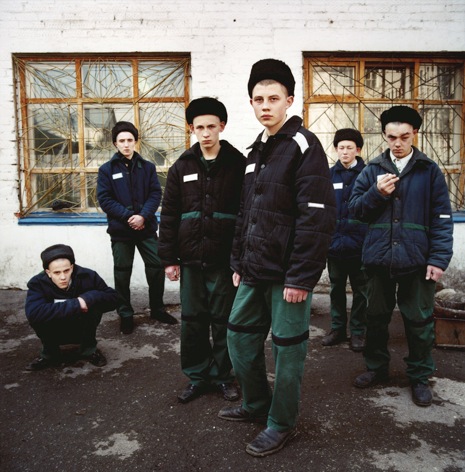
Youngprisoners

In Michal Chelbin's new series "Locked," she photographs prisoners throughout Russia and the Ukraine:

When I record a scene, my aim is to create a mixture of plain information and riddles, so that not everything is resolved in the image. Who is this person? Why is he dressed like this? What does it mean to be locked up? Is it a human act? Is it fair? Do we punish him with our eyes? Can we guess what a person’s crime is just by looking at his portrait? Is it human to be weak and murderous at the same time?

(Photo: Young Prisoners, Juvenile Prison, 2009 by Michal Chelbin)

Moral Philosophy Doesn’t Matter?

So claims Stanley Fish:

Philosophy is fun; it can be a good mental workout; its formulations sometimes display an aesthetically pleasing elegance. I’m just denying to philosophy one of the claims made for it – that its conclusions dictate or generate non-philosophical behavior …

His earlier rant against philosophy here. Paul Boghossian points (Scribd) to David Velleman's dissent in the comments:

Fish's examples of "real life" are not the ones to which relativism would matter. Consider instead how we (Westerners) deal with cultures that practice female genital mutilation. We could say, "Well, what's right for us isn't necessarily right for them, and it's meaningless to ask which of us is 'really' right." Or we could say, "If we're right (as we think), then they must be wrong, and we should try to convince them." Or we can say, "Both of us are right in the context of our own cultures, but some cultures are superior to others." And so on. In the first case, we don't even try to talk to them. In the second case, we try to engage them in moral argument. In the third, we expose them to our way of life and count on them to change. These are real-life alternatives, and in today's world, the choice among them matters a great deal.

How To Remember

Casey Walker reviews Joshua Foer's Moonwalking with Einstein: The Art and Science of Remembering Everything:

Briefly put, the human brain is manifestly better at remembering images and spaces than it is at recalling numbers and letters. Cicero, then, counsels, “The best way to memorize a speech” is to “make one image for each major topic” and “place each of those images at a locus.” You might not easily remember every topic you need to cover in a speech, but you will, in all likelihood, effortlessly recall the layout of your childhood house. The task, then, is simply to build the speech into that house.

Catholics Debating Capitalism

John C. Médaille takes the left-Christianist line:

In the standard theory of economics, only freedom is considered in the belief that justice will take care of itself. But the Church responds by saying that freedom itself is dependent upon justice, and to ignore the latter is to destroy the former. Freedom cannot be reduced to a mere competition of unrestrained desires. This describes not freedom, but license, and licentiousness always doubles back on itself to destroy freedom. No, true freedom starts with justice. And our Easter freedom means moving away from not just personal injustice, but also from those “structures of sin” (as the Blessed John Paul called them) into the freedom of Christ.

This is not merely an otherworldly call; every religion, but particularly an incarnational religion, has meaning in terms of our concrete social, political, and economic systems. And as Christians, it is our task to make the gospel concrete within our social institutions. Indeed, that is the whole reason for renewing our baptismal vows.

Robert T. Miller's riposte:

The magisterial doctrines of the Catholic Church entail very little about economics or even politics. They do not, for example, make any particular form of government morally obligatory, and thus the autocracy of the Roman Empire, the constitutional monarchy of Elizabethan England, and the democratic republicanism of the United States are all morally permissible. Similarly, Catholic doctrine does not make any form of economic organization morally obligatory; rather, a wide range of systems, including both capitalism and distributism, are morally permissible.

Now, I suppose the editors asked my opinion on this question because they expected me to argue that capitalism has some special moral standing in Catholic doctrine. Although I will not go that far, I will defend a more modest proposition, namely, that, for people like us in a society like ours, capitalism is the most reasonable choice among the various economic systems we might adopt.

A Poem For Sunday

2813626314_50c140b02e_o

"Let America Be America Again" by Langston Hughes:

Let America be America again.
Let it be the dream it used to be.
Let it be the pioneer on the plain
Seeking a home where he himself is free.

(America never was America to me.)

Let America be the dream the dreamers dreamed–
Let it be that great strong land of love
Where never kings connive nor tyrants scheme
That any man be crushed by one above.

(It never was America to me.)

Continued here.

(Photo by Flickr user zawtowers)