History Carved In Stone

GT_MLK

by Patrick Appel

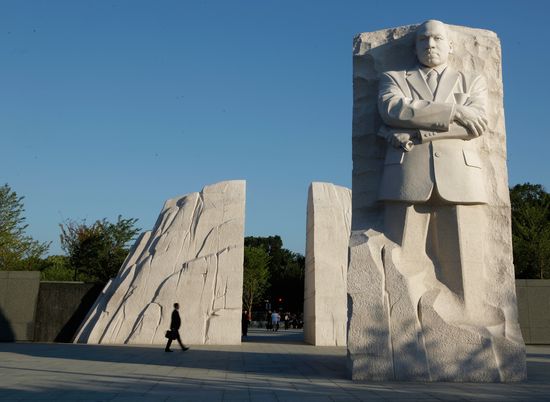
Wilkinson pans the new MLK memorial because the Chinese sculptor who chiseled King is renowned for carving statues of Mao:

That King's monumental likeness was chiseled from stone by an ace aesthetic hype man for Mao, a dictator responsible for " one of the most deadly mass killings of human history", suggests a couple things. First, and most obviously, it suggests that monuments like this one are pieces of propaganda, attempts to manipulate a state's citizens (or subjects, as the case may be) into parcelling out honour, reverence and esteem according to an "official" account of the country's history. This is a line of business most states are in, but it is not a line of business I think liberal states ought to be in, even if from time to time they happen to exalt worthy heroes, such as Martin Luther King.

Weigel differs.

(Photo: The new Martin Luther King Jr. memorial. By Chip Somodevilla/Getty Images)

Meter Madams

by Chris Bodenner

To help alleviate a budget crisis in Bonn, Germany, city officials found a way to collect income tax from streetwalkers:

[W]hile it might sound straightforward enough, the sex tax has been difficult to enforce among those prostitutes who do not work in established brothels and sex clubs. Leading the city to come up with plan B: an automated ticket machine in an area frequented by prostitutes and their customers.

Since Monday, freelance sex workers on the city streets have been required to pay €6 per night into the machine, which resembles an automated parking ticket distributor. This machine, however, emits nightly permits to practice prostitution.

Propping Up Factory Jobs

by Patrick Appel

Jon Gertner contemplates the future of manufacturing:

On both sides of the world, the fundamental appeal of expanding manufacturing is jobs. It is a curiosity of modern life that information companies can create extraordinary social disruptions and vast shareholder wealth but relatively few jobs. Facebook has about 2,000 employees worldwide. Google has about 29,000. Even in its new, slimmed-down state, General Motors, a decidedly less valuable company, has about 200,000 employees.

Ryan Avent believes nostalgia for manufacturing is misplaced. He sees manufacturing subsidies as a wealth transfer mechanism:

[I]t could be the case that Americans feel that some income redistribution is necessary, and they prefer to do it through effective subsidies to manufacturing employment rather than through disability payments to the long-term unemployed, or funding for retraining, or investment in infrastructure. From an efficiency standpoint, that's an extremely peculiar preference, but from a political economy standpoint it isn't too hard to understand. It sure is troubling that that seems to be the direction of enthusiasm in America, however.

Yglesias expands on that thought.

In Defense Of Civil War Reenactments, Ctd

by Chris Bodenner

A nuanced account from a Confederacy reenactor:

The Dish moves so fast, I hope it's not too late to respond to your post from two days ago. Mine is just a single perspective, but man, do I disagree with Lewis McCrary's argument that "for the reenactors" the hobby is a reminder of "original sin"; that even "the more provincial reenactors intuitively understand … that war is a result of the fallen human condition." I suppose that McCrary's perspective may hold for a few reenactors, but these were certainly not the people I knew.

Perhaps the hobby is different nowadays. I haven't donned my gray kepi and butternut shell since 1988, when I participated in the 125th anniversary reenactment of the Battle of Gettysburg as a member of the 12th Alabama Volunteer Infantry. I can tell you, though, that we in the 12th understood only a handful of concepts intuitively, among them "farb," as in someone who is not appropriately authentic; "hard-core," as in someone who is intimidatingly authentic; and "motherf*&@ing hot," as in what it felt like to march around in July wearing layers and layers of wool.

Rather than worry about original sin, we worried about whether the buttons on our jacket were too farby. My grandmother sewed me a 19th-century-looking vest, and soon it was falling apart so that once, when I came home mud-caked and skeletal from a long weekend camping, and all my clothes were rags, she eyed me up and down and, very quietly, began to cry. "What is this boy thinking?" she asked my mom.

It was one of my proudest moments as a reenactor. I looked awful, so I must also have looked authentic.

We "Alabamans" were actually Yankees from Iowa, and when we sat around the campfire we either talked about Monty Python or states' rights. The human condition was never even a subtext, except where it failed to imbue people with the wisdom to understand that slavery was in no way connected to the experience of Johnny Reb and that states like our beloved Alabama (a place I have never visited to this day) had every right to secede.

My father, a history teacher, was horrified by this sort of behavior, and I can only imagine what my little sister, who is African American, thought. But it was at Gettysburg, when I was not quite a sophomore in high school, that I had an epiphany. In order to maximize the authenticity of our participation in the mock battle, we were ordered to march seven miles (give or take) before taking the field. As the midday sun bore down on us, a guy behind me collapsed of a heart attack. (Or at least I heard later it was a heart attack.) We just kept on going. This was war, after all.

Except that the one thing that makes war war – death – is the one thing that this Gettysburg was so conspicuously missing. How can we have deep thoughts about, in McCrary's formulation, men doing violence to one another when the violence is so obviously absent? And if, through sheer willpower, we do manage to summon such deep thoughts, what can they possibly mean in the context of a hobby we are all here to enjoy?

In my experience, we obsess over authenticity precisely to avoid this uncomfortable truth about reenacting, and if – if - there is some intuitive understanding of the fallen human condition, it is not manifested in some unique or superior take on the Civil War. Rather, it comes out in the sheer absurdity by which I loved and cared for my three-band, muzzle-loading, reproduction 1862 Enfield rifled musket, paid for in full with paper-route money – an instrument of death that never hurt a flea.

Will The Super Committee Fail?

by Patrick Appel

Howard Gleckman chats with a room full of budget experts. The bad news:

To these veterans of the fiscal wars, the odds are awfully long that Congress’ new budget super committee will reach a broad deficit reduction agreement by Thanksgiving—perhaps one-in-three at best. But there is worse news for those who worry about long-term deficits: Although the debt agreement requires an additional $1.5 trillion in automatic spending reductions over 10 years should the Gang of 12 fail, not one of these experts believes those cuts will ever happen.  Congress will find a way to avoid, evade, delay, or otherwise confound these spending limits. In other words, the stick that is supposed to force lawmakers to act is mostly sawdust.

The Partisan Opinion Gap

by Patrick Appel

On healthcare reform it's closing:

Healthcare_Partisan

The lesson Kevin Drum draws:

I think this goes to show what happens when something falls out of public view. Roughly speaking, I think that ACA has been replaced on the cable shoutfest circuit with other topics, which means it's becoming less of a tribal totem. So you no longer say you hate it just because you're a Republican and Fox News says you're supposed to hate it. You only say you hate it if you really do. Ditto in reverse for Democrats. It's becoming less of a culture war issue and more a simple question of whether it provides you any benefits that you care about.

Splitting China And Russia

by Zack Beauchamp

Alejandro Sueldo thinks it's time for the U.S. to pull a Nixon-in-reverse:

Russia’s urgency to set its foot down amid China’s rise is also driven by unsuccessful attempts to assert itself on many European security issues, namely NATO and U.S. missile defense systems. Moscow has learned its lesson and wants to assure that it has a voice on Asian security matters. Shared concern over China offers Russia and the United States an opportunity to deepen relations with a strategy to engage and help contain China. Assuaging their concerns will require, among other initiatives, pressuring China to be more transparent about its military, eventually engaging China on arms control, and demonstrating that U.S. and Russian missile defense systems do not undermine China’s strategic weapons.

John Kennedy looks at how "China's Thomas Friedman" called America's war in Libyan War, while Alexey Sidorenko rounds up the Russian blogosphere's reaction to same.

Infinity Hurts Your Brain, Ctd

by Chris Bodenner

More insights from math, religion, literature and pop culture:

Your reader's bit about Douglas Adams' Total Perspective Vortex reminded me of the Master from Doctor Who. In the new series, it was revealed that the cause of the Master's drive to conquer came from looking into the Untempered Schism, a crack in time and space that allowed the viewer to see the infinity of time itself. Only a child at the time, the Master was driven insane by it, and for the rest of his life, he could hear an unending drum beat, calling him to war.

Another reader:

I am enjoying the continued discussion on Infinity. It is indeed interesting to read about the terror that it can induce in human mind. But, as a Hindu, brought up on Bhagavad Gita, this is not surprising at all to me. In the last chapter of Bhagavad Gita, the God reveals His infinite, eternal and universal form to Arjuna. Arjuna finds that vision terrifying. And he prays for God to re-assume His (finite) pleasing form. Even as a child, this portion of the Gita brought in me a terrifying awe – I wanted to imagine this grand and wondrous vision of God but at the same time terrified about it.

Different religion, same conundrum:

Ecclesiastes 3 – 11

10 I have seen the burden God has laid on the human race. 11 He has made everything beautiful in its time. He has also set eternity in the human heart; yet no one can fathom what God has done from beginning to end. 

Like many, I approached the concept of infinity for the first time through scripture. Reading the wisdom literature of the Hebrew texts as a young Christian messed with my head.  I am still reeling. Though one can read the "burden" as what precedes these verses, I have always wondered if it is our ability to contemplate but not fully comprehend that makes up our human burden.

Another:

A reader wondered if there is a beginning to infinity. Why not? In Biblical terms, "In the beginning…" In my Catholic childhood we said the "Glory be", which ended "as it was in the beginning, is now, and ever shall be, forever and ever. Amen. That's highly imaginable.

In math, choose all numbers between 0 and 10. How many numbers are there? Infinitely many. Or stand on the 10-yard line and do Zeno's paradox toward the goal – infinite number of halfway points until you get there. Turn around and do the reverse, doubling each step instead of halving it. You are at a beginning, but will never reach the end. The Eames film you posted is a fun way to follow that idea.

Another is in the same territory:

Math people always define infinite in a straightforward way. When I say, the limit of the function f(x) = 1/x, is 0, as x grows to infinity, it means something concrete. If you pick some number, d, as small as you want, there will be some number n, for which f(y) < | 0 – d |, for all y > n. If you haven't had calculus, it might not seem simple and concrete, but when you're familiar with it, it's pretty straightforward.

Another idea of infinity comes from set theory – we say that the cardinality of some sets is infinite. That just means that there isn't a finite set whose elements you can put in one to one correspondence with the elements of the original set.

This sounds like a glib point, but I think it's kind of central. The point of math is that it takes stuff that seems mystical or incredibly abstract, and it makes it concrete and mechanical. It takes stuff that's slippery and gives you a solid grip on it. If you want to figure out if a set is infinite, you have a really specific test you can run. One of the keys to math is not looking down. You don't think about infinity, and what it means – you think about the formal definition, and what you can do with it on a practical level.

Easier math to grasp:

Another example of infinity is the relationship between a mathematical point and a line.  By definition a mathematical point has no dimension – it is 0 units long, 0 units wide, and 0 units high.  A line, which is composed of such points, however has a dimension.  Its length is >0.  How is it possible to obtain a value >0 by adding only values of 0 together, which is essentially all you do when you place points adjacent to each other to form a line?  Normally, any number multiplied by 0 is 0; however, infinity multiplied by 0 is not 0.

Another:

Y'all have infinity exactly wrong.  Pressed for time today (consumed by several infinite tasks), I'll refer you to Emmanuel Levinas, who demonstrated again and again in his book-length essay TOTALITY AND INFINITY, beyond all possible refutation, that infinity and ethics are inseparable.  From the preface:

Infinity does not first exist, and then reveal itself.  Its infinition is produced as revelation, as a positing of its idea in me.  It is produced in the improbable feat whereby a separated being fixed in its identity, the same, the I, nonetheless contains in itself what it can neither contain nor receive solely by virtue of its own identity.  Subjectivity realizes these impossible exigencies – the astonishing feat of containing more than it is possible to contain.

If infinity hurts your brain, then your brain needs to be hurt.  The pain originates in your lethal attachment to one or another totality or totalization that means you no good, that relies on or intends your extinction as a unique individual who matters or could matter at all.  Infinity is the only and infinite beginning of all beginnings, the origin of origins.

Another sends "a classic section from Neil Gaimon's "Good Omens"":

I mean, d'you know what eternity is? There's this big mountain, see, a mile high, at the end of the universe, and once every thousand years there's this little bird-" 
"What little bird?" said Aziraphale suspiciously. 
"This little bird I'm talking about. And every thousand years-" 
"The same bird every thousand years?" 
Crowley hesitated. "Yeah," he said. 
"Bloody ancient bird, then." 
"Okay. And every thousand years this bird flies-" 
"-limps-" 
"flies all the way to this mountain and sharpens its beak-" 
"Hold on. You can't do that. Between here and the end of the universe there's loads of-" The angel waved a hand expansively, if a little unsteadily. "Loads of buggerall, dear boy." 
"But it gets there anyway," Crowley persevered. 
"How?" 
"It doesn't matter!" 
"It could use a space ship," said the angel. 
Crowley subsided a bit. "Yeah," he said. "If you like. Anyway, this bird-" 
"Only it is the end of the universe we're talking about," said Aziraphale. "So it'd have to be one of those space ships where your descendants are the ones who get out at the other end. You have to tell your descendants, you say, When you get to the Mountain, you've got to-" He hesitated. "What have 
they got to do?" 
"Sharpen its beak on the mountain," said Crowley. "And then it flies back-" 
"-in the space ship-" 
"And after a thousand years it goes and does it all again," said Crowley quickly. 
There was a moment of drunken silence, 
"Seems a lot of effort just to sharpen a beak," mused Aziraphale. 
"Listen," said Crowley urgently, "the point is that when the bird has worn the mountain down to nothing, right, then-" 
Aziraphale opened his mouth. Crowley just knew he was going to make some point about the relative hardness of birds' beaks and granite mountains, and plunged on quickly. 
"-then you still won't have finished watching The Sound of Music." 
Aziraphale froze. 

That exchange reminds me of the conservation between Ricky Gervais and Karl Pilkington embedded above.
Is Rick Perry Unstoppable?

by Patrick Appel

John Ellis views the debates as pivotal:

Once Labor Day has passed, there will be five debates, in quick succession, on the GOP presidential candidates’ calendars.  These will be important tests for Perry.  If at the end of two or three, it’s clear that he’s every bit the equal of Mitt Romney on matters of policy and politics, then the Perry juggernaut becomes all but unstoppable.  Romney’s “I’m the only electable one” argument will vanish and the party’s base will nominate one of their own.  If Perry stumbles badly in the debates, Romney’s campaign gets a second wind.

Jonathan Chait seconds:

Perry isn't a lock, but something has to happen to take him down, or he will win. Political pundits have been dismissing Perry's lead by claiming that early polls "mean nothing." But when you examine this view closely, it turns out to mean "early polls meant nothing in the 2007-2008 cycle." In general, early polls mean a great deal in Republican primaries. They're not perfect, but they are strong indicators.

The Daily Wrap

GT_DADT_110829

Today on the Dish, a Marine shared a tender moment with Obama on the end of DADT, and Dan Savage had to coin a new phrase for anti-gay Republicans caught with their pants down. Alex Nowrasteh wanted to charge an immigration tariff for visas, Walter Russell Mead assessed Clarence Thomas' role on the Supreme Court, and Michael Gerson earned an Yglesias award for defending family planning. Irene may not have been over-hyped, and we debated flood insurance provided by FEMA. In international news, John F. Copper thanked Taiwan with saving us from China, and we picked apart our attempts to negotiate with the Taliban. Daniel Serwer brainstormed how to hasten the fall of Bashar in Syria, Ed Carr didn't believe weather causes violence, and we imagined whether the Iraq war would have existed under a President Gore.

On the campaign trail, we brainstormed titles for Michele Bachmann's memoir, Perry's views on Medicare could be a gift to Democrats, and Maisie envisioned the future of imperial conservatism. Yural Levin tried to defend the right's approach to science, Huntsman may not be as moderate as we thought, and bloggers measured Perry's intelligence. Obama's approval rating leveled off at a low point, but calling someone a tea-partier is now an insult for candidates, and American politics devolved into the vacuous.

Friedersdorf listed people whose main crime was trying to sell simple things without a permit, and we debated legal protections for ugly people and the logistics of selling pot in a down economy. A new service matched students to colleges, New York City banned dogs from bars, and John Lennon and McCartney used pronouns differently when collaborating. We glimpsed the future of people voluntarily becoming cyborgs, and analyzed the lasting impact of Steve Jobs on how we look at our own jobs. Perspective is everything when photographing Gambian rats, screwing animals could be just as bad as stewing them, and face recognition software could change the future of photobombing.

Von Hoffman award here, MHB here, FOTD here, VFYW here, and VFYW contest winner #65 here.

–Z.P.

(Photo: By Sandy Huffaker/Getty Images.)