One of my favorite DJs has produced this classic PSB compilation.
Month: August 2011
Chinese Democracy Watch, Ctd
A reader writes:
I, and many others with more than a passing acquaintance with China, tend to react to articles like Paul Bonicelli's with an exasperated sigh. While events like the recent environmental protest in Dalian are heartening, the tendency of many American and European policy analysts to frame it in terms of whether the "stoic Chinese" (a phrase I find somewhat distasteful) have finally had enough, the clock is running out on the Chinese Communist Party, and that through massive protests democracy in China is, literally, on the march.
The Dalian protest is an almost picture-perfect replay of the 2007 protests in Xiamen.
In both cases, relatively prosperous middle-class people organized through technology (SMS and blogs in 2007, Twitter-like microblogs like Weibo in 2011) to stage a peaceful NIMBY protest against a polyxylene plant (yes, it was even the same type of chemical plant) in what is considered on of China's cleaner, greener cities. A good account of the Xiamen protest can be found here. It is certainly a fascinating example of civil disobedience and public expression that merits attention. But to tie it to democracy by pointing to various other protests that have happened over the past decade is tenuous at best.
For starters, protests in China are almost without exception highly localized and do not target the Communist Party or the government as a whole, but specific actions and often specific local officials or government agencies. Issues rarely overlap or invoke one another. While Dalian and Xiamen featured middle-class folks in peaceful march with t-shirts, banners, and bottled water, the Yilishen ant farming protests in 2007 involved thousands of violent poorer folks who were cheated in a massive pyramid scheme supported by local government. The Lhasa riots of 2008 and Urumqi riots of 2009 were about racial tensions and government development policies perceived as a threat by ethnic minorities.
While there's definitely mutual sympathy (less so in the case of Xinjiang and Tibet's ethnic strife) and recognition that others plights share the same underlying causes – corruption and unaccountability chief among them – most people don't translate this into a radical political philosophy or platform, unless they are the rare academic like Liu Xiaobo who attempts to draft a manifesto. Even then, the spirit of these various "mass incidents" is that people are upset about a specific, concrete problem, and are seeking redress, not political theories or organizations.
And that gets to the heart of why this isn't "democratization." Democratization requires institutions, and none of these protests are aimed at systemic change or demanding new mechanisms or political reform. In fact, I believe that while many if not most Chinese citizens recognize that there are systemic cancers on the body politic, the idea of organizing en masse to push for such radical reforms is seen as either foolhardy because a fatalistic belief it couldn't succeed, impractical when life already offers so many more immediate problems like financial security and family obligations, or dangerous because there's still an acute memory of how horribly wrong idealistic revolution can go.
Creepy Ad Watch
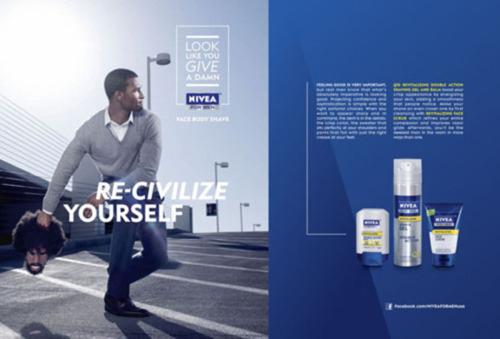
The Daily What watches the backlash:
Noting that none of the other ads in Nivea’s "look like you give a damn" campaign sport the tagline "re-civilize yourself," [Nona Willis] Aronowitz says: "The message couldn’t be clearer: natural hair on a black man isn’t a style preference or a nod to afrocentrism—it’s straight-up uncivilized." Roots drummer Questlove took the ad more personally, accusing Nivea of targeting him directly. "Lotion with a 38 yr old atlanta strippers name really wants my head off," Questo tweeted. "uncivilized?"
Should Twitter Be Your Stockbroker?
Rebecca Greenfield reports on Derwent Capital, an investment firm that is beating the market with a Twitter algorithm:
Using an algorithm based on the social media mood that day, the hedge fund predicted the market to make the right trades. Sounds unbelievable that something cluttered with mundane musings and media links could have anything smart to say about the market. But it's working so far.
Waiting For Super-Prez
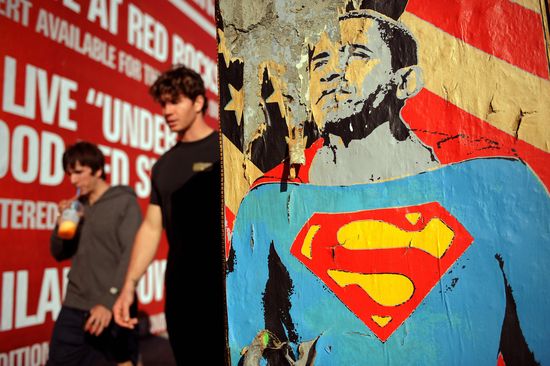
Scott Lemieux thinks Greenwald doesn't understand how constrained Obama is:
The fact that the president has very substantial powers in some areas doesn’t change the fact that in terms of domestic policy presidential power is subordinate and highly contingent. The fact that the president can unilaterally decide to bomb Libya doesn’t mean that the president can get 60 Senate votes for single payer health care because he really wants to. And pointing this out doesn’t mean that it doesn’t matter whether Barack Obama or Rick Perry sits in the oval office.
Yglesias concurs. Greenwald's response:
This presidency-is-weak excuse is often invoked to justify Obama's failures in all contexts beyond purely domestic policy (e.g., closing Guantanamo and the war in Libya). And all this is to say nothing of the panoply of domestic legislation — including Bush tax cuts, No Child Left Behind, and the Medicare D prescription drug entitlement — that Bush pushed through Congress in his first term, or his virtually unrestrained ability to force Congress to confirm even his most controversial nominees, including when Democrats were in control of Congress. That doesn't seem too weak or ineffectual to me: quite the opposite.
But it was part of the problem that Obama is trying to rectify. I agree with Glenn's view that Obama is far more conservative than many left-liberals want to admit, but part of that conservatism is a disavowal of the kind of ram-it-through authoritarianism of the Bush executive branch. Lemieux rolls his eyes, thinking Greenwald is still missing the point.
(Photo: A poster of US President-elect Barack Obama as Superman is seen on November 5, 2008 on Melrose Avenue in Los Angeles, California, one day after Obama won the November 4 election. Obama swept to an historic victory as America's first black president, but pleaded for time to heal and transform the superpower as he faces up to the task of forging his promised change. By Gabriel Bouys/AFP/Getty Images)
Car Culture Comes To A Halt?
Bradford Plumer wonders why this recession has reduced vehicle miles driven when previous slowdowns didn't:
There’s … a theory floating around that Americans—especially young Americans—are simply no longer as car crazy as they were in the 1970s. In 1976, three-quarters of all 17-year-olds had drivers’ licenses. By 2008, that was down to 49 percent. Last year, Zipcar, the car-sharing company, did a survey that found that 67 percent of 25- to 34-year-olds would prefer to drive less, especially if alternatives were available. (Mind you, Zipcar is hardly a disinterested party here, but other surveys have yielded similar results.)
The best news I've read in a long time. Jared Bernstein provides an excellent chart showing the stall in miles traveled by car in the US. Globally, of course, cars are still on the rise.
Mental Health Break
Long but thoroughly entertaining:
YouTuber mewlists of 25 Greatest Unscripted Scenes and 50 Trippists Drug Hallucinations in Films fame charts the Evolution of “Movie” Dance through 100 cinematic dance scenes from 1921 to 2010.
Plato On The UK Rioters
Angie Hobbs channels the philosopher's thoughts:
There must also be a willingness on the part of the whole of society to consider its values and the attitudes, actions and possessions to which it gives status. Each of us needs to consider whether we have, even unwittingly, helped foster the warped conceptions of value and status that currently obtain. We need to consider what we write, read and buy, the music and lyrics which we create and to which we listen, the programmes that we make and watch. …. As long as rewards and status are given, and can so clearly be seen to be given, to selfishness and greed, we cannot pretend that the riots are nothing to do with us.
Why We’re Dissatisfied
Because in our multi-tasking life, we keep using the standards of mono-tasking for everything we do. Casey Schwartz reviews Cathy Davidson's Now You See It: How the Brain Science of Attention Will Transform the Way We Live, Work, and Learn:
We've been trained to assume that working hard means focusing on a single task to completion, then doing it again. But, says Davidson, "the new workplace requires different forms of attention than the workplace we were trained for."
The result is that we feel anxious and guilty, convinced we’re not getting enough done, not achieving an honest day’s work, failing to live up to the iconic model of our hard-working, brick-and-mortar grandparents. As Davidson puts it, "We’ve inherited a sense of efficiency modeled on attention that is never pulled off track."
But these days, according to research, "the contemporary worker switches tasks an average of once every three minutes."
Awful Dates In 140 Characters Or Less
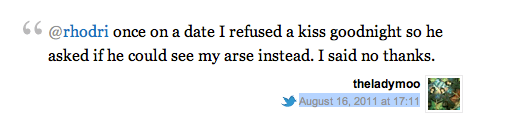
A collection of tweets from the UK.
 The Dish