The Future Of World Government

Jay Ulfelder pushes back against David Bosco and Anne-Marie Slaughter's optimistic claims of a future governed through international cooperation:

As observers of institutional development have repeatedly shown, the prospect of mutual gains from better governance does not lead inexorably to the development of new regimes or the strengthening of existing ones. Disagreements over exactly what the rules ought to be and how to share the costs and benefits of enforcing them have a tendency to scuttle or cripple most integrationist projects. Institutions may be useful as solutions to problems of cooperation, but demand does not lead automatically to supply.

Right now, globalization probably is broadening and deepening possibilities for mutual gains from international cooperation, but obstacles to collective action may be strengthening as well, as America’s and Europe’s relative power declines and new powers arise. I think we’ve seen this dynamic at work in the failures of the Doha round of talks on new rules for global trade and the Copenhagen conference on climate change in 2009. In both cases, there was no lack of mutual interest; instead, it was the shifting balance of power that impeded deal-making. In Doha and Copenhagen, rising powers demanded larger concessions than established powers were willing to make.

Previous coverage on the future of foreign relations here.
A Party Divorced From Facts

This clip is so W-esque it sends chills up my spine. But, as Chait notes, it's an almost perfect example of how fundamentalist thinking is simply incompatible with empirical reason:

This is not just about sex. What defines the current GOP is what I called in "The Conservative Soul" the fundamentalist psyche. This means an attachment to unchanging dogmas not just on religion, but on everything. So abstinence education must work because abstinence works (regardless of the data). And government borrowing is always wrong, even in an acute depression where aggregate demand has collapsed. And taxes must never be raised on anyone or anything, even though revenues are at 50 year lows and it's politically impossible to balance the budget by spending cuts alone. At the most recent Republican debate, every single candidate said they would turn down a debt deal with the Democrats that included a 10 – 1 spending cuts to tax increase ratio. That's insane in political and economic terms.

But if you're really a fundamentalist religious grouping more than a political party, it all makes sense.  Paul Waldman says that Perry's "stance on sex education is about 95 percent moral and 5 percent practical":

Liberals may think that conservatives support abstinence education because they believe it will reduce teen pregnancy, when the truth is that stopping teen pregnancy is at best a minor consideration for conservatives. If there's going to be any discussion of sex in school at all, they believe it ought to express the categorical moral position that sex is vile and dirty and sinful, until you do it with your spouse, at which point it becomes beautiful and godly (you'll forgive a bit of caricature). The fact that abstinence-only education is far less effective at reducing teen pregnancy than comprehensive sex-ed isn't something they're pleased about, but it doesn't change their conviction about the moral value that ought to be expressed.

How Can We Boost Employment?

Ezra Klein interviews economist Michael Spence on the subject. Spence sees no easy fix:

I don’t think there’s a solution to the employment problem in the short run. If you look at the situation, the domestic economy is demand short. That neutralizes the non-tradable part of the economy [Note: by non-tradable, Spence means things that don’t get traded across borders, such as education and health care. You can read more on the distinction here — E.K.], which is 70 percent of what we do, and neutralizes the domestic component of the tradable part. And the tradable part, even if it’s growing, won’t generate much employment. So we’re just not positioned to solve this unless the non-tradable sector starts to grow again.

Chart Of The Day

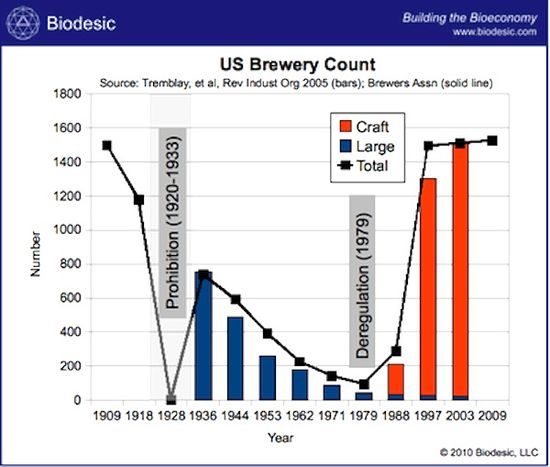
Us_brewery_count_biodesicthumb400x339

Via Tom Phipott, who comments:

What Carter actually did was deregulate the home-brew market—he made it legal to sell malt, hops, and yeast to home brewers. That, I believe was a significant move, because the US craft-beer industry was largely started by enthusiastic home brewers who went pro.

E.D. Kain, Erik Loomis, and Matt Yglesias all expand on Philpott's post.

Yglesias Award Nominee

"To dismiss concerns over an Iranian bomb as poppycock or warmongering by neocons seems extremely unfair and, yes, tendentious in the extreme. As academics, observers and journalists, we ought to be able to draw opposing conclusions about Iran’s nuclear program without attacking each other’s motivations and accusing one or another faction of being appeasers and Iran apologists on one hand or warmongering neocons agents of Netanyahu on the other… [W]hile it’s fair to say that the United States is much to blame for its bungled Iran policy since the fall of the Pahlavi dynasty, Iran is not exactly an innocent victim of American imperialism," – Robert Dreyfuss, The Nation.

Giving The Help A Hand, Ctd

A reader writes:

It's interesting that reviews and comments on The Help have consistently failed to mention the lawsuit against author Kathryn Stockett, which was recently dismissed on a technicality.  That backstory ironically and painfully contradicts the feel-good message some people are getting from the film.

Another writes:

I haven't seen the movie, so I don't really have an opinion on it. But I do know that there are women, black women, who are taking exception to it and in some cases are fairly angry because they feel it makes light of the experience of black women while pretending to elevate it in some way. Melissa Harris-Perry had strong words about it. And the American Association of Black Women Historians released an open letter expressing their objections.

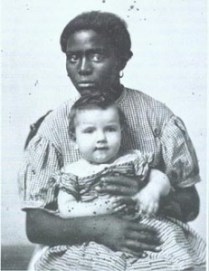
I was interested to read the opinions of Viola Davis (an incredible actress) and what Mammy01-thumb-250x324 drew her to the role. It seems that she initially wasn't keen on doing it. It bothered her that it was written by a white author. (Not in a racist slant, but because the black experience doesn't always translate accurately when projected through a white person's lense however well meaning.)

But they changed her mind with the screenplay. She makes comments about what it was like to film on location and how the South does not own what they did even to this day, when it comes to the treatment of the black workers. Too many dodge and scurry to deny owning any of it, she found.

(Photo via "A Critical Review of the novel The Help")

Is True Forgiveness Possible? Ctd

A reader writes:

I wanted to, as a former Catholic priest, offer a few comments on this lovely parable, which is usually interpreted according to the heart of the reader rather than the Gospel writer.

The parable, as I see it, is all about the father.

He has two sons, neither of which understands who he is. The younger treats his father as though he were already dead, asking for his inheritance in advance; leaves, and Pompeo_Batoni_003 squanders it till he longs to eat with pigs to fill his empty belly. At that moment, he comes up with an idea, one that just may rescue him from the abysmal shame in which he dwells. The son appears a long way off, the father sights him, and, in a detail designed to evoke astonishment, perhaps even ridicule in his first audience, the father runs to throw his arms around him (no dads in Nikes in the ancient world…profoundly undignified, shamelessly self-forgetful, foolish).
The son's stratagem, honest or not, is unnecessary. Again, the father reveals himself as pure, unbound love – "he was dead, and now is alive….he was lost, and now is found." He asks for no words or gestures, no apology, humiliation, propitiation, or sacrifice. The younger son just appears, that is all that's necessary. Does this son really change? We do not know; the parable has no interest in that. What is important is that the father has not.

The elder son, for all his faithful service at home, does not understand his father either. To us, of course, he is the less sympathetic character; dutiful yet calculatingly resentful. Does this son ever change? Again, we do not know, the parable is uninterested in that…and again, what is important is that the father has not changed  – "everything I have is yours."

If anything, the parable shows Jesus' understanding of his God. The father in the story is his image of the Father. There is no requirement, no measure. And we are, if anything, at different times, both of these sons.

After 2000 years, have we even begun to understand this Father?

And do we have the humility or self-esteem to accept this love? That has always been my problem. I think and have long believed that I am deeply unworthy of God's love. But at various points in my life, God has grabbed me by the scruff of the neck and held me close and told me, in a voice that pierces all the way through, that it doesn't matter if I am unworthy or worthy. God loves me because I am.

Those experiences – of total, overwhelming calm and peace – are what make me a believer. Still. For ever.

Huntsman’s Great Opportunity

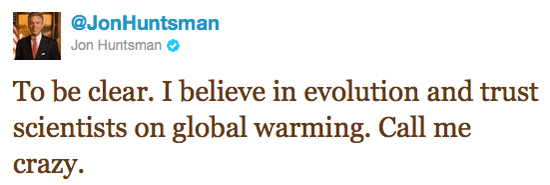
Screen shot 2011-08-18 at 2.51.09 PM

Allahpundit, a self-professed "fan of Darwin," thinks Huntsman has done himself no favors:

According to a Gallup poll taken last year, the number of Republicans who said God created humans in their present form within the last 10,000 years clocked in at a breezy 52 percent. Another 36 percent said evolution is happening but is being guided by God, and just eight percent joined me on RINO island by believing that evolution is happening on its own. (The last group is also a small minority among Democrats and independents, but not quite as small.)

This fan of Darwin thinks Huntsman needs to say more things like this, at every debate. He has a brand – and it is to challenge the know-nothing fundies now wrecking his party. Take them on. Throw reality in their face every time you can. You may well lose this time, but you're gonna lose anyway. Draw a line now. Make it pithy, like this tweet. Embrace science where science is appropriate and faith where faith is appropriate. Challenge them on gays and stop looking so scared when you do. Tell them the truth about immigration. Confront them on their no-taxes-ever doctrine by invoking Reagan.

Huntsman has a fantastic opportunity to be the reality-based prophet here, and to lay out the arguments that would make him a front-runner in 2016. Instead of shying from this, he should embrace it.

Noah Kristula-Green, meanwhile, wants GOP candidates asked about evolution at the next debate. Razib Khan claims that GOP candidates in the past have usually professed pro-evolution views and that a "realignment on this issue will be a sure sign that populism in the G.O.P. is the real deal."

Romney’s Strategy: Don’t Look Crazy

Adam Serwer observes:

Just about the only Republican presidential candidate who hasn’t said anything ridiculous in the last 24 hours is Mitt Romney. It’s a low bar to clear, but for a candidate who obviously has his eyes on winning the general election and not just the Republican primary, it’s also something of a vindication. And, hey, it might work even in the primary: If Romney can stand by while his opponents implode — without getting drawn into the whackiness himself — enough GOP primary voters just may decide he’s the last electable candidate standing.

Steve Kornacki is on the same page.