Why Does The MSM Ignore Ron Paul?

Will Wilkinson compares the libertarian's media coverage to Michele Bachmann's:

She's a photogenic embodiment of a certain polarising brand of conservatism that makes good copy and great TV. By contrast, Ron Paul is a goofily avuncular non-comformist ideologue who speaks unutterable truths about American foreign policy and delivers incessant indignant harangues about the monetary system that approximately no one in the media understands. I think Mr Paul's influence on the ideological cast of American conservatism has been underestimated and underreported, but to take even his influence, if not his candidacy, more seriously would require the talking haircuts and the newspaper typing corps to wrestle with a charged set of geopolitical and economic topics they would rather continue helping Americans not understand.

A-fucking-men. Look: if you want to understand where Rick Perry's know-nothing anti-Fed bullshit comes from, why not actually read Paul's arguments, rather than pretend he doesn't exist? Why not tease out how his foreign policy springs directly from his libertarian premises – and challenges the military-industrial complex more effectively than anyone since Eisenhower? Why not interview him more regularly? He's great TV actually – because complete sincerity is always good TV.

Kevin Drum insists that the biggest difference between Bachmann and Paul is "Paul has already run before." Bernstein adds two cents. Earlier thoughts on the Ron Paul media blackout here and here.
Will The Middle Class Vanish?

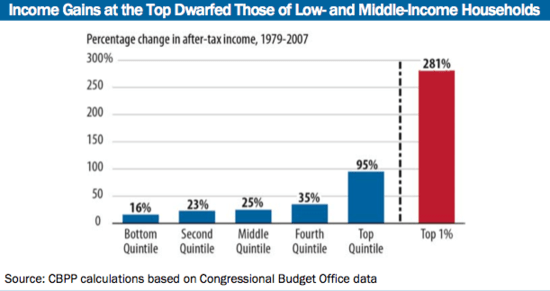
Income_Gains Jim Fallows believes so:

I honestly don’t see what forces are going to relieve the pressure on the middle class over the next decade or so. Barring some catastrophic change in energy prices or world conditions, the globalized production system will continue to develop. And its natural results, not just in the U.S. but worldwide, have been to enrich countries overall, while making their internal income distribution more polarized.

(That’s because opportunities are greater and more rewarding for those with globally-marketable skills, and competition is more intense for those with commoditized skills. In their different ways, China and the U.S. as whole economies are much richer than they were a generation ago, but both of them also are much less equal in distributions of income and wealth than they used to be.)

It is hard for me to imagine a technological breakthrough that would mainly be a great equalizer of opportunity in America or elsewhere. Obviously I hope to be proven wrong on this point.

Further debate on the subject here. Image from the CBPP.

Starbursts Watch

"It finally happened. I met former Alaska Governor Sarah Palin. She may be the loveliest woman on Earth, or at the very least Aphrodite’s better looking cousin. … [Todd] gave permission [to tell a joke], so I served up my best. “I like Sarah Palin, but I can’t stand her position on traditional marriage. I think it’s awful. What I mean by that is I can’t stand the fact that she is married to somebody who is not me.” He laughed, and out of nowhere she turned around. She liked the joke. She gave me a hug and I asked if I may take a picture with her. She said it was ok, but there was one problem. Due to sheer nerves I have not experienced since junior high school, I totally went brain dead and forgot how to work my cell phone camera," – Eric Golub, in the Washington Times.

Against Age-Based Education

After reading a report on high school grads unprepared for college, Walter Russell Mead reimagines the education system:

The truth is that if American high schools (and middle and elementary schools) were doing their jobs, many students could get all the formal education they need in 12 years. In any case, we need to move from a ‘time based’ to a competency based educational system.  You don’t get a high school diploma because you have spent 12 years in classrooms; you get a high school diploma because you have demonstrated a certain level of core competence.

James Joyner, along the same lines, wants to shorten college:

There's no reason an undergraduate degree should take more than three years unless the student is working his way through school and can't devote full-time energy. A master's degree should take a year and a JD two. The PhD has gone from a two- or three-year program as recently as the late 1960s to a five- to seven-year program almost solely on the basis of keeping grad students around as cheap labor. Accelerating the process would do wonders in curtailing the skyrocketing cost of higher education. I’m not sure, though, how it would help with the problem of students who aren’t ready for college.

The Gay Divide

Dan Savage shares an insight from the IGB project:

When I was a kid, and I was odd, the default assumption was that I was odd, not that I was gay. Now when a kid is odd in a Greensburg [Indiana], gay or straight, the default assumption is gay. Because my job requires me to be in constant communication with people all over the country who are writing in to "Savage Love," calling the podcast, I think I’m a little more conscious of what’s going on out there in the boonies — but even I didn’t see that. And that’s a bitter pill for those of us my age to swallow. Us out there leading our lives and being successful have actually kind of made it worse for 14-year-old gay kids in Greensburg, Ind.

But what is the alternative? That's my question. Jim Burroway fleshes out Dan's point:

[T]here is something of a divide within the gay community between those living in gay meccas and the rest of us living elsewere.

There is a huge part of me that would love to live in San Francisco, L.A., D.C. or New York. I love visiting those cities, but I also know how easy it is to get caught up in a bubble and loose footing with what’s really going on elsewhere in the country. If people in gay meccas talk about gay communities outside of their bubble — and that is a big if — the talk too often goes in one of two directions: either that of course gays everywhere enjoy the freedoms found in the meccas, or that of course gays everywhere else are being burned out of their homes or cowering in their basements.

That’s why I believe that living in a retrograde state like Arizona is actually an advantage to me. I do think that if I were to move to a major gay enclave, that I would develop a sort of laryngitis and lose an important part of my voice that comes from living in an area where we can’t take a lot of things for granted — but also where we aren’t exactly powerless rubes living in constant fear in our semi-closeted existences.

Combat Skills As Community Service

102301967

Joe Klein's latest (paywalled) article focuses on veterans who have committed to public service after returning home. Joe teases the article over at Swampland:

I spent the past few months traveling around the country, finding veterans who are using the skills they learned in Iraq and Afghanistan for the betterment of their communities. Any given rifle company Captain had to be, in effect, the mayor of a town in Iraq or Afghanistan–and had to develop political skills like the ability to deal with local shuras [councils of elders], the ability to find out from the local population what sort of construction projects they favored, the ability to put people to work on those projects with a minimum of fuss…as well as the ability to make important decisions under incredible pressure.

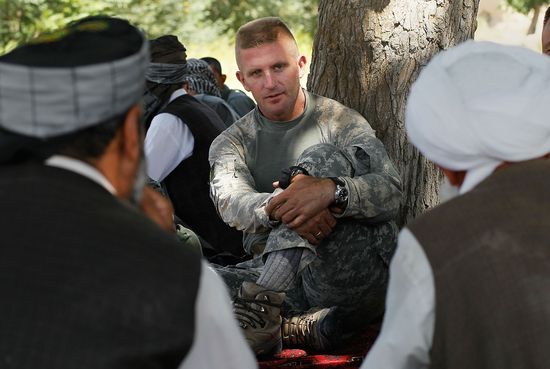
(Photo: Lt. Col. William Huff of the U.S. Army's 82nd Airborne Division, battalion commander of Task Force Professional, sits and talks with local Afghan leaders on June 22, 2010 in the Khushi Khona area of Afghanistan, in Herat Province near the Turkmenistan border. Informal meetings with important local tribal and government officials are a crucial part of the counter-insurgency strategy that the American military has adopted in Afghanistan. By Chris Hondros/Getty Images)