The Danger Of Vengeance

Alexander Lee wants Norway to resist calls from its Justice Minister and others to stiffen its criminal punishment laws post-Breivik:

As [Thomas] Paine recognized, the character of that punishment would affect the relative importance accorded to the protection and the limitation of human freedom in society. Paine thus opposed capital punishment and contended that the "avidity to punish" with harshness "is always dangerous to liberty."

When the desire for vengeance is given free rein in the name of liberty, it "either tortures [the] feelings or hardens the hearts" of the populace, and "leads men to stretch, to misinterpret, and to misapply even the best of laws” in such a way that liberty itself is threatened. If punishment is given priority over shared freedoms, there is a danger that government may encroach arbitrarily on individual liberty in a manner that potentially affects all. "He that would make his own liberty secure," Paine continued, "must guard even his enemy from oppression, for if he violates this duty, he establishes a precedent that will reach to himself." For Paine, even the most heinous crimes must be punished with justice and moderation, and with more regard for liberty than revenge.

The Children We Kill, Ctd

6a00d83451c45669e20154330e6140970c-800wi

There's been some pushback against the Bureau of Investigative Journalism report we highlighted:

Though even a single civilian casualty ought not to be taken lightly, the focus on alleged collateral damage distorts the essence of the drone program. In reality, technology allows highly trained operators to observe targets on the ground for as much as 72 hours in advance. Software engineers typically model the blast radius for a missile or bomb strike. Lawyers weigh in on which laws apply and entire categories of potential targets—including mosques, hospitals and schools—are almost always off bounds. All these procedures serve one overriding purpose: to protect innocent civilian life. The New America Foundation's database of strikes shows it's working.

This year civilians made up only about 8% of the 440 (at most) people killed in drone strikes in Pakistan down from about 30% two years ago. As for affecting U.S. popularity on the ground, according to the Pew Global Attitudes survey, the U.S. favorability rating—long battered by conspiracy theories and an anti-American media—hovers at about 12%, almost exactly where it stood before the program's advent seven years ago.

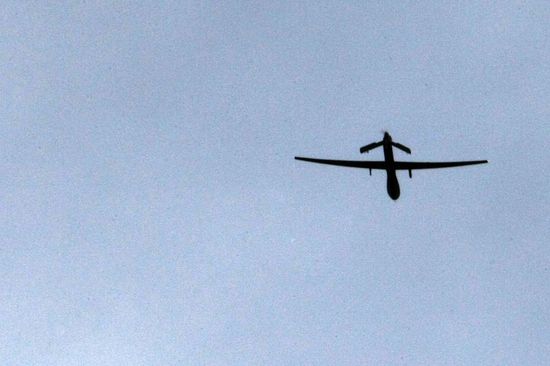
I noted the big increase in accuracy under Obama, and am glad for it. Benjamin Friedman still opposes the drone war, but I tend to agree with Ben Wittes' defense  of drone strikes as the least worst evil after the U.S. withdrawal from Afghanistan. The key is to keep refining accuracy and ensuring that civilian casualties, especially of children, are kept to an absolute, over-riding minimum.

(Photo: A US 'Predator' drone passes overhead at a forward operating base near Kandahar on January 1, 2009. By Joel Saget/AFP/Getty Images.)

The Stock Market Roller Coaster Continues

The market fell around five percent today. Felix Salmon yawns:

I’m not seeing fear or panic right here. For one thing, we’re in the middle of August — the time of year when traders and institutional investors go on vacation, volumes tend to dry up, and market moves can get magnified for no good reason. Today stocks fell as much as 5% and the VIX broke above 40 — moves which are indeed reminiscent of what was happening in those panicked days of 2008-9. But having experienced those days and come out the other side, I feel that the investing public as a whole has been toughened up a bit, inured to volatility in a way they weren’t back then.

Meanwhile, In Afghanistan

121289284

After Iraq's spike in violence, it's worth updating on our other land war in Asia. Jason Fritz worries that the critical Afghan National Police training mission isn't going so well:

Successful police development is one of the major keys to our withdrawal from Afghanistan. And yet we're still doing train and equip programs through contractors who are understaffed and receive oversight from government organizations who don't very well understand what they're supposed to do. … It is apparent that the U.S. is still not serious about the Afghan National Police as a viable force to assume responsibilities after we transition responsibility. So let's get this right very quickly or think about not wasting any more money on this endeavor.

Joshua Foust doesn't think our local development efforts are going much better. Pakistan isn't helping either. Nancy Youssef tries to assess the costs of these massive military adventures. Getty's Mark Wilson tallies another loss, seen above:

A U.S. Army carry team moves the transfer case of U.S. Army Spc. Joseph A. VanDreumel during a dignified transfer at Dover Air Force Base on August 17, 2011 in Dover, Delaware. Spc. VanDreumel, who was from Grand Rapids, Michigan, was killed while participating in combat operations in Afghanistan.

Is Perry A Neocon Or A Tea Partier? Ctd

Jacob Stokes spoke not a moment too soon – the neocon attacks on Perry have already begun:

Rick Perry? will likely have to contend with questions over his involvement with the controversial Chinese technology company Huawei. As governor, Perry wooed the Chinese firm for months before it finally decided to open its U.S.-based corporate headquarters in Texas, helping to create hundreds of new jobs in the state. 

The problem is that the company had previously come under fire for its reportedly cozy relationship with the Chinese People’s Liberation Army, its allegedly abusive labor practices and the cybersecurity threat that it posed to the U.S. and Europe. And now those cybersecurity concerns are back in the news, which could create some problems for Perry. Eli Lake reports that a new contract between Huawei and a U.S. military research center has prompted members of congress to call for an electronic espionage investigation:

More on the coming GOP backlash here.

The West Unites Against Assad, Ctd

Dan Drezner thinks Obama's speech was nice, but mostly irrelevant:

There is no public clamor or enthusiasm for yet another military engagement, nor do I see any genuine policy appetite for such a move.  Sanctions are already in place.  Covert action might be taking place, but that policy option can never be publicly acknowledged.  As the New York Times story notes, in calling for Assad to leave the United States is now moving towards the consensus in the region. When the rest of the policy quiver has been exhausted, sure, why not call for Assad to leave?  As a general rule, all else equal, I see no reason why the U.S. government should not express its actual preferences rather than hide behind diplomatese.  Or, as Douglas Adams would put it, this rhetorical move counts as "harmless." 

Marc Lynch, who Drezner pegs as an opponent of the move, appears to agree. Daniel Serwer looks at what comes next:

For President Obama’s new rhetorical line to be effective, other countries–especially Turkey, Saudi Arabia and the Europeans–will need to play hard ball with the Syrian regime.  Both the Turks and Saudis have sounded recently as if they are willing to do that, and the Europeans in their own complicated way seem to be moving in the same direction. Diplomacy is getting other people to do what you want them to do.  As many in the blogosphere are noting, Washington’s direct influence on events in Syria is small.

Jonathan S. Tobin, predictably, blames Obama for not doing this sooner, seemingly believing that the Syrian military follows Obama's orders instead of Assad's.

Asking For It

Rich Lowry expects Perry to be "hated" by the media. Friedersdorf pushes back:

If liberals start mocking [Perry's] rural Texas roots in 2012, I'll publicly say that they're wrong to do so. Our politics shouldn't be about cultural cues and identity politics. But any insults will come two years after Perry, in his 2010 book, pointedly mocked residents of California and Massachusetts for their cultures and values. It is too much for Perry or his sympathizers in conservative media to now come along and cast themselves as victims, or even to suggest, as Lowry does, that it is Perry's identity, rather than deliberately combative constructs, that makes him controversial.

Adam And Eve Did Not Literally Exist. Period. Ctd

Tumblr_l78712omFr1qbyasxo1_500

A reader writes:

There has always been a large strain in traditional Judaism that believed Creation and Adam and Eve stories were allegorical, not literal.  For example, see the Rambam, or Maimonides.  From Wikipedia:

Some medieval philosophical rationalists, such as Maimonides held that it was not required to read Genesis literally. In this view, one was obligated to understand Torah in a way that was compatible with the findings of science. Indeed, Maimonides, one of the great rabbis of the Middle Ages, wrote that if science and Torah were misaligned, it was either because science was not understood or the Torah was misinterpreted. Maimonides argued that if science proved a point, then the finding should be accepted and scripture should be interpreted accordingly.[26] 

Before him Saadia Gaon set rules in the same spirit when allegoric approach can be used, for example, if the plain sense contradicts logic.[27] Solomon ibn Gabirol extensively used allegory in his book "Fountain of Life", cited by Abraham ibn Ezra.[28] In 1305 Shlomo ben Aderet wrote a letter against unrestricted usage of allegory by followers of Maimonides, like Jacob Anatoli in his book "Malmad ha-Talmidim".[29] In spite of this, Gersonides copied Maimonides' explanation the story of Adam into his commentary on Genesis, thinly veiled by extensive usage of the word "hint".

The main point of Maimonides and Gersonides is that Fall of Man is not a story about one man, but about the human nature. Adam is the pure intellect, Eve is a body, and the Serpent is a fantasy that tries to trap intellect through the body.

Also, I must have missed that day in yeshiva when it was taught that "according to Genesis, there were humans outside of Eden awaiting Adam and Eve," as your reader put it.  A citation from him/her would be useful.

Another is on the same page:

Genesis merely indicates that after Cain was banished for murdering his younger brother Abel, he married and had children.  Genesis is utterly silent on the origin of his wife.  One could just as easily conclude that she had been born from Adam and Eve, but that was never mentioned because doing so was peripheral to the religious message of the text. "According to Genesis" isn't a helpful way to think about the question of Cain's wife because Genesis doesn't say anything at all about where she came from.  If you're relying solely upon the story as a history of human origin, then it's an even bigger jump to conclude that she came from some other human population than it is to conclude that she was born from Adam and Eve.

Another clarification:

I am enjoying the Adam and Eve discussion, but one of your readers made a classic mistake, and one that needs to be corrected: Virgin Birth concerns Jesus's birth, while Immaculate Conception concerns Mary's birth.

The Virgin Birth is a historic dogma that was explicitly included in the New Testament and can be found in the Gospels of Matthew and Luke. Both of these books teach that Jesus Christ was born of a virgin who did not have sexual relations with a man prior to conception. The Virgin Birth has been traditionally accepted by all branches of Christianity – Protestant, Orthodox, and Roman Catholic alike.

The Immaculate Conception, on the other hand, is a dogma that developed over the centuries, finally given its final form by Pope Pius IX in 1854, via the Bull "Ineffabilis Deus". It teaches that the Blessed Virgin Mary was, by the singular grace of God, concieved and born without the stain of original sin. This specific doctrine has not been generally accepted by Protestants and Orthodox Christians, although it is now defined as Roman Catholic dogma.

Another:

One thing that always bothered me: If Adam and Eve were the first humans in existence, why are they always portrayed as having belly buttons?

It's questions like these that got me kicked out of Sunday School.

(Image via the tumblr "befuddleme")