A Death Knell For Neoconservatism? Ctd

by Maisie Allison

Sam Tanenhaus argues that "legislative" conservatism has reemerged in the wake of imperial or "presidential" conservatism's ugly demise: 

Today’s Republican legislators, and the Tea Party faction that drives them, are indifferent as a group to foreign policy and distrustful of any and all presidential initiatives. That a Democrat now occupies the White House, and initially urged major reforms, has only hardened opposition on the right to a powerful executive. Even the specter of Reagan has receded. It is instead Goldwater’s dogma that resonates, his declaration (in 1960) that “I have little interest in streamlining government or in making it more efficient, for I mean to reduce its size. … My aim is not to pass laws, but to repeal them.”

Tanenhaus makes a compelling case, but unfortunately I find it hard to believe that a Republican would actually concede executive power, especially on foreign policy. At this point the latest incarnation of legislative conservatism seems less like a deep-rooted philosophical sea change and more like a crude political strategy that makes use of the branch Republicans half-control (it is telling that legislative conservatism's policy of obstructionism failed to check Obama on Libya). From James Lamond's response to Peter Beinart's eulogy:

[N]eoconservativism never had a wide political base, electoral force or popular movement behind it. As Vaisse writes, “nobody ever got elected on a ‘neoconservative platform.’” George W. Bush famously ran in 2000 pledging a “modest” foreign policy. As Beinart rightly points out, for what they have said about foreign policy thus far, the GOP presidential candidates tend towards the “modest” George Bush of 2000, versus the George Bush of 2003. But this is probably as much attributable the lack of a Tea Party foreign policy and a lack of a coherent world view from the broader GOP as anything else. And as Jake wrote earlier this month, Rick Perry — a Tea Party candidate —  is being advised by Donald Rumsfeld, Doug Feith and Dan Blumenthal, all either widely considered neocons or longtime allies. 

Basically, neoconservatism's global agenda persists even as the U.S. abandons the unpopular project of nation-building abroad. And as Lamond and Beinart suggest, there's already evidence of a new foreign emergency-boogeyman emerging in China (note that the American defense budget exceeds China's by sixfold). Yesterday Perry tentatively decried "military adventurism," adding that the U.S. "must renew [its] commitment to taking the fight to the enemy wherever they are before they strike at home" (Daniel Foster writes: "[T]he debate on the Right at the moment is, very roughly speaking, between the Bush Doctrine and good ol’ fashioned realism, and Perry certainly sounds like he’s trying to help himself to both"). In other words, if a Republican president is elected, expect a sudden revival of imperial conservatism.

The Iraq War And President Gore

by Zack Beauchamp

Reacting a recent poll that found most Americans didn't think a Gore Administration would be all that different from Bush, Steve Kornacki argues that Gore would have gone to war too:

President Gore would have been hearing the same pleas. His own vice president would have been Joe Lieberman, perhaps the most hawkish Democrat in Washington on Middle East issues. Marty Peretz, his old friend and confidante, would have had Gore’s ear and filled it with arguments for going into Iraq. Loud, influential, non-conservative media voices — like Tom Friedman and Peter Beinart — would have amplified these calls on the outside. Republicans would have been screaming for an invasion, and the public would have been on their side. Clinton could barely hold them all back in the ‘90s; after 9/11, would Gore have stood a chance?

Jonathan Bernstein counters:

Kornacki really gives away the game, though, when he notes that what Gore “objected to was more the go-it-alone nature of Bush’s approach.” Well, yes. That’s a bit of a problem, isn’t it? Because the go-it-alone approach wasn’t simply a matter of refusing the assistance of eager allies. Potential allies were reluctant to join a coalition precisely because of the way the Bush administration was handling the buildup to war. If Gore had an interest in invasion but only if allies could be found, then he would almost certainly have had to give weapons inspectors a far more thorough chance to do their jobs. And, as we now know, the inspectors wouldn’t have made discoveries that would have brought on war. So how exactly does Gore get his alliance?

Yglesias, though his analysis focuses on domestic policy, sides with Bernstein. So do I. It's possible I'm misremembering, being a young 'un and all, but my understanding is that the real selling point (pdf) for the war was the WMD threat. Since that specter was a product in large part of Dick Cheney's malfeasance, we likely wouldn't have heard much about mushroom clouds and smoking guns in a Gore Administration.

The Psychology Of Pronouns: Beatles Edition

by Zoë Pollock

After reviewing James Pennebaker’s new book on language, Ben Zimmer revisits Pennebaker's scholarship on the Beatles:

The songs on which [John Lennon and Paul McCartney] collaborated closely produced linguistic patterns strikingly different from those of either songwriter individually. The 15 songs that were true John-Paul partnerships, Mr. Pennebaker says, were “much more positive” in emotional tone and used “more I-words, fewer we-words and much shorter words than either artist normally used on his own.” Mr. Pennebaker discerns that same synergy at work in a very different collection of texts: The Federalist Papers, three of which were written jointly by Alexander Hamilton and James Madison.

For more, Pennebaker co-wrote an article in the journal Psychology of Aesthetics, Creativity, and the Arts, “Things We Said Today: A Linguistic Analysis of the Beatles,” (pdf) in 2008.

Yglesias Award Nominee

by Maisie Allison

"[W]omen in Congo have enough home-grown problems without importing irrelevant, Western controversies. While both the pill and condoms are generally available in larger cities such as Goma, access is limited in rural districts. … Contraceptives do not solve every problem. But women in Bweremana want access to voluntary family planning for the same reasons as women elsewhere: to avoid high-risk pregnancies, to deliver healthy children and to better care for the children they have. And this is a pro-life cause," – Michael Gerson

Face Of The Day

123048526

A small dog watches from its owner's lap as rain clouds gather above the seafront on August 30, 2011 in Weston-Super-Mare, England. According to weather experts, the UK's summer has been one of the coldest for many years. Figures from the Met Office show that average temperatures so far have been less than 14C (57F), the lowest since the summer of 1998. In the central England region (between London, Bristol and Manchester), the average of 15C (59F) is the lowest since 1993. By Matt Cardy/Getty Images)

— C.B.

The Politics Of Science, Ctd

by Maisie Allison

Matthew Boudway explains why Rick Perry's denialisms should worry Christians:

To those who ask, “Who cares what Perry thinks about Intelligent Design — who cares what any politician thinks about it?” the obvious answer is: What matters is that Perry show some sign of having thought about claims he pretends to take so seriously. A candidate who appears thoughtlessly sure that most scientists are wrong about evolution is unlikely to be sufficiently thoughtful about other things a president needs to think about (for example, the science of climate change, which Perry has dismissed with an infantile conspiracy theory). A habit of thoughtlessness is not so easy to segregate.

Taking Business Personally

by Maisie Allison

Virginia Postrel returns to 1980s culture to show how Steve Jobs transformed business into something more like sports or fashion, a "realm of passion and personality": 

[Jobs's] inspiring philosophy offers the promise of greatness and self-fulfillment, but also perpetual dissatisfaction. If business isn’t just about making money, if it is about finding a version of true love and leaving a cultural mark, the stakes are much higher. Your work becomes your identity.

Alan Deutschman's profile of Jobs looks at his management style:

[Jobs] found that by delivering brutal putdowns of his co-workers he could test the strength of their conviction in their own ideas. If he said “this sucks” or “this is shit” and they fought back fiercely, he would trust their passion, especially since he often lacked the necessary technical acumen or aesthetic confidence. (Even though he instinctively grasped the importance of design from early on—he had wanted to enclose the Apple I in a case of beautiful blond koa wood—he remained uncertain about his taste for many years before he settled on the safety of austere minimalism). He found that many of the most brilliant engineers and creative types actually responded well to cruel criticism, since it reinforced their own secret belief that they weren’t living up to their vaunted potential.

Von Hoffman Award Nominee

by Chris Bodenner

"Tuesday marked a week and a day since the Associated Press published the controversial remarks of Sen. Rick Santorum, R-Penn., in which he seemed to equate gay sex with incest and possibly even bestiality. It was the fourth day since President Bush said, through a spokesman, that Santorum was an "inclusive man" who was "doing a good job as senator—including in his leadership post." (Santorum is the No. 3 in the Senate GOP.) And it was the day Santorum himself was enthusiastically welcomed at a Senate GOP lunch, after which Majority Leader Bill Frist of Tennessee declared him to have "the full, 100 percent confidence of the Republican leadership in the United States Senate."

And with that, the furor seems all but over," – Jake Tapper, in a 2003 Salon piece entitled "Santorum's One-Week Scandal."

(Via Dan Savage, natch)

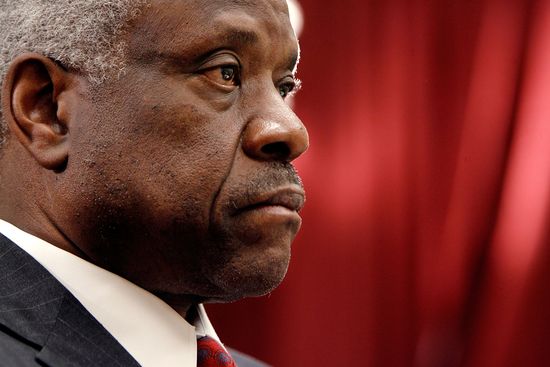
The Most Conservative Justice On The Court

GT_CLARENCETHOMAS_110829

by Maisie Allison

Walter Russell Mead is startled by Jeffrey Toobin's dramatic reappraisal of Clarence Thomas, who hasn't been taken seriously for a "generation…even as constitutional scholars stand in growing amazement at the intellectual audacity, philosophical coherence and historical reflection embedded in his judicial work":

Toobin is less interested in exploring why liberal America has been so blind for so long to the force of Clarence Thomas’ intellect than in understanding just what Thomas has achieved in his lonely trek across the wastes of Mordor. And what he finds is that Thomas has been pioneering the techniques and the ideas that could not only lead to the court rejecting all or part of President Obama’s health legislation; the ideas and strategies Thomas has developed could conceivably topple the constitutionality of the post New Deal state.