A 'one Swiss franc coin' and a 'one Euro coin' are seen on the top of a 100 Swiss francs note on this picture taken on August 17, 2010 in Lausanne. The Swiss central bank stepped into the market injecting 80 billion francs ($101 billion, 89 billion euros) in liquidity, but failed to stem the currency's rise against the euro and the dollar. By Fabrice Coffrini/AFP/Getty Images.
No footage has been offered by either ICG or its “independent” sources substantiating allegations of anti-Alawite incitement. And as against one lone video of posthumous indecency in Hama, the Syrian opposition has uploaded thousands of mobile phone records documenting everything from snipers firing at civilians from rooftops, screaming mothers cradling the corpses of their slain children, self-confessed mercenaries admitting that Hezbollah paid and bused them into Syria to enforce military discipline, mukhabarat thugs kicking old men in the head, and a mentally disabled man displaying his bruises and reprehending Assad personally. In other words, the weight of all available evidence overwhelmingly confirms the opposition’s narrative and discredits the regime’s. And yet, an organization dedicated to “preventing conflict” had instead become tribune for the sowers of one.
Amen. Carlos Strenger is equally harsh on Netanyahu and Lieberman's attempt to see the Arab Spring as an uprising of Iran-supporting fanatics:
In periods of change and uncertainty, the most important thing is to keep an open mind and to question old certainties and paradigms. Sure enough, Israel’s current political leadership has done nothing of the sort. Mr. Benjamin Netanyahu, and our Foreign Minister, Mr. Avigdor Lieberman “know” that the Arab Spring will turn sour, that it will turn into an Iranian Winter, and will be bad for Israel.
Both Netanyahu and Lieberman made up their minds about the Arab world long ago, and no facts will confuse them. Netanyahu’s views were shaped his father’s theory that Arabs are slightly subhuman and can only be kept at bay by force, if necessary by inflicting hunger an illness upon them (he thinks Operation Cast Lead was just a first step, and not enough). Bibi knows that he can neither say nor write this without making himself into a pariah internationally, so he just writes in his book “A Durable Peace” that Palestinians should get four disconnected cantons instead of a state – leaving open, of course, how he thinks Palestinians can be beaten into accepting these Bantustans.
A reader veers from the initial debate to further build the case for Star Trek as a pioneering force for equality:
Deep Space Nine deserves credit for the kiss you posted, and the relationship around it. Knowing the series, the fandom, and the writers/producers as I do, I'm certain the intent was noble, and it did move things forward in a bold way. But that was, frankly, two hot girls kissing (one of whom used to be the other's husband … it's complicated and nerdy). It beats pretending homosexuals don't exist, but it's the gay equivalent of the two-steps-forward-one-step-back African Amercians made with their caricature roles in the '70s.
You want to talk about Star Trek's boldy going there with homosexuality, I'm surprised no one has brought the Next Generation Episode "The Outcast" to your attention. This was far enough back in the '90s that you weren't going to see lesbians kiss on TV, but to my mind, this was a much more powerful and daring.
The episode is about a species without gender, that views gender expression as an abomination and an illness to be cured. It's powerful because there's nothing foreign about it. I was raised in a conservative, devout evangelical home with pretty standard anti-gay attitudes (hate the sin, love the sinner). I saw this at a young age. What I saw was Riker, a manly guy I respected and could relate to, falling in love with a woman (no learned moral outrage alarm bells there!) and losing her to the tragedy of an intolerant society.
I absorbed it as a tragedy, but didn't understand why a society would do that, even as I went to a church that behaved that way. The episode wasn't one of my favorites, and it perplexed me deeply. It was years before I made the obvious connection to homophobia and the ex-gay movement. That realization was profound, and it changed my life. My ability to judge and exclude and cast people out was cast down so completely I'm embarrassed to even talk about it in this anonymous email. The change was so complete and sudden, I almost literally felt as though scales fell off my eyes.
To this day, I don't think my parents have any idea the shape or size of the impact Star Trek had on my moral compass and political choices in this area and others. That's all to the good; they'd never forgive themselves for letting me watch it.
On the heels of a weak German GDP report, Ryan Avent fears that the strongest economy in the euro-zone is beginning to slow. McArdle is equally worried:
This is obviously a huge problem for the eurozone. Those who think that the euro can muddle through this without losing the periphery have been counting on Germany (and to a lesser extent, France) to deliver a bailout. A recession is going to erode Germany's economic ability to funnel cash into the PIIGS, but more importantly, it is going to make German voters much less patient with the notion.
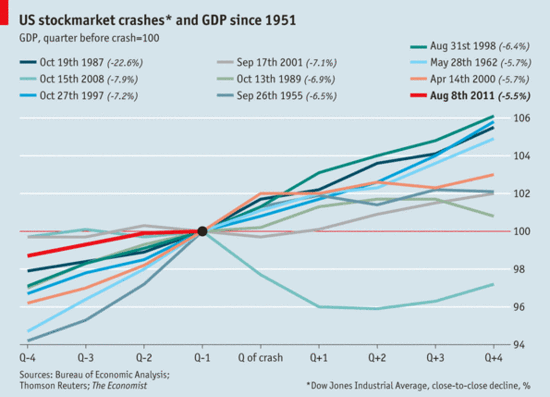
The Economistputs last week's stock market decline in context:
[H]ow predictive are big one-day falls of subsequent recession? Not very, as the chart below shows. In almost all big market falls since 1951 the crash has come in the midst of an economic recovery. In most cases, economic growth continued for several quarters after the crash, with the notable exception of the market collapse in October 2008, which was followed by recession.
A look at the predictive powers of longer-term market crashes here.
I want to add nuance to the Cameron Todd Willingham thread. Please note that I am not a Perry supporter. I have never voted for him for governor and certainly would not vote for him for president. I am also very against the death penalty and, as a lawyer, have done pro bono work on behalf of capital defendants. But the Cameron Todd Willingham facts are being slightly distorted by the national media.
Perry did not sign Cameron Todd Willingham’s death warrant. In Texas, death warrants are signed by the judge who presides over the defendant’s trial. So, when the case came before Perry, the issue was a pardon. But, in Texas, a governor cannot issue a pardon unless the pardon is recommended by the Texas Board of Pardons and Paroles. (Texas, like many former Confederate states, has a very weak governor.) The Board did not recommend a pardon or clemency in Cameron Todd Willingham’s case. In fact, it is not clear if they even reviewed the material submitted to them to demonstrate that he was probably innocent. And, of course, the Board members serving at the time of Cameron Todd Willingham’s execution were not appointed with the intent to particularly affect that case.
So, my point is that Perry really doesn’t have any particular personal complicity in Cameron Todd Willingham’s execution. (He is, in my view, one of many people who advocates for such an immoral punishment scheme and thus bears liability in that sense.) This knowledge about Perry makes his subsequent actions seem both more moral and less moral in my view. Perry did interfere with the commission investigating Cameron Todd Willingham’s execution in a manner that will probably preclude the commission from examining the case going forward. He did this not to protect himself from personal liability as he really has none. He did it because he (like many, many officials in Texas) is interested in bolstering our corrupt and immoral capital punishment system.
Hussein Ibish traces Israeli and Palestinian national identities:
In the decades immediately preceding 1948, the word “Israeli” was totally unknown and meant nothing, and the word "Palestinian” meant many things, but certainly not what it means today. Both of these national identities—the Jewish Israeli and the Arab Palestinian—are contemporary constructs born of recent history. They are largely grounded in their encounter with each other. They also embody deep cultural memories, traditions, myths, legends and tendentious narratives that at least to some extent retrofit the past to privilege their own national projects.
But all of this is entirely beside the point. Neither the Palestinian nor the Israeli national identity is more or less "authentic" or “legitimate” than the other because both are self-defined nationalisms adhered to by millions of people. The extent to which they are based on imaginary constructs—as all modern national ideologies ultimately prove largely to be—is meaningless in practice. Objecting to these mythologies is the political equivalent of complaining about the rain.
(Photo: Border policemen stand guard as a Palestinian youth talks on public phone during the Muslim holy fasting month of Ramadan on August 8, 2011, at the old city of Jerusalem, Israel. By Uriel Sinai/Getty Images)
Manan Ahmed reflects on his need to shave before travel:
Yesterday, in planning for my airport flight tomorrow, I went to my usual barber (a gentle man from Istanbul who speaks with kind eyes) and asked him to go ahead and make me pretty for the immigration control officer. As I sat there looking at the mirror, I realized that 1) I rather liked my face covered in short, grey, splinters. And 2) I was afraid of what these short, grey splinters would tell someone else about me.
I realized that this particular habit began ten years ago. I flew back into Chicago from London on Sep 16th, 2001.
Ben Smith infers that she will – from the way she behaved at the Iowa State Fair. Everything I know about her suggests she will. But Washington – Republican and Democrat – is convinced she's over. We'll see. I hope the establishment is right. But none of the current candidates seems viable to me.
Tom Waits sometimes sounds eerily like Cookie Monster. Not that I mind! I happen to love Waits and his carnival barker's growl! Here's Cookie Monster's rendition of Waits' "God's Away On Business".


 The Dish