
The GOP’s Reverse Class Warfare

Scott Galupo is indignant:

The sweeping 1986 tax overhaul that Reagan signed into law broadened the tax base, closed loopholes, and lowered individual income tax rates. It also established the Earned Income Tax Credit program, or EITC, which eliminated millions of the working poor from the rolls altogether. Expanded by President Clinton in 1993, the antipoverty program has been a smashing bipartisan success. Now it's become commonplace among the right to question whether such programs are "fair." …

The idea that the middle class—or whoever Rick Perry means by "We"—is suffering because the lower classes aren't paying taxes; the idea that the rich would create more jobs if their share of national wealth was even more heavily concentrated; the idea that, if everyone had "skin in the game," the economy would somehow improve, even as the beneficiaries of programs like the EITC are bearing the brunt of the Great Recession—all this is, to put it bluntly, a load of crap. It's a stupid, nonempirical, and corrosive mindset.

Bollocking The Surveillance State

Cory Doctorow thinks the London riots show it's time to rubbish the UK's omnipresent CCTV cameras:

The deterrence theory of surveillance had no nexus with the motivations of the rioters. The theory of street crime as a rational act is bankrupt. Evidence-led CCTV deployment shows us where CCTV does work, and that's in situations where crimes are planned, not pulled off in the heat of the moment. Parking garages, banks and jewelry stores, yes. And CCTVs make perfect sense as part of burglar alarms that switch on when the glass breaks (or buffer continuously, but only save the few seconds before a break-in). But the idea that we can all be made to behave if only we are watched closely enough all the time is bunkum.

Is True Forgiveness Possible? Ctd

A reader thinks so:

Mark Vernon seems to think that just because the father of the prodigal son did not say "I forgive you," that the son wasn't technically forgiven. Poppycock. This is as ludicrous as the idea that one cannot love another without saying the words "I love you." The actions of the father in the parable speak much more loudly about the fact of his forgiveness than any words ever could. If it were necessary for Our Father in Heaven to literally say "I forgive you" (or "I love you" for that matter) before it would be real, then no-one would be forgiven nor loved by that sublime association as I know (and you know) we are in an unending stream of spiritual generosity.

Another Christian writes:

To answer Vernon's question, no, this is not what God's forgiveness is like.  I believe Christian forgiveness is real not because of the feelings or actions which may be associated with it secondarily, but because it primarily describes the satisfaction of a debt owed to God, incurred by sin, in a legally concrete way.  The story of the prodigal son describes God's response to those who accept his forgiveness, but does not describe the means by which this forgiveness is made possible, namely the sacrifice of Christ. 

Sometimes we talk about "forgiving" each other for wrongdoing to refer to one person deciding that they are not going to hold the wrong done to them against the one who did it.  Vernon is right that forgiveness is impossible if he means one human debtor absolving another human debtor for sin.  But it does not mean this to Christians in the special case of the Gospel, which is a big reason the Gospel matters to people who believe in it. 

Paul's repetitive use of courtroom language in Romans has helped me to think of forgiveness in these terms: If God is the grantor of existence, life, and consciousness to humanity, all human effort is owed to him.  So anything taken for ourselves, even if that selfishness is expressed in harm to other humans, is still spiritually a debt to him.  We may invent social penalties to deter and express a sense of justice in the world, but these penalties have nothing to do with obtaining God's forgiveness. 

Since we're talking about parables, I'll try one: Suppose someone owns an orchard which is the only place in existence where apples can grow.  He hires people to work in the orchard, but they all steal apples from him.  Even if they decide they're sorry and want to pay him back, there's no way for them to give him what they've taken from him.  The apples are gone.  Even if one worker steals apples from another, and the other forgives him (meaning that he won't resent it and that he still accepts the other person), it does not pay the owner the debt he is owed.  Even if the workers grow trees from the seeds of the stolen fruit, it doesn't really pay back the owner because he was supposed to have all the trees from all the apples ever grown.  So even if the workers pay a penalty in some other form, as in our social systems of justice, this does not literally replace what the owner has lost. There is a debt owed to the orchard owner which may be socially satisfied, but is not a real repayment in the sense that its substance is not equal to what was taken from him. 

So also spiritually, I think that all humanity is indebted to God by any decisions we make which are consciously against our best understanding of goodness.  And so all of us have a debt that justice demands be repaid.  But the trick/genius/enigma of the story about Jesus is that theologically many of us have the idea that he suffered as if he owed a debt though he owed no debt, and that because of this, God's justice owed a debt to him.  Maybe a little like if the orchard owner punished the one worker who didn't take any apples.  And in the same way that it is impossible to measure how far we are "in the red" to God (in that our being is owed to him anyway), so also the measure to which Christ's death is "in the black" is without limit. 

So the Christian idea of forgiveness actually being real is that Christ satisfies God's justice for us, and our debt is wiped out.  People may "forgive" each other in terms of deciding that a certain action should not be punished by them for their own and the other party's well-being, but this is not the whole of what Christian forgiveness means. 

Sorry if this is too Bible-y, but I think this is a profoundly Christian question.

Indeed it is. I hope to write my own reflections on this topic soon.

Campaigns Are The Opiates Of The Masses?

Glenn Greenwald is on a roll:

Progress Obviously, at least in theory, presidential campaigns are newsworthy.  But consider the impact from the fact that they dominate media coverage for so long, drowning out most everything else.  A presidential term is 48 months; that the political media is transfixed by campaign coverage for 18 months every cycle means that a President can wield power with substantially reduced media attention for more than 1/3 of his term. 

Thus, he can wage a blatantly illegal war in Libya for months on end, work to keep U.S. troops in Iraq past his repeatedly touted deadline, scheme to cut Social Security and Medicare as wealth inequality explodes and thereby please the oligarchical base funding his campaign, use black sites in Somalia to interrogate Terrorist suspects, all while his Party's Chairwoman works literally to destroy Internet privacy — all with virtually no attention paid.

The rage on the left is real, isn't it? But when picked apart, the outrage against campaigns is surely excessive. Campaigns are probably the most effective criticism of those in power, because they target a leader at his or her most vulnerable and because everyone running against him or her has an incentive to expose and attack. The catastrophe of the Bush legacy was, for example, fully and expansively laid out in the campaign for 2008. The trouble for Glenn this time is that a Democrat is the incumbent and without a primary challenge, much of the conversation is coming from the right. The liberal critique of Obama is thereby muted.

But the media is following the democracy, not the other way round.

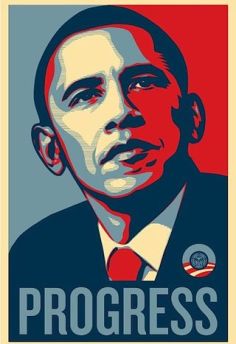
(Image of a special edition Shepard Fairey poster).

Adam And Eve Did Not Literally Exist. Period. Ctd

456px-Albrecht_Du?rer_002

A reader writes:

It's more complicated than saying that Adam and Eve didn't literally exist. It appears that the population of humans at one point diminished to a point where all humans now living are in fact descended from just one woman in the population, dubbed "mitochondrial Eve."  This does not mean that we are all descended from the "first woman," just that we are all descended from the "same woman."  Some Jews and Christians who are not literalists will nonetheless take this as a comforting affirmation of the reality of our common humanity, as will some secular humanists.  At any rate, it is what it is, an emerging scientific fact.

Another writes:

What gets me is that, according to Genesis, there were humans outside of Eden awaiting Adam and Eve.  And, thus, it is completely unnecessary for Christians to ever argue that the entire human race was spawned from Adam and Eve. As a Christian myself, I've become interested in a theory I heard within the last couple of years: that God created Eden as a beachhead on an already fallen Earth. 

The angelic fall preceded the fall from Eden and so the Earth and its inhabitants were already evolving (yes, evolving) in a spiritually-fallen universe.  The opening Genesis narrative is specifically the view from within Eden – a plot of land freshly created (or carved out) to launch God's spiritual plan and battle for redemption.  And the plan, on a spiritual level, required the creation of two, unfallen human beings.  The creation of Adam and Eve within this Eden requires no more of a leap of faith than any other Biblical miracle (think the Immaculate Conception).

This is the Cliff's notes version of the theory, of course.  But it starts us down the road of reconciling science with Christian theology and the actual Biblical narrative.

Another:

The Council of Trent did not state that Original Sin is passed genetically. It is implied because Adam is assumed to be the first man, and his sin is passed to all other people, but it is never stated explicitly. It's kinda strange Mr. Farrell simultaneously describes the teaching as "quite explicit" and "ultimately mysterious".

Papal encylicals are not dogmatic. Pius XII did not explicitly invoke papal infallibility and was not speaking "ex cathedra", or from the chair of Peter. The last case of infallibility is universally believed to be the Doctrine on the Assumption of Mary, in 1950. The views stated may be found interesting to believers but are ultimately not dogmatic.

The current Vatican is not denying anything. They are silent on the issue of Pius XII's view of evolution while maintaining the theological aspects of it. When they are silent on something, that usually means it is being reconsidered or it has already been abandoned.

The Roman Catholic Church is a 2,000-year-old institution. Please, for God's sake, cut them some slack on at least this issue. Institutions don't survive for 2,000 years by willy-nilly changing doctrine on a dime. They'll get there. The human genome wasn't mapped 300 years ago and the Vatican is just dragging its feet. This science is relatively new.

I just want the debate to begin. Because one reason that Christianity is in crisis is that it has failed to engage the modern intellectual world, except to spurn it. But we cannot spurn truth. And if faith is not related to truth, or widely seen to be hostile to it, it suffers.

(Painting: Albrecht Durer, 1507.)
In Search Of Bisexuals

Dan Savage sifts through the findings of a new study (pdf) that contradict a previous study's conclusion doubting dual-sex attraction:

How's this for irony: once researchers controlled for the young-and-temporarily-bi-identified and the gay-and-kidding-themselves-about-being-bi — once researchers refused to accept without question the professed sexual identities of the bi-identified men they recruited, once researchers acted like biphobes and bigots — they were able to demonstrate that "bisexual arousal patterns" actually exist.

Nate’s Data

Worth re-linking for the following stats on Perry. Here's why Rove is rattled:

[I]n an average of eight national polls conducted since July 1, Mr. Perry trails Mr. Obama by an average of 11 percentage points … Over all, Mr. Perry has won his three elected terms with an average victory margin of 13 percentage points. That’s certainly not a disaster, but it lags the 19-point margin for other Texas Republicans running in those years.

In the most recent two elections, Mr. Perry was losing quite a few voters who were voting for Republican for almost every other office.

Iraq Remains Iraq

August 15th was one of the bloodiest days the country has seen in recent memory, but Joel Wing says the Western press has misinterpreated the attacks. Wing insists that "there is absolutely no connection between the day’s attacks and the American withdrawal":

There is violence today with U.S. troops in Iraq, and if they get an extension to stay as trainers there will be violence, and when they go there will still be violence. Every insurgent group wants the foreign forces out, but they also have problems with the Iraqi government, which means they will continue their resistance whether the U.S. is in the country or not. The other problem was that of the 26 attacks that occurred, the police blamed Al Qaeda for only one of them, and only one other was probably their work as well. The reporters seemed to forget that there are several other insurgent groups active in Iraq such as the Baathist Naqshibandi, Hamas al-Iraq, Jaish al-Islami, Ansaral-Sunna, and Jaish Muhammed. Al Qaeda in Iraq is also almost exclusively focused upon high-profile attacks that will gain as much media attention aspossible so that it can raise money. Very few of the attacks on August 16 met those criteria. Overall, the English language media placed their own concerns in their writing, ignoring Iraq’s.

Abercrombie’s “Situation” Situation

The Jersey Shore star donning Abercrombie clothes in the show’s most recent episode appears to have gotten the company’s knickers in a twist:

The New Albany, Ohio company released a statement Tuesday evening titled “A Win-Win Tumblr_lq2ucpnu1D1qay9g8 Situation,” in which it stated a “deep concern” over the association between Mr. Sorrentino and the brand. A&F offered up a “substantial payment” to Mr. Sorrentino “to wear an alternate brand.”

“We understand that the show is for entertainment purposes, but believe this association is contrary to the aspirational nature of our brand, and may be distressing to many of our fans,” the statement read. The company also extended the pay-to-not-play offer to the other Jersey Shore reality stars and said it was “urgently waiting a response.”

The National Post snarks that the contremps “could result in a spike in revenue for Ed Hardy.” Kathy Sweeney somehow manages to construct a list only 10 items long of the Situation’s craziest past incidents.

(Image via Ashley Dominic, who also looks at some other Abercrombie missteps, of a shirt currently on sale at Abercrombie’s website.)

A Republican Apology

“I got in trouble talking about the Federal Reserve yesterday. I got lectured about that yesterday," – Rick Perry, after physically threatening the chairman of the Federal Reserve and calling him a near-traitor.

He sounds like a frat-boy being reprimanded by the dean. Even JPod isn't having it:

Yesterday, in refusing to apologize for what he said, Perry didn’t even suggest he’d been speaking lightly. He said instead that this — Fed policy, presumably — was something about which he’s passionate. That compounded the mistake. It stands to reason that if you’re looking to be the next president and you’re passionate about an issue, you take it with deadly seriousness, you don’t cheapen it. You address it as soberly as you can.

(But note JPod's classic post-modern right view that it is irrelevant whether the remark was indeed evil and wrong. All that matters is that it hurt Perry, therefore the GOP.) I'm with Larry Summers:

“This may be the least responsible statement in the modern history of president politics. While there is room for sharp debate over many economic issues, the economic thinking is primitive, the mention of treason is outrageous and the intimation of violence is abhorrent.”

Obama's response was, alas, milquetoast. Probably smart politics. But shouldn't the head of the executive branch say something when a leading politician physically threatens the Fed chairman and calls him a traitor? Because if these things are left unpunished, the violent rhetoric will only intensify.