
Cape Verde, 1.30 pm
Cape Verde, 1.30 pm
Many readers are asking about an Android app. One writes:
"The Dish app is now up and running." More accurate would be: "The Dish iPhone app is now up and running."
I'm curious why, when Android has a larger market share than the iPhone, publications more readily roll out iPhone apps? My guess would be that iPhone has a more attractive demographic. But perhaps other forces are at work: a greater PR value from associating with the sexy iPhone; a more available pool of iPhone app developers; better intellectual property protections on the iPhone; better contractual terms from Apple?
Not sure, but we asked the Beast techies about getting an Android app and they said "it's definitely a priority for us, and we're hearing that feedback loud and clear." Stay tuned.
Well, it's a theory:
The weaker Obama appears today, the more likely the Republican Party elects a tea party candidate like Bachmann or Perry, and the more likely they are to lose a general election to the president. By contrast, the stronger Obama seems today, the more likely the Republican Party trades in its zeal for strategy and nominates the most electable candidate, Mitt Romney, giving itself its best chance to take the White House.
I can see the strategic sense of this. But Obama only seems weak because he has been stymied by the GOP in the House, and because the severity of this recession was greater than we realized and the short term palliatives consequently mild. At some point, people will demand that something more be done to encourage employment and tackle the debt. If Obama proffers commonsensical ideas that at any other time would have commanded bipartisan support – and gets obstructed yet again – then he's off to Truman-land.
But on the whole, yes, the GOP is currently falling into a classic Obama trap.
I may be wrong but the GOP may be confirming my long-ago expectation that they'd swing to the far right after Obama's election, be given false confidence by a low turn-out mid-term, and then nominate someone essentially unelectable as a national figure.
But in this economy, all predictions are unreliable. The toxic cloud of high unemployment, low growth, and a vanishing middle class will make volatility and populism the norms. Which means that we may not have the full roster of Republican candidates yet.
Kevin Williamson mounts a defense of his Yglesias Award-nominated post from last week:
There’s political reality, and then there’s reality reality. In reality reality, the federal government and at least half the states are headed toward insolvency. Should we let that happen?
If we want to do something about that other than sit on our hands between now and 2013, that means doing a deal with the Democrats. Newt Gingrich is right: John Boehner should call the House back into session today, demand that the subcommittees identify substantial spending cuts, roll them up into a fiscal-consolidation bill (or lots of smaller bills), and dare the Democrats to ignore it. If one of the three leading GOP presidential contenders got behind such a plan, he’d be doing himself and the nation a service. If the price of getting such a bill signed into law is a tax increase, then Republicans should get behind something like the Simpson-Bowles plan, which is a net tax increase but also includes rate reductions and critical reforms to the tax code. You can give the Democrats a tax increase without giving them a class-warfare victory. Why not wait until 2013? For one thing, Republicans might not win in 2012. For another, there is no reason to believe that even under unified Republican government we would get the debt deal we really want: Look what the Republicans did last time around. …
Finally, I’ll defend my use of the phrase “the crazies.” Our country is in a perilous position and desperately needs to rationalize its finances — now, not in a year and a half. To allow an ideologically maximalist position grounded in emotion rather than in economic necessity to preempt doing so is dangerous.
Chait responds to Douthat's fretting over the extreme weakness of the GOP field. Jon also explains his earlier prediction that Pawlenty would receive the Republican nod:
The party base has become sufficiently empowered over the last two years that I think its veto carries more weight than the establishment's; a candidate with the crazy but not the electability (i.e., Michele Bachmann) probably stands a better chance of nomination than a candidate with the latter but not the former (Romney.) That said, I've long thought the nominee would probably be somebody who could do both. That explains my bad horse race pick of Pawlenty, who turned out to be a poor campaigner, but also suffered from a terrible moment in the first GOP debate which sent his campaign into a death spiral from which it never recovered.
Bernstein likewise defends his boosterism of Pawlenty. I think they both under-estimate how crazy the GOP base has become in the face of Obama.
We've been told again and again that the real motivation of the Tea Party is a multi-partisan movement to bring the debt and government under control. I've never believed this, partly because these people were never to be found under Bush. It was primarily a laundering device to disappear the Bush years, re-brand the GOP as a wholly different entity and thereby avoid the long wilderness that the catastrophes of the first decade of this century might have led them into.
Now we have some large data sets to review the reality. And the reality is that the Tea Party is the Christianist right-wing of the GOP.
Early on, Tea Partiers were often described as nonpartisan political neophytes. Actually, the Tea Party’s supporters today were highly partisan Republicans long before the Tea Party was born, and were more likely than others to have contacted government officials. In fact, past Republican affiliation is the single strongest predictor of Tea Party support today… And while the public image of the Tea Party focuses on a desire to shrink government, concern over big government is hardly the only or even the most important predictor of Tea Party support among voters.
So what is? Religious fundamentalism, fueled by racial and cultural panic:
They are overwhelmingly white, but even compared to other white Republicans, they had a low regard for immigrants and blacks long before Barack Obama was president, and they still do.
… Next to being a Republican, the strongest predictor of being a Tea Party supporter today was a desire, back in 2006, to see religion play a prominent role in politics. And Tea Partiers continue to hold these views: they seek “deeply religious” elected officials, approve of religious leaders’ engaging in politics and want religion brought into political debates. The Tea Party’s generals may say their overriding concern is a smaller government, but not their rank and file, who are more concerned about putting God in government.
So Bachmann is not such a fluke, is she? Or a flake, for that matter. And Perry was smart to launch his campaign with a no-Catholics-please evangelical prayer rally (to balance his otherwise corporate cronyism appeal to some business interests). And Romney really can't compete. The only one who could at this point? Palin. For the same reasons as Perry and Bachmann. And she's very very tight with Perry.
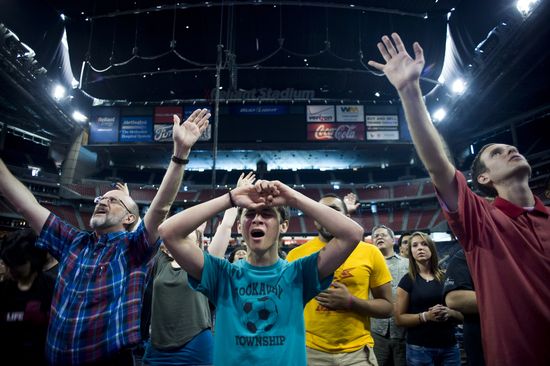
(Photo: Cody Walsh, 18, (C) stands with arms raised in a crowd of attendees as they dance and sing during the opening musical act of the non-denominational prayer and fasting event, entitled 'The Response' at Reliant Stadium August 6, 2011 in Houston, Texas. Thousands attended the event organized by Gov. Rick Perry in order to pray for God to help save 'a nation in crisis' referring to America. By Brandon Thibodeaux/Getty Images.)
A reader is echoing many:
Look, I'm against Perry and everything he represents. Not only were his statements regarding Bernanke unpresidential, they were downright moronic. But he came nowhere close to calling for or supporting a Texas lynching for the Fed Chairman. Yes, Perry claims that Bernanke is guilty of a capital offense, but that is light years away from advocating Texas justice outside the confines of the law. Furthermore, "Treating him ugly" does not have plain meaning as you suggest. It is subjective language carrying different meanings for different people. Indeed, a lynching is the last thing I would imagine when hearing the expression.
Here's the actual quote:
If this guy prints more money between now and the election, I dunno what y’all would do to him in Iowa but we would treat him pretty ugly down in Texas.
Notice the obvious physical threat: "do to him". Not "say to him", but "do to him." Not "I'd do" something to him, but "we" would. And when someone says "we'd" like to "do" something "pretty ugly" to a public official – with a reference to Texas lore, where lynching was once commonplace, I'm sorry but this was a threat of violence, especially in the context of a capital offense which could go unpunished.
This was a threat of a lynching. It's one of the most disgusting things I've heard from a public official in a long time. It's disturbing how the media decided that "treasonous" was the great offense here, when it wasn't even close. And the thug still hasn't apologized.
Can you imagine what would be said if Obama said anything like that? Drudge would be offering photos of black rioters and thieves for weeks on end.
Steve Kornacki pushes back against the Dish's media critique:
[Ron Paul] grabbed 10 percent in Iowa, good for fifth place, and 8 percent in New Hampshire, another fifth-place showing, and that was pretty much it. The media filed this under lesson learned: Paul's supporters could make a lot of noise — but it was misleading noise. This is why his string of straw poll successes in the past few years — including last weekend's — hasn't gotten much notice. And this is probably the way it should be, until and unless Paul can demonstrate that these performances are anything but the product of his army mobilizing for relatively low-turnout events and producing deceptively impressive results. So far, there's not much evidence for this.
A reader has similar thoughts:
You wonder why the media doesn't give more coverage to Ron Paul's candidacy. Best way to explain it is because Paul's support is a mile deep and an inch wide.
Paul finished strong in the 2007 Iowa Straw Poll, pulled in nearly $20 million in the last quarter of 2007 and was the leading fundraiser in the GOP field that quarter. But his 2008 campaign was notoriously disorganized and probably as much a reason for his inability to get media coverage as any alleged bias reporters had against him. He spread his ad buys thinly over several states prior to Super Tuesday and failed to make a significant dent in any, then told his supporters he would split time between his presidential and congressional re-election campaigns. This, even though there was a month to go before McCain secured the nomination.
Paul has two problems. One is that he's made several statements that he's less interested in winning than spreading his ideas. That's fine for him, but a political party wants its standard bearer to be a conqueror, not a philosopher. More importantly, most Republicans aren't libertarians. They're strong religious conservatives who don't see Paul speaking to them the way Bachmann and Perry do; or they're business people who might like his anti-tax message but know his demands to end the Fed would plunge us back into a 19th century cycle of boom and bust. Paul can't make either group believe in him enough to support him in a general election. To see a serious Paul candidacy, they'll have to move or he will.
Another reader focuses on policy:
I wonder if Paul's difficulty isn't that he takes many positions that are anathema to today's mainstream Republicans and conservatives. I wonder if it is that he's so adamant about cringe-worthy positions such as the return to the gold standard. It makes him, frankly, come off as a doddering, wild-eyed loon (see his questioning of Bernanke earlier this summer), immune to reason regarding certain positions he's come to see as sacrosanct. Few economists that I've read think the return to the gold standard would be anything less than a disaster, yet Paul continues to stubbornly bash on about it.
He certainly makes good points about the waste of blood and treasure we've seen in the last decade, but those good points get drowned out by his almost ludicrous adherence to select claptrap.
Howard Gleckman reviews it:
Bottom line: While Perry is no fan of taxes, neither has he been an absolute opponent of all tax increases all the time.
Bottom bottom line: Rick Perry may be too liberal for today's GOP.
Watching Perry schmooze with primary voters in Iowa, Will Wilkinson previews the right-wing attack on Perry:
Mr Perry is a big-spending, lobbyist-loving, Al Gore-supporting ex-Democrat who is all pork and no tricorne.
Michelle Malkin is incensed by his HPV vaccine decision:
While Perry and his campaign staff have now paid lip service to making a “mistake” in shoving the executive order down families’ throats, they remain defiant in defending the decree and Perry’s zealous, big government overreaching. From the latest story on Perry’s “reversal” in the Washington Post: “Perry campaign spokesman Mark Miner dismissed the criticism. Governor Perry has always stood on the side of protecting life, and that is what this issue was about…”
Oh, no it wasn’t. Please read this, get informed, pass it on, and make sure that you don’t fall for a purported cure to our political ills that’s worse than the power-grabbing disease in the current White House.
Nate Silver rounds up widespread conservative attacks on another front – electability:
The speech by Gov. Rick Perry of Texas to announce his presidential candidacy on Saturday got generally favorable reviews, but it did not take long for some influential Republicans to become overtly skeptical about what Mr. Perry might do for the party in November.
The Wall Street Journal editorial board lumped Mr. Perry into the same category as Michele Bachmann and questioned his appeal to swing voters. Karl Rove critiqued Mr. Perry’s impolitic remarks about the Federal Reserve chairman, Ben S. Bernanke.
And in perhaps the clearest indication that the Republican establishment wants to hedge its bets against Mr. Perry, there were renewed calls for another heavyweight candidate — like Representative Paul D. Ryan of Wisconsin — to enter the race.
Jennifer Rubin piles on.
(Charts from a post on Pennsylvania for Palin retweeted by Sarah herself.)
 The Dish