The Threat To The Fed

Like Ezra, Neil Irwin worries that Perry's extremism will politicize monetary policy:

[T]he attack from Perry and others in the race for the Republican nomination does complicate the Fed’s job ahead. The central bank is supposed to make its decisions in response to economics, not politics. But officials will be reluctant to do anything that puts the Fed in the crosshairs of what is sure to be a polarizing presidential election. That being the case, Fed leaders might be more receptive to tools to ease monetary policy that don’t come across as "printing more money."

Yglesias differs somewhat:

I think that insofar as it seems likely that Obama will be opposed in the 2012 general election by someone who regards Bernanke as a traitor and who evinces fundamental ignorance of the role of a modern central bank, that this will tend to neutralize any pro-Republican prejudice that may exist in Bernanke’s mind.

Heh.

How Does Murdoch Survive This?

He can try and argue that he was ignorant of the crimes; but he cannot deny responsibility for the cover-up. And a classic cover-up it was. A critical piece of evidence, a letter from one of their chief phone-hackers, was edited to remove the money parts:

As Marian Wang, a blogger for ProPublica, points out, another copy of Mr. Goodman’s letter was also supplied to the parliamentary committee by News International, in response to a request from the panel. What is most interesting about the version that News International produced is that it omits more than just names from the letter — two entire sections of Mr. Goodman’s letter are missing. Both sections relate to Mr. Goodman’s claim that the newspaper’s editor, Mr. Coulson, and its senior lawyer, Tom Crone, had assured the reporter that he would not lose his job as long as he “did not implicate the paper or any of its staff,” during his trial.

This is obstruction of justice, it seems to me. Here's the section that someone high up at News International removed before handing it to the parliamentary committee tasked with looking for evidence that hacking was more widespread than a lone rogue reporter:

iii My conviction and imprisonment cannot be the real reason for my dismissal. The legal manager, Tom Crone, attended virtually every meeting of my legal team and was given full access to the Crown Prosecution Service’s evidence files. He, and other senior staff of the paper, had long advance knowledge that I would plead guilty. Despite this, the paper continued to employ me. Throughout my suspension, I was given book serialisations to write and was consulted on several occasions about royal stories they needed to check. The paper continued to employ me for a substantial part of my custodial sentence.

iv Tom Crone and the Editor promised on many occasions that I could come back to a job at the newspaper if I did not implicate the paper or any of its staff in my mitigation plea. I did not, and I expect the paper to honour its promise to me.

Coulson is toast.

Is Perry A Neocon Or A Tea Partier?

Jacob Stokes senses tension:

The thing that demonstrates most clearly how Perry’s tendencies as governor reject neoconservative thinking are his actions to win business from Venezuela and China. Neocons would isolate those regimes, especially if the nature of said business carries national security concerns, as oil from Venezuela and communications technologies from China do. … On foreign policy, Perry’s writings and his advisors don’t square with Perry’s actions as governor and the positions of his Tea Party backers. If advisors and campaign biographies are destiny, the Tea Party will have some real problems with Perry when as he begins to develop and explain his positions on foreign policy.

Casting The President

84196941

Cringing at Richard Cohen's claim that Perry, unlike Bachmann, "actually looks like a president", Steve Benen begs the legacy media to "catch up":

I realize perceptions like these become ingrained over the course of many decades, and these media observations are not intended to be racist of misogynistic. Handsome, middle-aged white men have been the presidential norm for generations. I get that. But the larger point is this: observers accustomed to the old way are going to have to change their perceptions. I don’t know whether Barack Obama "looks like a president" by the standards of the media establishment, but I do know he is the president, which necessarily changes what it means to look like one. Hillary Clinton may not have been out of central casting, but she very easily could have been elected, too.

Jonathan Bernstein buries Cohen's cultural view even further:

Yes, once upon a time movie presidents all looked like Henry Fonda and Walter Huston. But a quick check of wikipedia reveals that recent presidents have included Danny Glover, Blair Underwood, Louis Gossett, Jr., Chris Rock, Michael Dorn, Morgan Freeman, Jimmy Smits, Geena Davis, Patricia Wettig…do I need to go on? […Y]es there are still plenty of James Cromwells and James Caans, but Hollywood loves its black presidents, and is gradually getting used to the idea of women in the White House, too. Which means that Richard Cohen is not only years behind reality, but he's also years behind where the rest of the culture is.

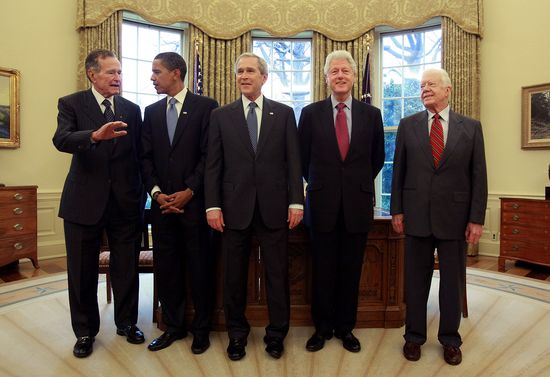
(Photo: US President George W. Bush (C) stands with President-elect Barack Obama (2nd L), former President George H.W. Bush (L), former President Bill Clinton (2nd R) and former President Jimmy Carter (R) in the Oval Office of the White House in Washington, DC, on January 7, 2009. Bush, acting on a suggestion by Obama, invited the former Presidents and President-elect for lunch, the first time since 1981 that all living presidents have been together at the White House. By Saul Loeb/AFP/Getty Images)

Is Social Security A Ponzi Scheme? Ctd

A reader writes:

What a silly argument made by Indiviglio.  If a Ponzi scheme is "an economic arrangement where the money paid into the system by later entrants is paid right back out as benefits to earlier entrants," that pretty much describes any form of insurance. The defining characteristic of a Ponzi scheme is that it is unsustainable, because it requires, like a chain letter or Amway, a geometrically increasing number of participants to deliver the promised returns.  (Amway stays afloat because most participants pay in a little – or a lot – but withdraw without ever receiving any return.) Neither insurance nor Social Security requires a geometrically increasing number of participants so long as the system is funded based on sound actuarial principles.

Another parses further:

Having represented the victims of actual Ponzi schemes in court, I feel compelled to point out an important distinction between Ponzi schemes and Social Security: a Ponzi scheme is just that, a scheme. The definition provided in Zaid Jilani's dictionary omits this important component. The participants are kept in the dark about how the benefits are obtained. Thus, a Ponzi scheme is not really an economic "arrangement" in the sense that the participants have agreed to it. By contrast, we all know (or should know) how Social Security works. It is more akin to something else, namely an insurance program where the insured event (reaching the retirement age) is guaranteed (barring premature death).

Another:

So if Social Security were a Ponzi scheme, Michael Astrue, current head of the SSA, would take from current payers, skim off a huge amount, live lavishly, pay earlier investors outrageous returns, and then go bankrupt at the next downturn.  I’m sure Astrue makes a decent salary, but the administrative cost of Social Security is 0.39% (see how many mutual funds have expense ratios that low), and the returns to retirees are modest.

Another:

The problem with a Ponzi scheme is that, at the sorts of exorbitant rates of return that are generally promised in a successful Ponzi scheme (see Madoff, Bernie), Ponzi schemes are unsustainable on a long-term basis.  They require the investment base to grow much, much faster than the population which inevitably becomes impossible at some point.

Yet another:

In a Ponzi scheme, the organizers of the fund don't have the power of taxation and don't have any actual vehicle to earn money. But the government has both; they can increase taxes to pay for Social Security, and they can adopt measures to make the economy grow, such as by increasing immigration. Notice that there is no difference between the populace paying for its retirement through private investment and paying it for it through taxes for Social Security; either way assumes that there will be enough growth to support a group of non-working people in addition to supporting the working people.

Another:

Even if you think that the "fund as you go" approach somehow made Social Security a Ponzi scheme, it hasn't been that way since the 1980s.  The 1980s reforms specifically adopted a model in which a surplus was built up to help cover expenses in the future.  In other words, and unlike a Ponzi scheme, a lot of the money being paid out today and for the next 30 years will effectively be returned to the people who put it into the fund.

One more:

It is time to step back and do some rational thinking on this topic. There is in the neighborhood of $2.5 trillion in the Social Security "Trust Fund," although this fund is roundly skewered by critics. Yet there have been huge surpluses in the past that have built up this value, so the basic Ponzi assumption of money coming in barely keeping ahead of money going out is false on its face.

So let's think about this.  If you had a trust fund backing up your private pension, where would you invest it to best insure that you will have it when you need to retire?

1. In the stock market? Many people do, but many also saw their trust fund drop in half in value very recently. Not very secure. Plus, what would be the value of the U.S. stock market if the U.S. government collapsed, and was unable to pay it's bills? It would surely drop by even more than half very quickly.

2. In gold?  Gold lost half of its value during part of the Reagan administration, and it may well do that again now that Glenn Beck is less able to pump the fear of global collapse required to keep the price up.

3. In foreign investments? Maybe for you, but I doubt any Tea Party Republican would stomach that.

In reality, if you really want to be as safe as one can reasonably be in this world, you would do exactly what the international markets did the day after the debt downgrade. Invest in the safest securities in the world: U.S. Treasury debt, which is where the Social Security Trust Fund is currently invested.
The Barbarous Closet

A reader writes:

Ok.  This will sound corny.  But last night I watched "Behind the Music: Ricky Martin" on VH1 and I could not help but think of Michele Bachman the entire time.  It is easy to see how, given her and her husband's limited interaction with the gay community, she would believe that living as a gay man or woman is filled with personal despair, bondage and enslavement.  That is exactly how the closet feels.  Perhaps that is how Marcus Bachman's patients report feeling and continue to feel as a result of his "treatment."

But Ricky Martin's heartfelt interview was true testament to how one's self acceptance can shake off the sheer terror and sadness that comes with hiding one's sexuality and trying to live a life that is inauthentic to how God made you.

The pure relief in his voice, his face when he spoke of the moment of coming out was truly inspiring.  He stated that he wished he could come out again because it felt so good.  Here is a man who, by all accounts, had everything – he's gorgeous, sexy, talented, rich, famous, respected and adored.  But despite it all, he couldn't be happy until he lived his life in honesty.

Michele, look at this man's face as he talks.  Is this man in despair; personally enslaved?  I think not.