Sheltered From Risk, Ctd

by Patrick Appel

A reader defends government flood insurance:

Why does the public favor federally subsidizing the risk taken by homeowners and residents in flood-prone areas? From the view of basic human psychology we probably favor helping people out when their homes & livelihoods are at risk, and most people are not going to put a lot of energy into stripping away such protections. People will live near water, and I would hypothesize that many of us would rather help out than see mass bankruptcies after a flood. Surely this is as worth while as some semi-useless defense system that employees an entire town for its construction. But there is a stronger argument.

From the point of view of the nation's general welfare, we all reap enormous benefits from having people live along the coasts and shores, both in the history of building our nation as a great power and moving forward (generally, if not specifically in every community that is at risk.) There is a reason that settlements have always tracked waterways, the enormous economic benefit of having ports for shipping and transportation.

Maybe I'm off-base, but it seems to me we would all have to pay more for importion/exporting goods if everyone in low lying areas had to travel an extra 30 miles to get to work. And oil exploration around the Gulf would be a lot for more expensive. This is true not just of oceans and the Gulf but also the Mississippi. (Maybe that explains it; it's because first-in-the-nation primary Iowans need flood insurance).

Not everyone will benefit equally from this wealth and welfare enhancement, and not all who benefit from the subsidy "need" it. But from my perspective it is overall better for the nation. This is pretty standard for federal programs, and I am in favor of efforts to more narrowly target recipients of federal subsidies to better track our actual policy priorities. But the fact that this is more so a way to deal with already existing conditions (large populations living in flood-prone areas) makes it even more reasonable to support. This, of course, if a vision for solving the collective-action problem that the modern Republican party rejects (in-land/high-ground free riders on value created by at-risk for flooding communities and commerce). I'm amused to see progressives such as Yglesias also fail to see the broader context for subsidizing some of the risk for coastal communities.

Kevin Drum makes related points. Another reader:

I work in the insurance industry and have been asking for years why do FEMA flood policies cover second homes? I am ok with subsidizing homes for a flood loss but have a real problem subsidizing anyone's second home. I know the cost of a flood policy with a standard or excess insurance market would be very expensive or maybe even impossible to find but why is that FEMA's problem? If you can't afford to insure your second home then you shouldn't own one. This is a form of government welfare for affluent citizens.

What irritates me is that some politicians are now calling for reducing or eliminating FEMA help during natural disasters. I bet they won't look at dropping policies for second homes because too many of their wealthy constituents will raise hell to keep their cheap subsidized insurance in place.
Weather And War, Ctd

by Zack Beauchamp

Ed Carr pours cold water all over the "weather oscillations cause violence" paper I looked at last week:

This paper is a mess.  But it got into print and made waves in a lot of popular outlets (for example, here and here).  Why?  Because it is reviving the long-dead corpse of environmental determinism…people really want the environment to in some way determine human behavior (we like simple explanations for complex events), even if that determination takes place via influences nuanced by local environmental variation, etc.

 Environmental determinism fell apart in the face of empirical evidence in the 1930s.  But it makes for a good, simple narrative of explanation where we can just blame conflict on climate cycles that are beyond our control, and look past the things like colonialism that created the foundation for modern political economies of conflict.  This absolves the Global North of responsibility for these conflicts, and obscures the many ways in which these conflicts could be addressed productively.

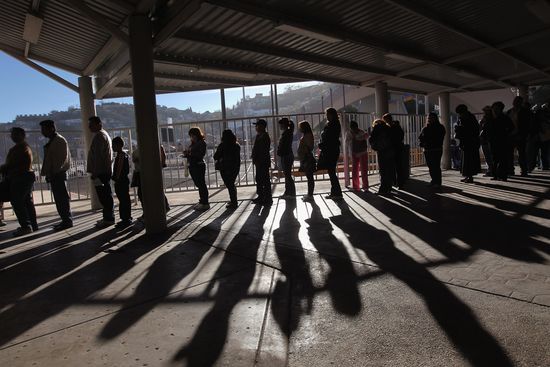
Should We Charge For Immigrant Visas?

GT_IMMIGRATIONLINES_110830

by Zoë Pollock

Yes, argues Alex Nowrasteh, promoting an immigration tariff:

A tariff makes the process more predictable and timely because it focuses on one factor — money. Instead of relying upon the arbitrary decisions of bureaucrats or lotteries, immigrants have a benchmark they can reach. They can save, borrow money, or have their employers pay the tariff with the certainty that, unless they are criminals or very ill, they will be able to enter the U.S. to work, start a business, and build a life.

The immigration tariff is pushed by Nobel Prize winning economist Gary Becker, but its central concept dates back to the birth of modern economics. In The Wealth of Nations, Adam Smith endorsed a tax on wool exports. It's not that he supported the tax, but rather saw it as an improvement over Britain's outright ban on the export of wool that existed at the time. He was right. A tariff, while surely imperfect, is a great big step toward stimulating economic growth and raising revenue.

Something about charging people for the opportunity for a better life rubs me the wrong way, but our immigration system is undeniably broken. Would this actually help?

(Photo: Hundreds of people wait to pass from Mexico into the United States at the border crossing on December 10, 2010 at Nogales, Arizona. By John Moore/Getty Images.)

Today In Overregulation

by Zack Beauchamp

Apparently New York City has banned bringing dogs to bars, even if you're sitting outside. Thom Lambert makes the principled case against the law:

 We classical liberals are often criticized for undermining communitarian values by emphasizing individual liberties.  In reality, though, a liberal society (in the classical sense, not the welfare-state sense) fosters community by allowing people to associate in ways they find most meaningful.  … Nothing builds community better than a collection of spaces — bars, coffeshops, diners, etc. — where neighbors can go to relax, converse, and share their lives.  And nothing is more likely to keep people coming back and to get them talking to each other than to allow them to bring their dogs.  If you don’t believe me, head down to your local dog park and watch people interact.  Nobody’s a stranger at the dog park. 

Ilya Somin concurs. This sort of regulatory overreach is a clear area where liberals and libertarians have far more in common with each other than either conservatives or illiberal leftists who prioritize public morality and values over individual liberties. But I'd rather stay away from the political philosophy for the moment, and say "fuck that!" to the city telling me where I can and can't take my dog.

Targeting Perry’s Weak Spot

by Patrick Appel

Marc Thiessen claims that Romney will attack Perry by arguing that "Perry is against the very idea of Social Security and Medicare." Allahpundit looks past the primaries:

If Perry beats Romney for the nomination … then the DNC has a golden attack line handed to them: “Rick Perry is so radical on Medicare that he even scares other Republicans,” punctuated by a shot of Romney attacking Perry on those grounds at one of the debates. It would be devastating. Even if Perry tries to explain it away, the fact that he’d be on the defensive on this issue of all issues would be trouble.

Mataconis nods.

An Eid Uprising

by Zack Beauchamp

Syria has been rocked by significant protests today. The government's response was predictably murderous. Daniel Serwer lists some ideas for how to hasten Bashar's fall:

The international community needs to reward and encourage those among the protesters prepared to keep to nonviolence and maintain unity of purpose.  Monday’s formation of the Syrian National Council (SNC), an analogue to the  Transitional National Council that has become the post-Qaddafi governing structure in Libya, is a good development.  It will need wholehearted moral and financial support from Europe and the United States, though at this stage formal recognition would be premature.

Dov Zakheim predicts an Alawi revolt against Assad. Terry Glavin examines how economic maladies are fuelling the revolt.

Match.com For College

by Patrick Appel

Kevin Carey checks in on the college admissions process. He touts ConnectEDU, a website that will use data to match students to colleges "in the same way that Amazon uses millions of sales records to advise customers about what books they might like to buy and Match.com helps the lovelorn find a compatible date":

This won’t just help the brightest, most driven kids. Bad matching is a problem throughout higher education, from top to bottom. Among all students who enroll in college, most will either transfer or drop out. For African American students and those whose parents never went to college, the transfer/dropout rate is closer to two-thirds. Most students don’t live in the resource-rich, intensely college-focused environment that upper-middle-class students take for granted. So they often default to whatever college is cheapest and closest to home. Tools like ConnectEDU will give them a way to find something better.

He goes on to imagine other facets of a vastly more efficient college admissions process.