Biblical Literalism Is Literally False

The latest news from actual historical study of the Jewish Scriptures. Just one small detail:

The Book of Jeremiah is now one-seventh longer than the one that appears in some of the 2,000-year-old manuscripts known as the Dead Sea Scrolls. Some verses, including ones containing a prophecy about the seizure and return of Temple implements by Babylonian soldiers, appear to have been added after the events happened.

Trapped, Ctd

As Douthat surveys the extremely weak GOP field and turns his lonely eyes to Chris Christie, Jonathan Bernstein reminds us that the party has a bigger problem:

There’s no one else out there on the horizon who has been doing the sorts of things one has to do to run for the Republican nomination for president. Anyone else — Chris Christie, Paul Ryan, whoever — would be starting from scratch, very late in the game.

The other thing I’d say to Republicans disappointed in the current choices…is this: What you’re upset with isn’t the candidate — it’s the party. It’s inconceivable that anyone could get the Republican nomination while using anything but solid Tea Party rhetoric on pretty much every issue. They’re all going to claim that taxes should never, ever, ever be raised no matter what, that half of what the government does is evil or unconstitutional or whatever, that the scientific consensus on climate is some sort of crazed conspiracy, and so on down the line…That’s what the Republican Party is right now, and that’s what their nominee is going to say. So no saviors need apply.

“Perry Is Not An Idiot And Not An Ideologue”

GT_PERRY_110816

Erica Grieder defends him (before the Ben Bernanke news):

He has been criticized from the right on immigration, for example–immigration being an issue where Texas is considerably more liberal than the nation as a whole. In 2001, for example, he signed legislation that allows undocumented Texan students to qualify for in-state tuition at state colleges and universities, and he has defended it recently. …

What does get Perry going is economic issues. His strongest ideological commitment is to small-government conservatism–although he's not pure on that either, because he will engage in some tacit industrial policy if it's a matter of boosting job creation. He is first and foremost a business conservative, and once you understand that about him, everything else makes more sense.

That’s why, for example, he’s a big booster of renewable energy even though he’s a climate change sceptic and doesn’t want the EPA to regulate greenhouse gas emissions. That’s why he wanted to build the Trans-Texas Corridor and why he is so enthusiastic about tort reform. That’s why he seems to spend most of his workday trying to poach jobs from other states. That’s why he doesn’t have a very aggressive stance against illegal immigration. That's why he'd rather cut education spending than close tax loopholes.

(Photo: Texas Governor Rick Perry puts his hand on Defense Secretary Robert M. Gates as they chat on arrival in the East Room for a dinner at the White House February 25, 2007 in Washington DC. President George W. Bush held a State Dinner at the White House in honor of the nation's governors. By Mike Theiler-Pool/Getty Images.)

Is Social Security A Ponzi Scheme?

Reacting to Perry's repeated claims, Zaid Jilani consults the dictionary: 

A Ponzi scheme is an economic arrangement where the money paid into the system by later entrants is paid right back out as benefits to earlier entrants. None of these social insurance programs that Perry mentioned fit this definition. They benefit those who pay into them with guaranteed benefits.

Daniel Indiviglio perks up:

Wait — what? Social Security fits that precise definition.

It was created during the Great Depression by President Franklin D. Roosevelt. Retirees began receiving benefits immediately, without having paid into the program themselves. Those benefits were paid by taxing current workers. So, in fact, Social Security is technically identical to the definition of a Ponzi scheme that Jilani provides. 

But what about those "guaranteed benefits"? Don't those make a difference? Well, let's think about this. Imagine if an investment advisor came to you and said:

"Hi there! I want to sell you a retirement vehicle for which you will be provided a guaranteed benefit of x dollars per year after the age of 65. But the money you contribute will be paid to current beneficiaries, while your money will be paid by future beneficiaries. If there's ever a shortfall, we'll just borrow money from China in order to keep the guaranteed benefits coming — or force future contributors to provide more money. Alternatively, we might increase the age at which you'll receive benefits. And we might even think about means testing your benefit."

All of those supposed "guaranteed benefits" sure come with a lot of caveats, don't they? Is it even fair to call those benefits guaranteed? For all we know, the U.S. could continue to run into deficit problems for the next few decades and could feel compelled to do away with Social Security altogether.

Comparing Bush And Perry

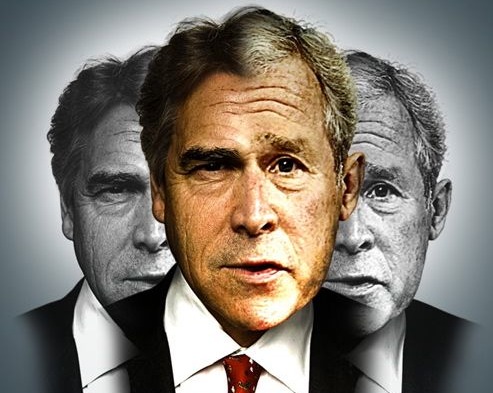
Bush-perry

A reader pushes back:

You keep trying to conflate the two, but at this point in his career Bush was nothing like Perry. Governor Bush worked closely with Lieutenant Gov. Bob Bullock and Speaker Pete Laney, both Democrats. When Bush announced his presidential run, members from both sides of the aisle flocked to endorse him.  Granted, he had a hot economy and Democratic majorities to deal with, but he went into it with an attitude of conciliation and compromise.

Perry, on the other hand, has never worked with the opposition.  

He fully supported the mid-decade redistricting that all but eliminated white male Democratic office holders in 2003, sent the Democratic senators fleeing out of state to avoid a quorum.  Twice, in 2003 and 2011, he faced massive deficits which he closed through cuts, eviscerating health and human services and more than doubling college tuition rates across the state in 2003 and cutting $4 billion from public education this year, while refusing to touch a $9 billion rainy day fund the state has in the bank. But he didn't cut the economic development fund he uses for corporate welfare. 

He is an phenomenal campaigner.  His opponents react to him like squirrels to rattlesnakes, completely freezing.  He can skip debates with no repercussions.  He can brag about public education while forcing the layoffs of 100,000 teachers in a state that ranks 45th in SAT scores and has no vocational education. He brags about creating jobs and gets great credit even though most of them are low paying and we've lost jobs in his tenure overall. He allows an innocent man to be executed and brags about it, then fights DNA testing on another death-row inmate that would tell us if he's guilty or if the real killer is still roaming the streets.  The hurricane evacuation during Rita in 2005 was a clusterfuck beyond all belief (only the fact that it veered slightly east at the last minute let us avoid a 5-figure body count) with buses of refugees being sent back to the storm zone. He denied there were any problems and blamed the traffic jams on lack of contra flow. 

Bush was bad for this country, but Perry would be a disaster. His policy is written by the business lobby.  Anybody who thinks Perry has any competence at all is just deluding themselves.  It's not his Christianism that's so scary; it's his actual performance in office. Even Palin has worked with Dems before and has taken on the entrenched powers, even if it was out of selfish purposes.

On that note, Benjy Sarlin spotlights one of Perry's political blunders in Texas – issuing an executive order imposing HPV vaccinations on sixth-graders – that raised the ire of both Democrats and Republicans.

(Image by Mario Piperni)

Iraq, The Failed Neocon Experiment, Ctd

Matt Duss buries Abe Greenwald's attempt to lay claim to the Arab Spring as a child of Bush's war:

It’s probably a devastating enough rebuttal just to note that that quote from Fouad Ajami, one of the Iraq war’s most committed cheerleaders, constitutes the entirety of Greenwald’s evidence that the Iraq war spurred the democracy movements throughout the Arab world.

This is understandable, as there is no real evidence for the claim. Arabs themselves clearly don’t agree, as all available polling shows the war to be overwhelmingly unpopular in the region. An April 2010 RAND study also concluded that, rather than encouraging reform, "Iraq’s instability has become a convenient scarecrow neighboring regimes can use to delay political reform by asserting that democratization inevitably leads to insecurity."

Examining the claim in an article back in July, the Council on Foreign Relations’ Steven Cook concluded, "It is time to put the Bush boosters’ arguments where they belong: in the trash heap of discredited ideas."

Pay Attention To Paul!

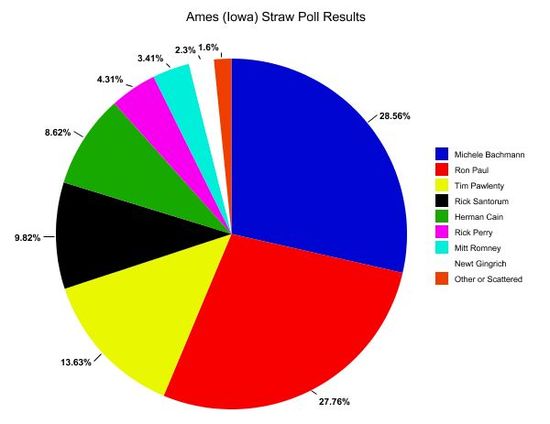
Ames-chart

Washington Examiner's Tim Carney is angry at the media for ignoring Ron Paul's showing in Iowa:

Paul came within one percentage point of straw poll victor Michele Bachmann at Ames, and scored more than twice as many votes as third-place Pawlenty. … So, again, why doesn't Paul get the attention he seems to deserve? Mostly because the mainstream media and the Republican establishment wish he would just go away. One reason the bipartisan establishment finds Paul so obnoxious is how much the past four years have proven him correct — on the housing bubble, on the economy, on our foreign misadventures, and on our national debt.

Jon Stewart was hilariously on-point on this last night. It's not his domestic views that upset the establishment; it's his daring to broach the catastrophe that is the Bush legacy in foreign affairs. But in so many ways, he should be the candidate of the moment, as this tongue-in-cheek video shows:

Carney's colleague Philip Klein, like the WSJ, tries to swat away the libertarian gadfly:

In last Thursday’s debate, Paul dismissed the significance of Iran getting nuclear weapons (a radical regime that has called for "Death to America" and wiping Israel off the map). To be clear, it isn’t a matter of him being against sending troops to Iran, or bombing Iran — he is even against imposing sanctions, or taking any other actions to attempt to stop them from getting nukes. He also warned that assassinating terrorists would "translate our rule of law into a rule of mob rule." In May, Paul said that he wouldn't have ordered the raid that killed Osama bin Laden because "it was absolutely not necessary." This is just a small inkling of the positions he’s taken recently.

Derbyshire sides, in a somewhat confused fashion, with Carney.

(Chart by Alex Holzbach)

Perry In Boots

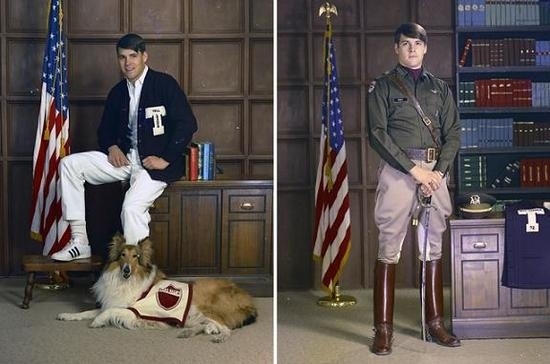
Rick-perry-texas-am-class-photo-1972-20503-1313369786-41

Buzzfeed is circulating some hot but hilarious class photos:

When Rick Perry arrived at Texas A&M University in 1968, it was at the end of a summer in which Soviet troops crushed the Prague Spring, protesters at the Democratic National Convention were met by a police riot, and the United States reeled from the twin assassinations of Martin Luther King Jr. and Robert F. Kennedy. With its conservative culture, military tradition, and focus on agriculture, few places in the U.S. might have seemed more insulated from the prevailing currents of the age than in College Station, Texas. But A&M was in the midst of its own political awakening …

Also, the parallels with Dubya are getting uncanny:

[Perry] was a member of the Corps of Cadets, a member of the Alpha Gamma Rho fraternity and one of A&M's five yell leaders (a popular Texas A&M tradition analogous to male cheerleaders).[11] … According to Perry's university transcript, he earned 20 B's, 27 C's, and 9 D's. … Perry was a prankster in college. He once placed chickens in the closet of an upperclassman over Christmas, and also utilized M-80 firecrackers and knowledge of plumbing to frighten students on the toilet.[15]

[I changed my original title for this post, as riding boots don't qualify as even "preppy" jackboots. But I always get a little disturbed by a man in boots that high and jodhpurs.]

Rick Perry’s Unemployment Record

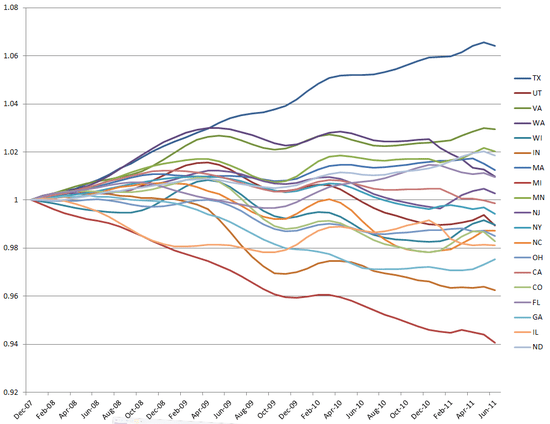
An eye-popping graph which provides some serious perspective. Take away the oil price boom and government jobs and it's pretty dismal. But this post contains much more information and shows real buoyancy in Texas' economy, not only caused by the oil boom, and an unemployment rate inflated by an influx of new residents. This graph of population growth for many large states in the current recession is just as eye-popping:

PopulationGrowthIncreaseBig