Pakistan’s Latest Betrayal

As was widely predicted at the time, Pakistan almost certainly allowed China access to the wreckage of the state-of-the-art helicopter in the OBL raid. Con Coughlin shows how stupid this was:

For a country that is supposed to be a key ally of Washington – and is the recipient of billions of dollars of American aid – this represents a serious breach of trust on the part of the Pakistanis. Islamabad cannot expect to be a key ally of Washington while at the same time indulging in open acts of treachery. Congress is already angry with Pakistan for not doing more to track down bin Laden, who was allowed to live with impunity on Pakistani soil for the best part of a decade.

Noah Shachtman downplays an inspection of the aircraft and is more concerned with whether Chinese officials were able to take away samples, namely a piece of the stealth coating. Either way, Walter Russell Mead sounds the death knell for the US-Pakistan alliance.

An Idle Mind Is The Writer’s Workshop

Christian McEwen draws a connection between creativity and free time:

"I have a basic indolence about me which is essential to writing," [the short story writer Grace Paley] said in an interview. "It really is. Kids now call it space around you. It's thinking time, it's hanging-out time, it's daydreaming time. You know, it's lie-around-the-bed time, it's sitting-like-a-dope-in-your-chair time. And that seems to me essential to my work."

Such testimony is not just plain good sense; it is good science too.

In a recent article in Discover magazine, the journalist Stephen Johnson reported on a conversation with neuroscientist Antonio Damasio. The cognitive part of our brain works very fast, Damasio explained. "So you can do a lot of reasoning, a lot of recognition of objects, remembering names in just a few hundredths of a second." But the emotional part of our brains works very differently, and there is precious little evidence that this is going to change. Tasks that have to do with empathy and imagination, with slow-growing qualities like love and fidelity and ethics, will continue to develop in their own sweet time.

Rescuing Capitalism From Itself

Nouriel Roubini worries about the state of the global marketplace:

So Karl Marx, it seems, was partly right in arguing that globalization, financial intermediation run amok, and redistribution of income and wealth from labor to capital could lead capitalism to self-destruct (though his view that socialism would be better has proven wrong). Firms are cutting jobs because there is not enough final demand. But cutting jobs reduces labor income, increases inequality and reduces final demand.

Recent popular demonstrations, from the Middle East to Israel to the UK, and rising popular anger in China – and soon enough in other advanced economies and emerging markets – are all driven by the same issues and tensions: growing inequality, poverty, unemployment, and hopelessness. Even the world’s middle classes are feeling the squeeze of falling incomes and opportunities.

To enable market-oriented economies to operate as they should and can, we need to return to the right balance between markets and provision of public goods. That means moving away from both the Anglo-Saxon model of laissez-faire and voodoo economics and the continental European model of deficit-driven welfare states. Both are broken.

Chart Of The Day

Chart

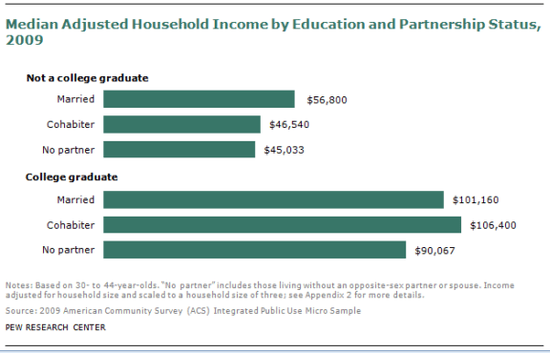
According to a recent Pew study, less-educated adults are less likely to realize the economic benefits associated with cohabitation:

The typical college-educated cohabiter is at least as well off as a comparably educated married adult and better off than an adult without an opposite-sex partner. By contrast, a cohabiter without a college degree typically is worse off than a comparably educated married adult and no better off economically than an adult without an opposite-sex partner.

Freakonomics editorializes, "So if you didn’t make it to college… better get married!"

Perry’s Craziest Ideas, Ctd

Avik Roy fisks Yglesias' list. His clearest hit:

Matthew argues, without evidence, that Perry believes Medicare “must never be cut”:

8. Medicare is Too Expensive But Must Never Be Cut: Both establishing Medicare in 1965 and expanding it to include prescription drugs in 2003 are examples of “an irresponsible culture of spending in Washington” (page 63), but establishing “‘councils of experts’ and panels of various sorts” to assess the cost effectiveness of different Medicare-eligible treatments is a “frightening” “scheme” that “undermines freedom” and can be fairly labeled “death panels” (page 81).

I was really surprised to read this from Matthew. He knows that there are plenty of proposed methods for reducing Medicare spending that don’t involve expert panels. While Perry doesn’t outline such a plan in the book (at the time, after all, he wasn’t running for President), we can be reasonably confident that he will. “By far the most alarming problem we face with respect to the largesse of the federal government,” Perry writes, “is the very real crisis of the looming implosion of New Deal and Great Society entitlement programs.”

Matt responds here.

Why Do College Websites Suck So Much?

University_website

A reader adds another gripe to the thread:

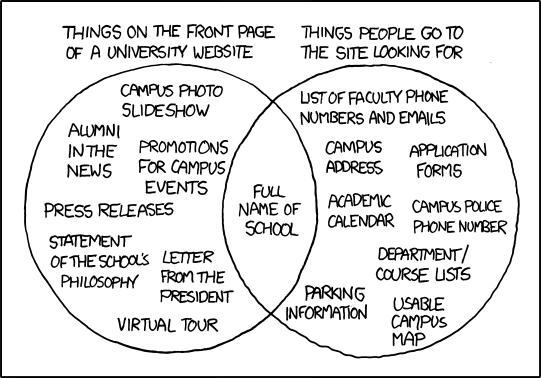
I would submit that college and university websites are even worse, as a class, than restaurant sites. The problem is that college sites are invariably controlled by the marketing arm of the institution, which sees the site as a recruiting device for future students. So we get giant slide shows of happy (and multicultural!) students on grassy lawns, virtual campus tours, and empty bloviations from the college president who wants "to welcome you to Western Flatlands State University, where the future is you!" The people who actually use the websites the most – current students, faculty and staff – have to dig past the flash animations and such to find such hidden items as the course schedule for next semester of the phone number of the financial aid office. This XKCD comic nails it.

Can Islam Accommodate Capitalism? Ctd

A reader writes:

Let us also bear in mind that in almost the entire Muslim world, capitalism and colonialism (in its various guises) have been inextricably linked. While capitalism should (theoretically) open doors to all peoples, for the last 150 years, it's been a vehicle to transfer wealth from to western nations and the economic elites who collaborate with western governments and corporations (See Saud, House of). The link between capitalism and political repression whether in the form of direct colonial rule (North Africa, India) or rule by western allies (Iran, Saudi Arabia, Iraq) is not one that is easily broken.

Another writes:

There are two ways of responding to this question.

One is empirical: currently, one of the fastest-growing economies in the world, if not the fastest of all, is Turkey, to the credit of a government with Islamic roots, and a new pious middle class from the socially conservative central provinces. This development has actually been compared to the Protestant roots of capitalism. Not only that: Above one of the gates of Istanbul's Grand Bazaar, an early modern temple of commerce if I ever saw one, is an inscription: He who gains is a friend of God (al-kasib habib Allah). The same text is found on a panel in the Blue Mosque. So you have praise for economic activity at the heart of an Islamic society. The movement of Fethullah Gülen is another example, and it would be hard to argue that for these people capitalist activity clashes with their religiosity.

Sorman's summary of the argument about waqf does not hold water (I haven't read Kuran's book yet, so I don't know if Sorman accurately represents his position). How is running waqfs like family trusts, and in the process depriving the central government of revenue, indicative of a lack of capitalist institutions or spirit? If any, it proves that Muslim entrepreneurs knew how to use the existing legal framework for capitalist enterprises.

Which brings me to the second point, that the question as such has to be questioned. This type of essentialist argument about Islam as a unified whole obviously does not make sense, as has already argued in an article you linked to earlier, and as is evident from the examples above. Therefore, the observation that Islam was founded by a merchant is entirely meaningless, since there is no essence based on this origin. Just as the Bible was able to accommodate countless different and contradictory interpretations over time, do does the Koran. Islam is practiced in myriads of ways, and these ways have been conditioned by historical, social, cultural, and political factors.  In math, if you try to divide by zero, you are punished by meaningless results. In history, if you ask ahistorical questions, you are punished by meaningless debates.