Iraq And Amnesia

121173257

Not so long ago, this country (and this blog) was obsessed with the Iraq war. If we had spent a fraction of time we spent debating non-existent WMDs worrying about credit default swaps, we'd be in much better shape today. More than 5,000 Americans died in this war; up to a hundred thousand Iraqis died in one of the most incompetent occupations in history. The cost of this war is at the very least $1 trillion. It is almost over. And yet we are too busy focusing on domestic partisan politics to assess the greatest foreign policy error since Vietnam.

The neocons are unrepentant. But examine two facts on the ground. The first is that the violence from al Qaeda type cells is still endemic:

The violence touched nearly every region of the country, except for Kurdistan, and appeared to be aimed at security forces in both Sunni and Shiite areas.

In all, there were 37 attacks, more than double the daily average this year, nearing the level of violence at the height of the sectarian conflict here in 2006 and 2007. The attacks included 11 car bombs, 19 improvised explosive devices and 2 suicide bombers.

Over 300 were wounded and close to 70 people died. Remember that al Qaeda did not exist in Iraq before we invaded it. Meanwhile, we have new evidence of how regime change in Iraq has affected the region as a whole. It has empowered Iran and is now helping Assad. The Shia bonds have created a new Shiite crescent from Tehran to Damascus:

“The unrest in Syria has exacerbated the old sectarian divides in Iraq because the Shiite leaders have grown close to Assad and the Sunnis identify with the people,” said Joost Hiltermann, the International Crisis Group’s deputy program director for the Middle East.

He added: “Maliki is very reliant on Iran for his power and Iran is backing Syria all the way. The Iranians and the Syrians were all critical to bringing him to power a year ago and keeping him in power so he finds himself in a difficult position.”

Doug Mataconis asks:

Why The Heck Did We Go To War Again?

A good question, no? And one worth asking now – before another round of amnesia sets in.

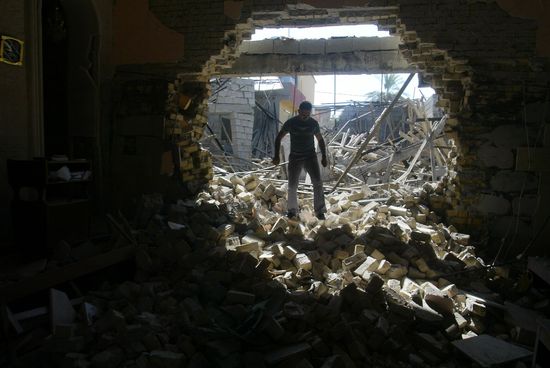
(Photo: An Iraqi man inspects damages at the Mar Afram Syriac Orthodox Church following an explosion in the northern city of Kirkuk on August 15, 2011 as a series of nationwide attacks hit the country. At least 41 people were killed and 90 wounded in a spate of violence across Iraq, just months ahead of a pullout of US forces. by Marwan Ibrahim/AFP/Getty Images.)

Whatever Happened To Civilian Control?

Jacob Stokes fisks the emerging GOP line of attack claiming that Obama "didn't listen to his generals" on Afghanistan. His takeaway:

In short, while the military might have been hesitant about Obama’s plan, [generals believe] it’s neither reckless nor strategically misguided. Even if the military held that view though, there are three reasons why, ultimately, the president has to have final say on decisions like this.

And if you wondered if Rick Perry would go there, wonder no longer:

"One of the reasons that I’m running for president is I want to make sure that every young man and woman who puts on the uniform of the United States respects highly the president of the United States," he said.

Putting the respect of troops for the commander-in-chief in question is yet another radical assault on existing traditions and institutions. There is nothing these people won't destroy for power.

“Think Of It Like Political Islamism”

Michelle Goldberg diagnoses the core philosophy of Perry and Bachmann: the most radical theocratic politics in the West. And if you haven't read Ryan Lizza's extraordinary piece on Bachmann's explicitly celebrated theological worldview, please do. Money quote:

For believers in Dominionism, rule by non-Christians is a sort of sacrilege—which explains, in part, the theological fury that has accompanied the election of our last two Democratic presidents. “Christians have an obligation, a mandate, a commission, a holy responsibility to reclaim the land for Jesus Christ—to have dominion in civil structures, just as in every other aspect of life and godliness,” wrote George Grant, the former executive director of Coral Ridge Ministries, which has since changed its name to Truth in Action Ministries. “But it is dominion we are after. Not just a voice … It is dominion we are after. Not just equal time … World conquest.”

But both Clinton and Obama are Christians. My own view is that it is the very sincerity and clarity of Obama's Christianity – laid bare most pellucidly in his Neiburhian Nobel speech – that drives the Christianists nuts. It is so alien to them that they have to believe he is a Muslim.

Medicare Spending Decelerates

This won't get the headlines of the debt ceiling fight but in many ways, it's much more important to future fiscal health:

From 2000 through 2009, Medicare’s outlays climbed by an average of 9.7 percent a year. By contrast, since the beginning of 2010, Medicare spending has been rising by less than 4 percent a year. On this,  both Standard Poor’s Index Committee and the Congressional Budget Office (CBO) agree.

Why the slowdown, which could cut the debt massively in the distant future? Zeke Emmanuel believes it's the looming impact of the ACA:

The reform measures that will rein in Medicare inflation have not yet been implemented.  But, he explained, providers are “anticipating the Affordable Care Act kicking in.”  They can’t wait until the end of 2013: “They have to act today.  Everywhere I go,” Emanuel, added, “medical schools and hospitals are asking me, ‘How can we cut our costs by 10 to 15 percent?’

Conscripted Into The Revolutionary Guard

2511960

An illuminating dispatch published by Tehran Bureau:

The past seven days have passed like seven years. I have a beard now; we all have. My skin is burned; so is the skin of all the others. What we're receiving is a mix of political and religious indoctrination with basic military training. There is no talk of military tactics, just simple facts such as how to use light weapons and so on, but the indoctrination is serious. Most of the time is spent talking about the enemies of religion and the state — everything from the Fetne 88 (the so-called "sedition" following the disputed election in 2009) to the Baha'is. A very simplistic attempt at brainwashing is going on.

They try to convince us that all is well and that the events of recent years have all been a conspiracy by the West; the same worn-out rhetoric that you hear from every propaganda outlet of the regime. The theory classes, however, are a hoot. Most of the time we are napping or chatting and despite all the threats of punishment, nobody really listens. When we do tune in, it's sort of light entertainment. You hear medieval ideas being explained by someone who really believes in them, some notions so outrageous that it is very hard to imagine anyone really giving them credence.

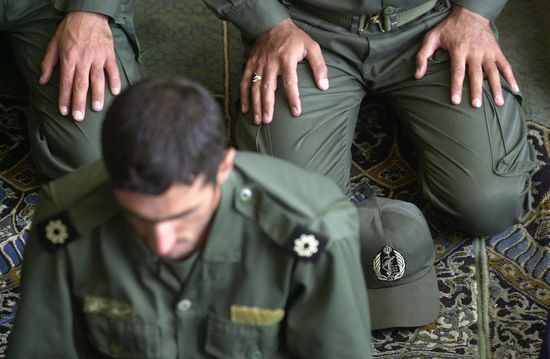
(Photo: Iran's Revolutionary Guards attend Friday prayers at Tehran University on September 19, 2003 in Tehran, Iran. By Scott Peterson/Getty Images)

Be Nice To Your Coworkers

Jonah Lehrer summarizes a new study concluding that less-friendly colleagues "were associated with a higher risk of dying":

While this correlation might not be surprising – friendly people help reduce stress, and stress is deadly – the magnitude of the “friendly colleague effect” is a bit unsettling: people with little or no “peer social support” in the workplace were 2.4 times more likely to die during the study, especially if they began the study between the ages of 38 and 43. In contrast, the niceness of the boss had little impact on mortality.

The famous British Whitehall study found that the amount of control we have at the workplace matters. But an unexpected source of stress emerged in the Tel Aviv study featured by Lehrer:

While men in unfriendly workplaces fared worse when they had little control, women actually seemed to fare better. In other words, their health status was improved when they had no say over their work day. One possibility cited by the researchers is that having a modicum of control at the office exacerbated the tensions between the office and home. Because many of the women were also mothers, having control left them with an extremely stressful series of choices. Should they stay late at work? Or go home and take care of the kids? This freedom, it turns out, compounded the stress of the unfriendly workplace. Control without support was even worse than having no control at all.

Your Role In Somalia, Ctd

Gulliver fisks Max Boot's angry response to the NYT expose on the US-funded security company training African troops:

This may be a news flash to you, but "we're not willing to send even U.S. trainers" almost anywhere (assuming you mean uniformed American servicemen) with the exception of Iraq and Afghanistan, in large part because of the massive manpower requirements of those wars. The bulk of U.S.-provided military training in partner nations is performed by contractors like DynCorp and MPRI (and innumerable subs); sometimes it's contracted through the State Department (as with putative peacekeeping training in Africa), and sometimes it's executed by DoD through foreign military sales. …

All of that said, I kind of agree with Boot that the Times article makes a mountain out of a molehill.

Map Of The Day

Screen shot 2011-08-10 at 9.49.49 AM

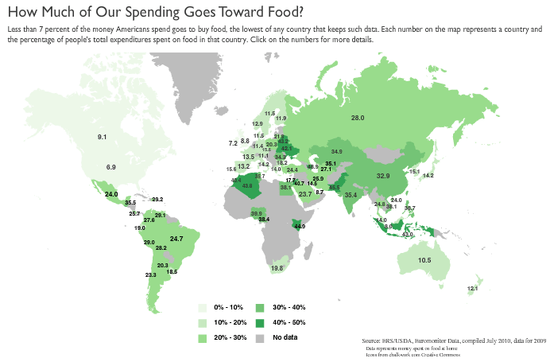
Natalie Jones illustrates global food spending:

A one dollar bag of rice in the U.S. is not the same as a one dollar bag of rice in Indonesia. For an American, who, on average, devotes about seven percent of his or her spending to food, it won’t matter that much if the price of rice doubles to two dollars. An American can likely take the money that would have gone to a “non-essential” item and put it towards food instead. But for an Indonesian, who devotes 43 percent of his/her spending to food, it could mean less to eat.

The full interactive version is here.