Can You Live Without A Credit Card? Ctd

Some remaining thoughts on last week's popular thread:

My girlfriend physically took my credit card away. We're much better off. Digitally, however, I continue to use the card for everything from Amazon books to server costs to music. The digital economy runs almost entirely on credit. There's almost no concept of cash online. Am I glad I don't have the credit card in my wallet any more? For sure. Can I live without a credit card at all? Nope. At least not online.

Another writes:

I highly recommend taking a look at the publically available fee schedules for Visa (pdf) and MasterCard (pdf). It's not easy to make sense of it, but if you invest the time, you can learn a lot about how the credit card industry works today.  One of the most interesting and least understood points is that Visa passes the cost of rewards programs onto the merchants:  you'll notice that a given merchant doing a given type of business pays extra if a customer uses a rewards card, and how much extra depends on the card.

Note that merchants will always pay more than the number listed in this table, because their bank takes an additional cut.  In many cases their bank will force them to use a third-party payment processing company, who will also take a cut.  Sometimes those processing firms force you to buy the service through a local sales firm, who will also take a cut.  If you do e-commerce, you'll have to file the electronic payment information through yet a another firm, who will take yet another cut.  It adds up.

We all benefit from electronic payment processing: it is a huge step up for everyone from having to have safes and cart cash to the bank and/or deal with the hassle, wasted time, and worry of accepting paper checks.  But there is no reason that electronic payment processing should cost three times more for a one type of card vs. another type of card, and it seems preposterous to me that these credit card companies make 1-4% on almost every consumer transaction in the developed world and yet claim they can't make a profit.

P.S. Your second reader here was wrong on one point: It is not illegal to charge different prices depending on the payment method.  However, the credit card industry writes that requirement into all their merchant contracts.

Another:

Your reader wrote, "If everyone used cash, prices for everything would go down." True, but so would sales, income and other tax revenues.  Pretty much everybody who has ever worked for, in, or owned a mostly cash based business, knows that lots of the income is never reported, cash can be stolen, tips unfairly distributed and so on.  The audit trail left by electronic payments has stopped many of these evil practices.  And many if not most honest small business owners are damn glad that their cash registers aren't pots of gold to either their employees or thieves, and the late night bank deposit of cash isn't enough to get killed over. So maybe it's a protection racket, but hey, everyone wins.

One more:

Full disclosure:  I am an attorney who spent much of last decade as outside counsel defending an enormous credit card company in antitrust matters.  I am not going to defend here everything that credit card companies do, and they do not remotely merit it for some of their practices.  I would like, however, to clarify some common misperceptions and push back a little against some of your customers' assertions.

1.  Credit card companies do not necessarily need you to carry a large balance in order for them to make a profit.  They do need you to use your card a lot.  For each transaction a customer makes, that customer's bank receives an "interchange fee" from the seller's bank (ultimately paid by the seller, of course).  For credit card transactions, this amount is currently generally a bit less than 3%, and for debit card transactions, this amount is typically a bit less than 2%.  In other words, if someone makes $5,000 in credit card charges every month, the issuer bank makes approximately $150 a month off of that customer in interchange fees every month, without having to have much credit default risk (given the propensity/ability to pay off).  That is a very attractive type of cardholder for a bank to have, and one of the types that are actively sought.  If you carry a large balance, that cuts into your ability to use the card a lot to generate interchange fees, so there is a trade-off.  The banks do want you to have a large involvement with their product (either by having a large loan from them or by making a lot of purchases or both), but that is of course true of most products from most businesses.

2.   It is true that historically, merchants have not been permitted to charge more for payment card transactions than for cash transactions.  That is not because the practice is illegal, but because Visa and MasterCard have rules that say that if you want to accept the card, you must agree to that policy.   I do not know whether I think that the rule is still necessary.  But to provide some perspective, it was necessary initially for the cards to survive and grow, because credit card companies had to convince customers to use a payment method that was not accepted widely and simultaneously had to persuade merchants to accept a payment methodology when there were not many customers who had the cards.  It was a very delicate and difficult balancing act that took decades to play out.  One of the things Visa realized early on was that if merchants were free to charge higher prices (because they found the cards weird and wanted a premium for dealing with the weirdness), then customers would not adopt this strange new card, and the careful chicken and egg management process would have been nearly impossible to surmount.

3.  The no-price discrimination policy, combined with the interchange fee, leads to the result, on a simplistic level, that a merchant keeps more cash from cash payers than from credit card payors.  But the conclusion that therefore prices are higher for everyone is far, far too simplistic.  Payment cards provide an insanely and ingeniously efficient and safe payment system in comparison to any current alternative.  Using cash, on the other hand, has numerous costs for lots of parties involved.  A merchant has to physically manage the cash.  That includes ensuring that the employees do not pocket any of the cash before accounting for it, ensuring that neither the employees nor robbers take the cash before it can be secured.  That can entail costs such as security guards, safes, armored truck services.  Then they also have to take the time to go to the bank, have the deposit counted, etc.  I haven't done the analysis, but it is not at all clear to me that the costs associated with cash amount to less than the interchange fee cost of the payment card transaction.

And that is just on the merchant's side.  There are similar costs for the consumer as well.  If a consumer pays for everything in cash, the consumer must make multiple trips to the bank, must expend effort to keep the cash safe, etc.  The consumer must decide whether to carry lots of cash at once, and bear the risk of theft, or carry small amounts and bear the burden of going to the bank repeatedly.  And quite obviously, for consumers and merchants who do want to make a transaction on credit, the credit card is invaluable.  Back in the day, many department stores had credit departments that evaluated consumers for transactions, made individual determinations, and then had to deal with collections.  It is much much cheaper for them to pay an interchange fee and outsource the entire credit department, and it is obviously more efficient overall for this credit decision to be made by only one party rather than by each store.

More discussion at our Facebook page.

Traveling With Virgin Eyes

Rorschmap

Jessa Crispin critiques the way most Americans travel by quoting Andrzej Stasiuk, from his book On the Road to Babadag: Travels in the Other Europe:

It is good to come to a country you know practically nothing about. Your thoughts grow still, useless. Everything must be rebuilt. In a country you know nothing about, there is no reference point. You struggle to associate colors, smells, dim memories. You live a little like a child, or an animal. Objects and events may bring things to mind, but in the end they remain no more than what they are in fact. They begin only when you experience them, vanish when others follow.

He’s right, though, to add “a country you know practically nothing about.” It’s so easy to discard your daily routine in a country you know from art and film and literature and just pick up one of their storylines. They practically sell them vacuum-packed at duty free, next to the VAT-less booze. The most traveled-to, the most postcard-ready of the European capitals suffer under the weight of so many photographs, so many young people waiting for their transformation. “Observation irons out objects and landscapes,” Stasiuk writes. “Destruction and decline follow. The world gets used up, like an old abraded map, from being seen too much.” 

(Image from James Bridle's Rorschmap.com, as he describes it is "cartographic navel-gazing, a reframing of the map. It will not help you find anything.")

The Untruths She Persists In

A reader writes:

I am in general a fan of David Gregory, but he was not prepared for the interview with Bachmann on MTP. She is using the same talking points that she has used since she announced including her statement that only one employee of the Department of Transportation was paid $170,000 before Obama took office and now there are over a thousand. That has been thoroughly debunked. See here. She blames the S&P downgrade on failure to curb entitlements, but the downgrade also included reasoning related to the failure to raise revenue. See here.

Issue after issue reveals her hypocrisy, her cherry-picking data, and her extremism. He could have nailed her, but did not.

The Factcheck page on her makes Palin look like George Washington.

Yglesias Award Nominee

"[I]n 1982 Ronald Reagan was willing to sign what was then the largest tax increase in American history (TEFRA) because he believed he’d get three dollars in cuts for one dollar in tax increase. Reagan came to regret his tax increase — but not because the ratio was wrong but because Democrats never delivered on the spending cuts. If Reagan had gotten the cuts he asked for — and the York/Baier question pre-supposes the spending cuts would be real – he would have taken that deal. Are Republicans in 2011 saying that a deal that would be far better than one Reagan expected and agreed to is simply beyond the pale? If so — if taxes cannot be raised under any circumstance — then we have veered from economic policy to religious catechism," – Pete Wehner.

The Children We Kill

2009.08.21-Syed-Wali-Shah-Aged-7-Ob32

A new report from the Bureau of Investigative Journalism reveals the profound moral costs of drone warfare, waged by the unacccountable CIA:

The highest number of child deaths occurred during the Bush presidency, with 112 children reportedly killed. More than a third of all Bush drone strikes appear to have resulted in the deaths of children.

On only one occasion during Bush’s time in office did a single child die in a strike. Multiple deaths occurred every other time.  On July 28 2008 for example, CIA drones struck a seminary in South Waziristan, killing al Qaeda’s chemical weapons expert Abu Khabab al Masri along with his team. Publicly the attack was hailed a success.

But the Agency’s strike also killed three young boys and a woman. Despite the secrecy surrounding the drones campaign, details emerged in May of this year that not only was the US aware of this ‘collateral damage’, but that the then-CIA chief Michael Hayden personally apologised to Pakistan’s Prime Minister Gilani for the error.

The Obama administration has also killed over 50 children, but seems to be trying to improve:

There are indications that the Obama administration is making efforts to reduce the number of children being killed. Following the incident in September 2010 that killed Din Mohammad’s children, and another strike just weeks earlier in which a further three children died, there has been an apparent steep fall in the number of child fatalities reported by media.

That is partially in line with claims by some US intelligence officials that drone targeting strategies have been altered to reduce civilian casualties. Although the Bureau has demonstrated that CIA claims of ‘zero casualties’ are false, there are fewer reports of child casualties since August 2010.

(Photo: Syed Wali Shah Aged 7, killed in strike Ob32/Noor Behram.)

Seeing Obama Through The Civil Rights Prism

OBAMARAINRoslanRahman:Getty

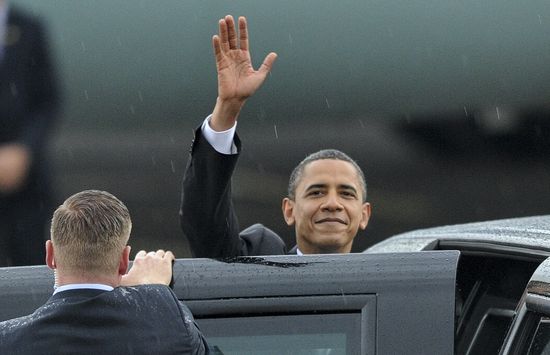
I rather glibly wrote recently that one reason president Obama has not opened a can of rhetorical whup-ass on those actually seeking the default of the US Treasury, is that he wants to avoid the "angry black man" trope. Once he is defined as that, the GOP needs nothing more to use the race card silently against him. That's why they keep arguing that the president who killed bin Laden, prevented a Second Great Depression and achieved universal healthcare in his first term is somehow another Jimmy Carter.

But of course he isn't. And of course he understands the political dynamic out there. He just knows that the one thing the far right wants – and needs – to do is get into a fight with him, elevating them, dimnishing him, and alienating the middle of the American electorate. His approach is the classic civil rights movement approach with a black leader addressing a largely white electorate: non-violence, reasoned argument … well, this Washington Monthly commenter puts it all far better than I can:

How does Obama break the iron unity of the GOP opposition to assemble a governing majority in the US Congress? …

Obama acts entirely within the tradition of mainstream African American political strategy and tactics. The epitome of that tradition was the non-violence of the Civil Rights Movement, but goes back much further in time. It recognizes the inequality of power between whites and blacks. Number one: maintain your dignity. Number two: call your adversaries to the highest principles they hold. Number three: Seize the moral high ground and Number four: Win by winning over your adversaries, by revealing the contradiction between their own ideals and their actions. It is one way that a oppressed people struggle.

Obama has taken a seat at the negotiating table and said “There is no reason why we cannot work out solutions to our problems by acting like responsible adults. That is what people expect us to do and that is why we have entered into public service.” That is the moral high ground.

Honestly, I have been reminded more than once in the last few months of those brave college students sitting in at a Woolworth’s lunch counter, back in the day. Obama sits at that table, like they did at the counter. Boehner and McConnell and Cantor clown around, mugging for the camera, competing to ritually humiliate Obama, to dump ketchup on his head.

I don’t think those students got their sandwiches the first day, but they won in the end.

Obama is winning. Democrats are uniting behind him, although some white progressives think that they could do the job better. Independents are flocking to him. Even some Republicans are getting disgusted with their Washington leaders. Obama is not telling us about lack of seriousness of the Congressional GOP; he is showing us the vivid contrast between what we expect of our leaders and their behavior. The last two and half years have been a revelation of the essential conflicts in our society and politics.

If white progressives understood much about the politics of the African American struggle in the United States, we would see Obama in the context of that struggle and understand him better. And you don’t have to be African American to know something about the history of the African American struggle. The books and the testimony is there. It’s not all freedom songs. But you have to be convinced that it is something that can teach you something you don’t already know.

Let the Dish say Amen.

(Photo: Roslan Rahman/Getty.)

“I’m Not Judging Them”

By that, Bachmann is saying that her belief that gay men and women are sick and need to be cured is not in itself a hostile judgment. It is just the truth. She knows it is the truth because the Bible says so. And you know this is something she believes in by the work her husband has been doing. And you know this is something that is a priority for her since she can make speeches in which she says:

It's a very sad life. It's part of Satan, I think, to say that this is gay. It's anything but gay. … It leads to the personal enslavement of individuals. Because if you're involved in the gay and lesbian lifestyle, it's bondage. It is personal bondage, personal despair, and personal enslavement. And that's why this is so dangerous. … We need to have profound compassion for people who are dealing with the very real issue of sexual dysfunction in their life and sexual identity disorders.

Personal despair? And this is what she regards as an empirical description of what I and other gays and lesbians regard as our core identities. What she is saying is that there is no such thing as a homosexual. There are merely heterosexuals with fucked-up psyches who need help. She is saying that for her, an entire American minority should, in an ideal world, not exist. And her likeliest competitor, Rick Perry, believes that the unconstitutional sodomy laws should be enforced; and Bachmann would reinstate the mandatory closet for anyone in uniform.

When was the last time someone ran on a platform that, in his or her view, in an ideal world, an American minority should not even exist?

The Christianist Takeover

GT_PERRY_08142011

It now appears to be complete. When I wrote "The Conservative Soul," David Brooks was underwhelmed by its core argument: that an accelerating shift was taking place in American conservatism that was transforming the small government secular temperament into a fundamentalist religious mindset that sought its refuge not in doubting humankind's capacity for good, but in believing in God's ability to heal all things, including politics.

David argued that the religious and fundamentalist shift in the GOP was over-rated, and that there was no conflict between evangelicalism and mainstream American values.

As any number of historians, sociologists and pollsters can tell you, the evangelical Protestants who now exercise a major influence on the Republican Party are an infinitely diverse and contradictory group, and their relationship to these hyperpartisans is extremely ambivalent.

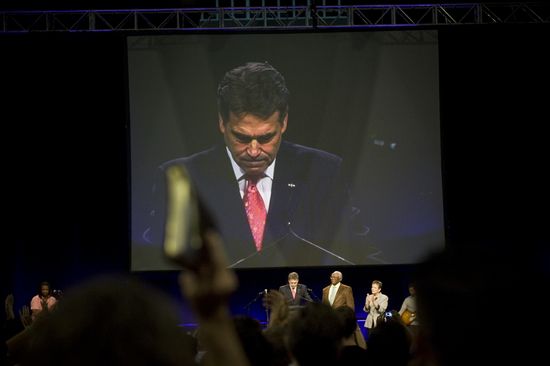
Well, a few years later, examine the candidacies of the two front-runners for the GOP. One launched his campaign in a revival meeting calling for God to solve our economic problems (having previously led mass prayers for the end of the Texas drought); the other emerges entirely out of Dominionist theology and built her entire career in the Christianist world of home-schooling, and anti-gay demonization. One reason Mitt Romney is not a shoo-in? Sectarianism, and his own previous deviations from binding orthodoxy. And it is this fundamentalist mindset – in which nothing doctrinal can be questioned, and the real world must be bent to the shape of a rigid theo-ideology – that defines these two candidates.

Hence Bachmann's belief that the entire deficit can be ended in short shrift solely by massive cuts in spending. This "spending alone" principle cannot be compromised, since taxation in and of itself is a way in which the liberal elites control people's lives. It doesn't matter what economists say about the consequence of wilful default or of austerity too sharply imposed. It only matters what God says. And God is bound up with a radical American theology in which slavery was more benign than the Great Society, and that the Founders were abolitionists. That American theology creates the justification for the use of American military power across the globe, especially in protecting and advancing Greater Israel, Bachmann's and Perry's fundamentalist cause of causes.

This is what this party now is: a religious movement clothed in anti-government radicalism. It has nothing to do with the conservative temperament, conservative political thought or conservative ideas. It is hostile to most existing institutions, especially government, contemptuous of the courts, and seized of an ideology as rigid as any far-left liberalism, as utopian as any wide-eyed socialist, as fanatical as anything the left spawned in the 1960s.

And it has hijacked an entire political party; and recently held to ransom an entire country. I knew it would get worse before it gets better. But this bad?