“Optimus Prime Muslims”

Wajahat Ali vents his frustration:

These are Muslims who transform during Ramadan – and only during Ramadan – into obnoxious, religious blowhards and completely change their personality and behavior traits for 30 days only to de-evolve into the same exact human being immediately on Eid, the day celebrating the end of fasting. These guys stop listening to music, watching tv, logging on facebook, reading magazines and the whole shabang.

Now, I have no problem with this. Go forth and free thyself from these technological crutches that have paralyzed human interactions, I say! However, I do have a problem with Optimus Prime Muslims lecturing me for being a heathen for occasionally watching a Netflix flick or catching a re-run of Dexter. “You watch movies during RAMADAN!?!? Wow…ok, maybe we were…raised…differently. Well, Allah is Merciful…I guess.” Listen, I don’t drink, do drugs, beat people up, snort cocaine off of strippers’ bellies, gamble or even know what bacon tastes like. Life is hard for a practicing Muslim. Relent. Give a brother some instant Netflix. That’s all I’m asking.

Aziz Poonawalla rounds up more Ramadan blogging.

Choosing Submission

James Wood reviews a new collection of essays on "The Joy of Secularism":

[M]any religionists assume that life without God would be life without meaning. Where secularists cherish autonomy and choice as qualities that make life meaningful, Baptismreligionists often emphasize self-abnegation and submission to a higher power. This would appear to be a wide gulf. But [philosopher Philip] Kitcher suggests that religionists and secularists actually agree about how to create meaning in a life.

Many believers think of their submission to God not as compelled, he points out, but instead as "issuing from the choice of the person who submits." Life develops meaning because someone identifies with God's purpose. This identification must spring from an act of evaluation, a decision that there is value in serving a deity whose purpose is deemed good. Believers, then, make an autonomous choice "to abdicate autonomy in order to serve what the autonomous assessment has already recognized as good." Both atheists and believers are involved in making independent evaluations of what constitutes life-meaning. They draw different conclusions about what that meaning is, but they go about finding it in similar ways.

Richard Brody connects God to art:

Art is the closest thing that atheists have to religion, and it’s the devotion to art that ought to help an atheist temper his disbelief with fascination. I’m an atheist, a secularist, a materialist—and I refer often to God, heaven, and the soul, for the same reason that I talk about Hamlet, Oz, and the Id: namely, they are ideas of vast, epochal, and fecund imaginative power. God is the main character of those very good books that may well be The Greatest Story Ever Told, and to ignore them because of their religious import is as silly as dismissing Homer as a pagan cultist; to dismiss them for the uses made of them is as odd as disdaining Shakespeare because of a dull English class. And the imaginative sympathy that lets a Democrat enter the mind of a Republican or grant a believer insight into the secular experience, or vice versa, is one of the essential elements of art.

(Photo of a baptism in Italy by Luca Vanzella)

God Has Left The Cathedral

Brian Jay Stanley sounds the death knell for one of Europe's biggest tourist draws:

The glittering walls and shrines are decorated with ill-gotten gold, stolen relics, and war booty. The soaring domes and spires were raised to heaven not from piety but ambition, to outdo nearby cathedrals and show that Florence was better than Pisa, as modern Malaysian and Shanghai architects compete to build the tallest skyscraper. The niches are filled with the tombs of the rich, not because rich men were holy then but because they wanted to buy the best salvation for themselves, as today's rich use their millions to nuzzle up to power and buy the best laws and policies for themselves. In the cathedrals' history as opposed to their aura, I recognize the same political machinations, class inequality, greed, and immorality that rule the world today—the trademark signs of man curiously grafted onto religion. Life has left Europe's cathedrals, but God was never there.

Are Atheists Also Evangelicals? Ctd

Responding to this reader, another defends faith's reasonability:

Your reader writes:

String theory is a theoretical branch of physics that exists mostly in mathematical models, designed to reconcile two things that we know already to be true (relativity and quantum mechanics). It's an explanation of the gaps in our knowledge, and it may be incomplete. No one is asserting for certain that there are, what, eleven dimensions? They're asserting that if there are, we can explain apparent discrepancies between these two known facts. String theory is an admission of exactly what Aslan is seeking – that our best scientists working with the most advanced technology in the world cannot prove everything.

Much the same can be said about belief in a higher power, at least for me. It is an admittedly incomplete attempt to reconcile apparent discrepancies between known facts. I annoy my fellow believers with my "faith" in science and its ever increasing detail in explaining our physical reality. I know the ridiculous improbability of the divine when compared against all that we can empirically know.

Yet I've had my mother call me from across the country just hours after I was fired, knowing something had gone wrong, down to the minute. I have felt the healing power of Reiki. I have, while blindfolded, "seen" the incoming punch and caught it, while tuned in to (my?) Ki. My wife has been healed of three separate illnesses/syndromes, two of which doctors consider incurable, at two separate Charismatic Christian services. I've met enough people of varying faiths to know that a great many have had very, very hard to explain experiences that Science often dismisses.

I know that these are not empirical evidence; that's kind of the point. I'm a skeptical individual, and have tried to find every possible explanation. All fall short. So I end up with a very skeptical Belief. It is an admission that not everything is provable, an attempt at an explanation of the gaps in what I know to be true. And it grows, shrinks, and changes as I find more things that are true.

So when I bump into the "God probably isn't real" crowd preaching their certainty to me, I am as saddened by their inflexible evangelicalism as I am by the "God is real and he will throw you in Hell if you don't completely surrender to him (in my way, of course) today" crowd. Neither one has much willingness to admit that we see through a glass, dimly.

Debating The Big Questions

Red Cardigan accuses New Atheists of ignoring the big questions like “Why are we here?” or “Why is there suffering?”:

The part that frustrates me is that people from the dawn of human history have grappled with these questions, not finding them either frivolous or evidence of clinical depression. … New Atheism seems to think that "Death is a natural termination of the processes of organic life," is all the answer anybody needs, and that anybody who wonders at all beyond that point is just a superstitious person with a need to be comforted by fairy-tales.

Within a couple back-and-forths, Michael Mock addresses Cardigan's main inquiry:

[A]theism, new or old, does not address those questions because it isn't the sort of thing that should address those questions. It's not a worldview; it's just a lack of belief in gods – one god, two gods, many gods. So what she's really complaining about is what I'd call materialism – the idea that the world that we can see and measure and verify is the only thing that we can meaningfully talk about. Trying to talk about this as a characteristic of some kinds of atheism is misleading and distracting.

Vorjack cites a Buddhist parable in response:

It’s just as if a man were wounded with an arrow thickly smeared with poison. His friends & companions, kinsmen & relatives would provide him with a surgeon, and the man would say, ‘I won’t have this arrow removed until I know whether the man who wounded me was a noble warrior, a priest, a merchant, or a worker.’ He would say, ‘I won’t have this arrow removed until I know the given name & clan name of the man who wounded me… until I know whether he was tall, medium, or short… until I know whether he was dark, ruddy-brown, or golden-colored… until I know his home village, town, or city…

Vorjack concludes:

Right now, you’re alive. Worry about how to live. The meaning of suffering is less important that the fact of suffering.

(Video: Dutch Wife from Jesse Kanda on Vimeo.

The View From Your Window

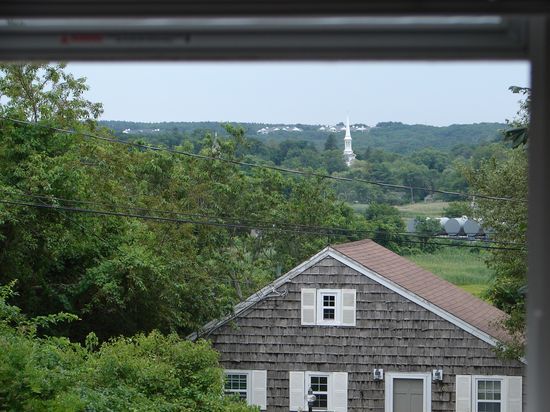
Sandwich-MA-12pm

A reader sends a view worth revisiting:

My husband and I both follow your blog and love playing the VFYW contest, keeping a tally of each of our correct answers for our own competition (I believe I'm winning and may be entitled to bonus points for having my photo of St. Barts selected for the contest, even if you did label it the easiest contest yet…) A few weeks ago, my husband called me over to the computer to show me a VFYW you had posted from a reader and asked if I recognized it. I recognized it instantly and we agreed that it was definitely taken in the same neighborhood as, and probably a street or two behind, a house my family rents every summer in Sandwich, MA.

Last week we were back at that house, and as I sat out on the back deck I decided to pull up the VFYW photo from July 3 and was pretty surprised to realize it wasn't just taken in our neighborhood; it was taken from our house! There are train tracks that run past those large tanks and whenever the train whistle blows my nephews run upstairs, into the bathroom, and look out the window to watch the train go by. I have spent a lot of time lifting small boys (who aren't so small anymore) up to look out that bathroom window, which is why the view was so familiar to me. This is the view from that bathroom window.

I just wish this had been a contest photo! I would have had a story to go along with my submission and could have won the book before my husband! Thanks for the bit of extra fun you added to our summer vacation!

Was MLK A Christianist? Ctd

A reader complements the thread:

I'm a graduate student and I'm teaching a course called "Dr. King and Empire: How MLK Jr. Resisted War, Capitalism and Christian Fundamentalism" this fall at my school. I've done a lot of research on how Dr. King interpreted the Christian doctrines and Christianity. You may want to see an article I published in Tikkun Magazine called "King's God: The Unknown Faith of Martin Luther King Jr."

King denied the ontological divinity of Jesus, didn't think heaven/hell were literal places, saw the Bible as myth, rejected the bodily resurrection of Jesus (beginning at the age of 13), rejected original sin, etc.

Another:

You asked us to "imagine a pro-life movement that never sought to make abortion illegal but tried solely to highlight its profound moral implications."  I thought immediately of Mother Teresa speaking against abortion, pleading for the unwanted babies of other women, give them to me.  In her Nobel Peace Prize speech, she said:

We are fighting abortion by adoption, we have saved thousands of lives, we have sent words to all the clinics, to the hospitals, police stations – please don't destroy the child, we will take the child. So every hour of the day and night it is always somebody, we have quite a number of unwedded mothers – tell them come, we will take care of you, we will take the child from you, and we will get a home for the child. And we have a tremendous demand from families who have no children, that is the blessing of God for us.

I know many Christians do adopt, and see adoption as a certain religious calling, and I commend them for their love for their children, born to other parents but just as much their own.  As a Christian myself, I wish more of us would adopt instead of rallying against Roe vs. Wade.  What more could we do to be "pro-life" than adopt a child? 

But I am challenged my Mother Teresa's words because when I think of other people's unwanted children, I confess that deep down, I do not want their children, either.   Mother Teresa, of course, was a better follower of Christ than me.

Jesus said, "let the little children come unto me."   I believe the pro-life movement you speak of does exist among the faithful, inspired by Christ, doing as Mother Teresa.  That pro-life movement is quieter.  They are busy raising their kids.

Tonguing Your Supporters

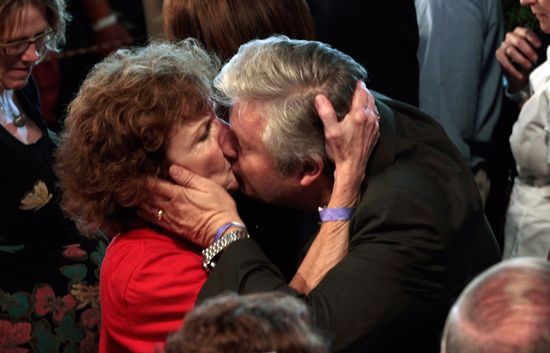
121079781(1)

Well, it's a novel approach, I suppose, especially when you are such a woman-killer as Marcus Bachmann. Or maybe it's his outfits that drive women crazy. The unidentified woman (random? mother? a stalker? or just voter?) in a lip-lock with the wannabe First Gentleman, does seem to have his head in a death-hold. Today he was wearing a ribbed, pale green top, capped by a dark blazer. When he gets to be First Man, I can confidently predict the fashion world will explode in Washington like nothing since Nancy Reagan.

But I regress …

(Photo: Marcus Bachmann (R), husband of Republican presidential candidate Rep. Michele Bachmann (R-MN), gets a kiss from a supporter in his wife's tent during the Iowa Straw Poll outside the Hilton Coliseum at Iowa State University August 13, 2011 in Ames, Iowa. Nine GOP presidential candidates are competing for votes in the Iowa Straw Poll, an important step for gaining momentum in a crowded field of hopefuls. By Chip Somodevilla/Getty Images.)

Sarah Palin’s Iowa Toe-Nails

120919387

Oh no, she didn't! Oh yes she did:

Former Alaska Governor Sarah Palin's toes are painted black with white polka dots while visiting the Iowa State Fair August 12, 2011 in Des Moines, Iowa. Although she has not announced any intention of running for president, all of the Republican presidential hopefuls are visiting the fair ahead of Saturday's Iowa Straw Poll to greet voters and engage in traditional Iowa campaigning rituals. Photo by Chip Somodevilla/Getty Images.

Well she did once say:

"We are so desperate in Alaska for any semblance of glamour and culture.''