Short-Sighted Selfishness Will Doom Us

Jack Goldstone fits American global decline into a larger historical pattern:

In short a key difficulty faced by regimes in decline was selfish elites.  Nations that were the richest countries in their day suffered fiscal crises because elites preferred to protect their private wealth, even at the expense of a deterioration of state finances, public services, and long-term international strength.

By ‘selfish elites’ I do not mean, of course, simply elites’ aspirations to maintain disproportionate shares of wealth and power.  That ambition is a universal constant. What I wish to emphasize is that in some eras in history, elites have identified their interests with the national state and the public weal, and they have been willing to tax themselves heavily to expand the influence and resources of their nation and their government.  At other times, … elites have turned into competing factions, driven by self-enrichment at the expense of their rivals and opponents, even when that meant starving the national state of resources needed for public improvements and international competitiveness.

Defining Evil

Norm Geras takes on Terry Eagleton's definition of evil as "destruction for the hell of it:"

It follows from this that, for example, someone's torturing an animal to death merely for pleasure might count as evil whereas their torturing hundreds of people to death in order to intimidate a population threatening the oppressive regime they work for wouldn't. And a short and obvious answer to this proposed definitional restriction is: pull the other one. To be persuasive a definition needs to capture the core of our intuitions on how the relevant concept functions, and the suggestion that torturing large numbers of people to death isn't evil provided only there's some end in view would be widely rejected, since extreme cruelty to sentient beings is one of the paradigm meanings of the word 'evil'.

An Editor Exodus, Ctd

A reader writes:

As a former frequent (and now occasional) editor of Wikipedia, a few thoughts on the various reports of its demise, and the popular theory that turf-warring bands of administrators are to blame – there is another side to this coin

Many editors who find themselves being "oppressed" by administrators often do so with good reason: Political partisans frequent the site, and many politically sensitive articles are common battlegrounds from activists trying to cement their version of the facts into the web encyclopedia of record.  Spammers and self-promoters both attempt to use the site to hawk their wares or tout their employers, their band, etc.  There are many noteworthy people, including a few scientists, who have been banned from editing due to a persistent desire to edit their own biographies and inflate the importance of their own careers.  Numerous crackpot scientists would attempt to place their ridiculous claims, devices, and therapies on par with legitimate medicine.  And many editors' contributions are just plain garbage – material that is unsourced, dubious, or flat-out-wrong. 

Some of these people will accept gentle self-correction, but many of them will not, acting as though modification of the encyclopedia is a God-given right.  And if and when their corrections are reverted, it's always the same excuse: the administrative authority being exercised is ALWAYS arbitrary and capricious and being done for no good reason.  In short, the failing always lies with the admins, and not with contributors who can't be bothered to learn (or who are there to flout) the norms of the site.

Of course, turf-warring admins do exist – any community as large as Wikipedia will have its share of bad apples.  And there has been, ever since the site's founding, a perpetual debate on the subject of "notability" – the notion that some topics are of insufficient importance to merit coverage in the encyclopedia.  Probably 90% of the notability battles concern attempts at self-promotion, as articles about local garage bands get whacked; however the other 10% often concerns obscure topics that some editors find important and interesting and others consider trivial, or lowbrow topics such as Pokemon species or porn stars which some editors considered unworthy of mention.

But during my Wikipedia editing career (I stopped editing regularly for personal reasons having nothing to do with the site's policies, and remain a contributor in good standing), it was my observation that over 80% of the contributors who ran afoul of the admins had very little useful material to contribute to the encyclopedia.  The vast majority of the rest were valued contributors on many topics but were unwilling to submit to community consensus on a controversial topic they held in high importance (Israel-Palestine being a notable example of this), and decided to walk as a result.

Faces Of The Day

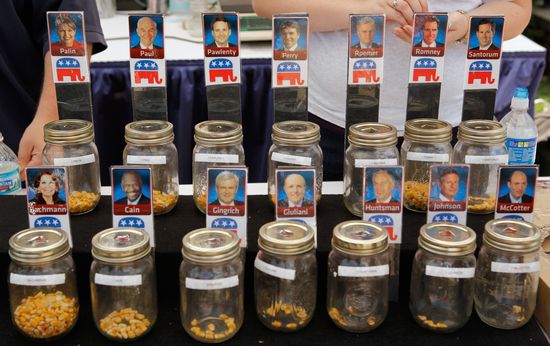
GT_CANDIDATES-CORN-110811

Voters put corn kernels into jars with their favorite Republican presidential candidates on the first day of the Iowa State Fair on August 11, 2011 in Des Moines, Iowa. The candidates, including Mitt Romney, John Huntsman and Newt Gingrich, visited the fair ahead of Saturday's Iowa Straw Poll to greet voters and engage in traditional Iowa campaigning rituals. Eight GOP hopefuls will meet in a nationally televised debate in Ames tonight. By Chip Somodevilla/Getty Images.

Debating HCR’s Constitutionality, Ctd

Robert Levy disputes the pro-ACA interpretation:

The Commerce Power is expansive. But [the Patient Protection and Affordable Care Act or PPACA or ACA]'s mandate stretches beyond dictating how a product may be produced, distributed, exchanged, or consumed. The mandate actually compels that a transaction occur – the purchase of health insurance, which cannot legally be acquired across state lines. Neither an act nor an interstate market exists to be regulated. Essentially, the PPACA mandate is regulatory bootstrapping. Congress forces someone to engage in commerce so it can regulate the activity under the Commerce Clause.

Tackling the notion that the healthcare market is in some way exceptional, Ilya Somin worries about the precedent the ACA sets for congressional power:

In the Sixth Circuit case, Judge Sutton and Judge Boyce Martin resolved the issue by simply ruling that the Commerce Clause gives Congress the power to regulate inactivity on the same basis as "activity." This approach pretty obviously leads to unlimited congressional power to impose mandates. Under current precedent, Congress can regulate any that it has a rational basis for believing that it affects interstate commerce, in the aggregate.

That, of course, is true of virtually any activity of any kind. It is also true of virtually any failure to engage in activities, especially economic transactions. Any failure to purchase a product has some substantial economic effect, at least when combined with similar failures by other people. This is true of failures to purchase broccoli, failures to purchase cars, and so on. …

If the Court upholds the individual mandate, it will not be able to do so in a logically consistent manner without opening the door to virtually any other mandate. As UCLA law professor Adam Winkler points out in his contribution to this symposium, the government's numerous briefs in the various mandate cases all fail to explain how there can be any for Justices who might be inclined to uphold this law, but also want to maintain limits on congressional authority. The dilemma is exacerbated by the fact that this "slippery slope" problem is not merely theoretical.

Your Role In Somalia

Jeffrey Gettlemen, Mark Mazzetti and Eric Schmitt explain how US tax dollars are funding the fighting on the Horn of Africa:

Bancroft Global Development [is] an American private security company that the State Department has indirectly financed to train African troops who have fought a pitched urban battle in the ruins of this city against the Shabab, the Somali militant group allied with Al Qaeda.

The company plays a vital part in the conflict now raging inside Somalia, a country that has been effectively ungoverned and mired in chaos for years. The fight against the Shabab, a group that United States officials fear could someday carry out strikes against the West, has mostly been outsourced to African soldiers and private companies out of reluctance to send American troops back into a country they hastily exited nearly two decades ago.

The Economist speculates about the future of this shadow war. Clinton Watts focuses on the immediate implications al-Shabaab's pullout from Mogadishu.

Understanding The Looters, Ctd

Estate1

A reader writes:

It's interesting to go back and read a speech David Cameron gave in July 2006, when he was leader of the opposition. Though he never uses the phrase, it became famous as his "hug a hoodie" speech, as Labour disparagingly called it at the time. Everyone disparaged it really, and apparently it's come to be seen by Tories as a big blunder of Cameron's early years as leader.

The thing is, the speech is full of good points.

The Cameron of 2006 doesn't excuse wrongdoing – "Individuals are responsible for their actions, and every individual has the choice between doing right and doing wrong" – but he acknowledges that "there are connections between circumstances and behaviour". He recognises that you should punish a criminal, but that it's better to prevent people becoming criminals in the first place, and to do that you look at improving people's lives. He advocates compassion and justice, trust and responsibility, optimism and purpose. Hell, he even uses the word "love" a few times. How rare is it to hear a political speech that does that?

Whatever good points it contains, though, that speech is gone. There's no way a UK politician of any stripe could make it now without being jumped on for justifying thuggery. The riots will be eventually be over and Britons will have to figure out where we go from here. When that time comes, someone ought to be giving the hoodie speech. But I don't think it's possible that anyone, least of all the man who originally gave it, will.

Earlier thoughts of understanding here. The above image is from a series of remixed ads we posted during the election.

The Stigma Of Male Infertility

Margaret Hartmann examines a study on how gender stereotypes determine the extent to which couples share their struggles with friends and family:

[Researchers] found that couples often adjust how much information they share with their loved ones based on whether the man or the woman feels more stigmatized by their reproductive problems. When the woman is more concerned about how people will react to her infertility, both partners share more with friends and family. However, when the man is more concerned about how he'll be perceived, both partners keep their problems quiet.

A Liberal Snaps, Ctd

Kevin Drum is angry with Matt Miller for playing right into Republican hands. Steve Benen analyzes the thinking behind Miller's tantrum:

Based on nothing but my own perceptions and recent experiences, I'm often surprised at how common this is. I’m on a number of email lists, for example, with fellow lefties in various circles, and I’d say the criticisms of Obama on a daily basis, particularly over the last month or so, outnumber criticisms of Republicans by at least 50 to 1. These are folks who know full well who's chiefly responsible for the nation’s self-inflicted wounds, but like Miller, emphasize the fact they’re "mad at Barack Obama" anyway. The unstated message seems to be, "Sure, Republicans have become an American nightmare. That's obvious. In fact, it’s such a given, it's not worth talking about. Instead, let’s denounce the White House…."

Understanding The Public’s Preferred Cuts

Pivoting off Will Wilkinson, Brian Fung argues that to understand what the public's real view on what to cut, we need better polls:

Take this CNN poll, for example. The survey effectively absolves respondents of the responsibility for making a choice. Asking people whether they’d accept cuts to defense spending in one question, and entitlements in another, tricks poll-takers into considering each of these sectors out of their proper context. Such questions are misleading because they presume there is nothing else on the table when respondents know that there are other options the pollster hasn’t mentioned. Choosing not to cut defense spending becomes easier when you know you can just cut from something else that’s not in the question. Lawmakers don’t have that luxury. Neither should poll respondents.