Was MLK A Christianist?

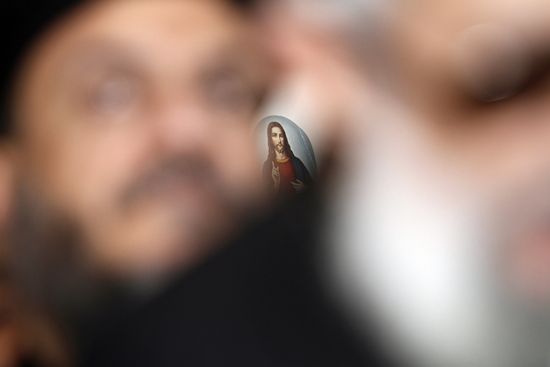
COPTJESUSMohammedAbed:Getty

Alan Jacobs criticizes my desire to see Christianism replaced with a more private, less political Christianity:

[Martin Luther King, Jr.] could have stayed in his prayer closet instead of politicking; he could have attended to his own failures as a Christian, which of course were many; he could have forgiven white Southerners instead of judging them. But no. He became an "outside agitator," marching into ordinary American communities and telling them that their local laws, and indeed in some cases federal laws, were not to be obeyed — and why? Because they conflicted with the law of God! Notice the arrogance with which he associates his cause with God Himself.

His bottom line:

So maybe, just maybe, it's not an utterly privatized and "libertarian" Christianity that we need but rather one that reads the Bible better. But if that's true then the term "Christianism" is vacuous and misleading, and Andrew needs to step back and start over.

Christianism, in my definition, is the fusion of politics and religion for the advancement of political goals. And in that core sense, yes, King was a left-wing Christianist. He used the Bible to make his case, and fought to remove liberties from his fellow citizens in order to expand liberty for all in the name of God. I think it's possible that Christianism can lead to good results. How can one appreciate a man like Wilberforce without it? But it can equally lead to bad results: slavery, Prohibition, the subjugation of women, the persecution of gays, etc. All these were buttressed and perpetuated by Christianist power-politics for centuries. The question is: does this fusion of politics and religion, overall, help or hurt our polity?

I'd say it hurts, because the kind of absolute conviction that divine sanction gives to people is inherently dictatorial and indifferent to the compromises necessary in a diverse, pluralist society. And King's Christianism was crucially leavened by his manifest Christianity. I'd argue that it was his and his movement's moral example of Christian non-violence that truly changed America's heart and broke the politicized Christianist deadlock between the two camps. He didn't just preach his faith as politics, but he practised it in a way very close to Christ's, seeking punishment, enduring imprisonment, and risking death, to bear witness to a deep moral truth about the dignity of every person. This submission to violence, rather than its gun-totin' celebration, is what distinguishes King's Christianism from so much of today's. It embraced its powerlessness, as a paradoxical way to change the world. And that, truly, is Christianity more than Christianism. It is an indirect approach to power.

Imagine a pro-life movement that never sought to make abortion illegal but tried solely to highlight its profound moral implications. Or a Christian movement that simply upheld the virtues of traditional opposite-sex marriage, rather than seeking to ban gay marriage. It would remain a moral movement with possible political consequences. But it seeks first of all to change people's hearts and minds; not corral majorities to control other people's lives. It is about Christian witness, not Christianist power.

Similarly, the gay rights movement is peopled with many Christians, myself included, who deep down view their cause as advancing the Kingdom of God on earth. Our most powerful tool in all this is moral suasion, non-violence and personal testimony. But, for my part, I have never argued for the rights of anyone else to be abridged, just that the government itself should cease baselessly discriminating against some its own citizens. And while I have been quite candid in the religious and spiritual basis of my belief in gay dignity, you will search Virtually Normal for a single sectarian or religious argument for it.

Far from vacuous and misleading, I think this distinction is critical in rescuing conservatism from divine and ideological distortion.

(Photo: Mohammed Abed/Getty.)
“According To The Natural Law …”

Rick Santorum takes Robert P. George's medieval philosophy on the road:

Still: there is an inherent, natural, unbridgeable, definitional difference between a napkin and a paper towel? The argument, it seems to me, defeats itself. A reader adds:

I hate to say it Andrew, but Santorum is right…just not in the way he thinks. Marriage is marriage, and water is water. That is to say, all water is composed of the same elements, regardless of how it appears externally. It can be frozen, bottled, salinated, even flavored, but it's still water. My mother and father are married. You and your husband are married. My ex-roommate and her wife are married. To an observer, these situations look different. But each marriage built a family based on committment, trust, and love.

Also, if Santorum was comparing American beer and water, he was being redundant.

Does Perry Make Palin DOA?

That's how Seth Mandel reads the polling:

In the most recent Gallup polling, Perry’s positive intensity score is at 23, five points higher than Palin’s 18. The full poll, however, shows when Perry and Palin are in the race together, Perry polls at 15 percent to Palin’s 12. (The poll includes Rudy Giuliani​ as well.) Additionally, Perry has the kind of grassroots support, popularity with conservative new media and solid reputation among conservative evangelical voters from which Palin would build a campaign. For Palin to run, she would need to focus her firepower on a moderate establishment candidate, like Romney. But Perry may well begin his official campaign as either the frontrunner or close to it.

There's no doubt they compete for the same electorate. But in a battle for the true believers, my money is on Palin. And she is the incumbent vice-presidential candidate.

The Secessionist Looms, Ctd

Pareene is in fine form:

I mean, Rick Perry may be a neo-Confederate sympathizer with a recurring tendency to bring up secession, but he doesn't look as weird in a photograph as Bachmann does, I guess.

Perry's flirtations with neo-Confederate organizations and symbols — ably documented by Justin Elliott — are so extraordinarily reprehensible that it should immediately and permanently disqualify him from being taken seriously for national office. The Confederacy was not a bunch of generally well-meaning dudes who went a little too far, it was a gang of racist traitors who launched a bloody war to defend a monstrously unjust institution. Having neo-Confederate sympathies in America should be equivalent to supporting the reconstituted Fascist party in Italy, or worse. It should not be considered something that 50 percent of the nation should be willing to look past, or even embrace.

Marriage Equality In New York

A new poll suggests it will be very hard to overturn by a ballot initiative. And this should buck up legislators whose consciences dictated approval:

Nearly seven in ten suburban residents — 69% — and about two-thirds of those upstate — 66% — don’t want the law overturned. 57% of New York City adults agree … 44% of registered voters in New York report they are more likely to vote for a state senator who voted to pass the same-sex marriage law. Three in ten — 30% — are less likely to cast their ballot for such a legislator while nearly one in five — 19% — says it makes no difference to their vote. Seven percent are unsure.

Understanding The Looters

GT_SYMPATHY-FLOWERS_110811

Mary Evans pushes back against the "rioters-as-senseless-brutes" meme emerging in Britain:

It is not that there is much dispute that people should not have to jump for their lives from burning buildings or that people should not steal. That is the easy bit. It is doing the difficult thing – and being prepared to think about why these things happened – that seems to have vanished.

It is not, therefore, that suggestions about the impact of various government cuts ( for example of the EMA and provision for youth services) on communities has not been made. It is that these suggestions are somehow being ruled irrelevant, as if they belonged to a political and moral universe that has nothing to do with behaviour on the streets. This refusal of the possibility of explanation, let alone understanding, empties politics of everything except a crude form of moralism. This moralism can only see the world and its inhabitants as good or evil, the ‘scum’ who need to be swept from the street or the looters who should be shot.

The problem with this theory is that most of the cuts have yet to take effect. A reader thinks our reax "missed an entire point of view, summarized nicely here by a member of the British press":

Most of the people who will be writing, speaking and pontificating about the disorder this weekend have absolutely no idea what it is like to grow up in a community where there are no jobs, no space to live or move, and the police are on the streets stopping-and-searching you as you come home from school. The people who do will be waking up this week in the sure and certain knowledge that after decades of being ignored and marginalised and harassed by the police, after months of not seeing any conceivable hope of a better future confiscated, they are finally on the news.

In one NBC report, a young man in Tottenham was asked if rioting really achieved anything:

"Yes," said the young man. "You wouldn't be talking to me now if we didn't riot, would you? Two months ago we marched to Scotland Yard, more than 2,000 of us, all blacks, and it was peaceful and calm and you know what? Not a word in the press. Last night, a bit of rioting and looting and look around you." 

 … Riots are about power, and they are about catharsis. They are not about poor parenting, or youth services being cut, or any of the other snap explanations that media pundits have been trotting out. Structural inequalities, as a friend of mine remarked today, are not solved by a few pool tables.

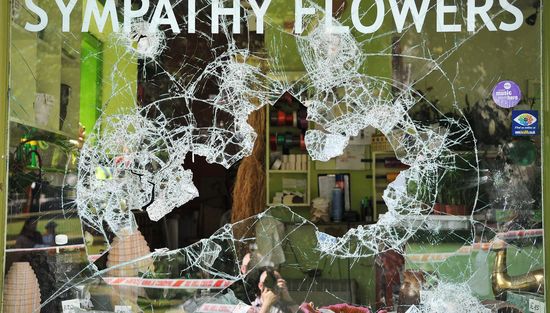
(Photo: The smashed windows of a florist in Haven Green following a night of rioting in Ealing on August 9, 2011 in London, England. By Jim Dyson/Getty Images)

What Romney Once “Believed”

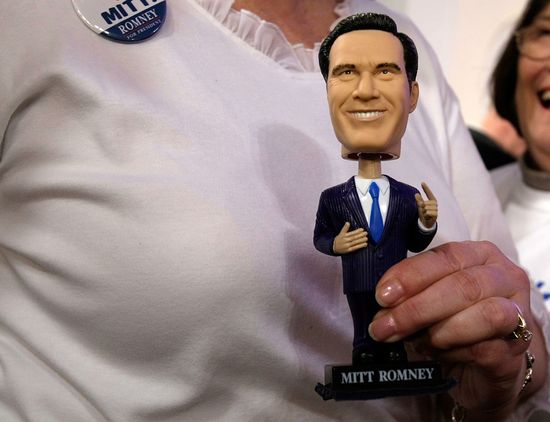
BOBBLEMITTAlexWong:Getty

He was indeed once a fiscal conservative, arguing to Standard and Poor's no less that Massachusetts deserved a good credit rating because of its recent tax hikes:

The presentation to the ratings agency reveals that Romney’s administration made the case to Standard & Poor’s that his state was creditworthy because of both spending cuts — the current preferred GOP method — and new revenues, including fees he imposed and tax “loopholes” he closed. The presentation also prominently cited a controversial set of tax increases in the summer of 2002, which Romney, then a candidate, had opposed.

In other words, standard conservative thinking when it comes to debt. Like David Cameron's austerity measures. Like Barack Obama's and Alan Simpson's preferred, balanced solution. Or in other words, now a career-killer among the radical anti-government populists who now run the GOP. I'd watch for a barb along these lines in the debate tonight (which I'll be live-blogging). If that isn't an easy one for Bachmann, I don't know what is.

The Fairy Tale Of Drew Westen, Ctd

Fareed adds a final kick to the posterior:

Maybe Obama understands that with a budget deficit of 10% of GDP, the second highest in the industrialized world, and a debt that will rise to almost 100% of GDP in a few years, we cannot cavalierly spend another few trillion dollars hoping that will jump-start the economy. Perhaps he believes that while banks need better regulations, America also needs a vibrant banking system, and that in a globalized economy, constraining American banks will only ensure that the world’s largest global financial institutions will be British, German, Swiss and Chinese. He might understand that Larry Summers and Tim Geithner are smart people who, in long careers in public service, got some things wrong but also got many things right. Perhaps he understands that getting entitlement costs under control is in fact a crucial part of stabilizing our fiscal situation, and that you do need both tax increases and spending cuts—cuts that are smaller than they appear because they all start with the 2010 budget, which was boosted by the stimulus. Is all this dangerous weakness, incoherence and appeasement, or is it common sense?

Confessions Of A Black Limbaugh Listener

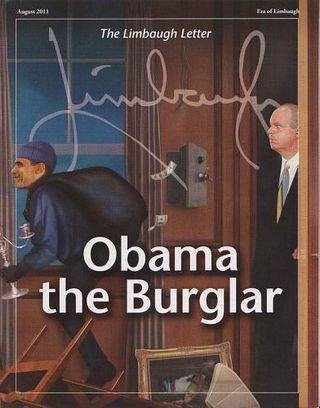
D.R. Tucker has a must-read about the magazine cover that made him stop defending Rush after 15 years:

I became a conservative because I disliked what I saw as the culture of victimology on the left, the tendency to blame all social problems on racism, sexism, anti-Semitism or 2950525200107148304S500x500Q85 homophobia. I felt the left promoted a “grievance industry” that encouraged minority groups to hate members of the majority. Of course, there’s a difference between saying social bigotry is not the cause of the woes of certain groups and saying social bigotry doesn’t exist at all. …

I didn’t vote for Obama. He was too progressive for my center-right tastes. I wanted judges in the mold of Scalia and Thomas on the Supreme Court, not Ginsburg and Breyer. I admired the fact that he chose to run—he had more courage than Powell in that respect—but my support went to John McCain.

Do I regret that vote? No. What I do regret, however, is my inability to see Limbaugh the way the folks I used to debate saw Limbaugh. Because I was obsessed with defending Limbaugh from any criticism, I couldn’t distinguish between legitimate and illegitimate criticism of the man.

Does Limbaugh personally dislike blacks? I can’t credibly make that claim. Has Limbaugh exploited racial stereotypes to make money? The evidence for that is obvious.

End Of Gay Culture Watch

A reader in Seattle writes:

Here's an interesting article about the change in geographic concentration of gay couples in Seattle and surrounding areas. The money quote, in the 5th paragraph, concerns one motive a family of five cites for moving to a quieter neighborhood outside the city: "Out here, we can go to a restaurant and not get stared at because we brought our kids."