Here She Comes!

Ask yourself: if Sarah Palin were not running for president, why on earth would she re-start her "he's an alien" bus tour in Iowa this week? Money quote:

A Gallup survey out Tuesday showed that Palin generates more enthusiasm among GOP voters than most of the candidates already in the race. And as Mississippi Gov. Haley Barbour recently put it, "she could raise enough money to burn a wet mule." … She has plans to return to the state over Labor Day weekend for a Tea Party rally in the Des Moines area.

The latter could be a perfect moment for a formal announcement. Yes, I know she could be squeezing the last drop of the publicity that will end abruptly the minute she says she's not running. And I can't know the future. All I can say is that everything I have ever learned about Palin suggests she will run. It's her divine destiny, as she and countless others believe. And if Rick Perry thought he could suddenly become the focus of attention in Iowa, he forgot someone as radical as he is, with more, er, starbursts.

Why Do Restaurant Websites Suck So Much? Ctd

Screen shot 2011-08-10 at 4.15.55 PM

Many readers are sending us this link:

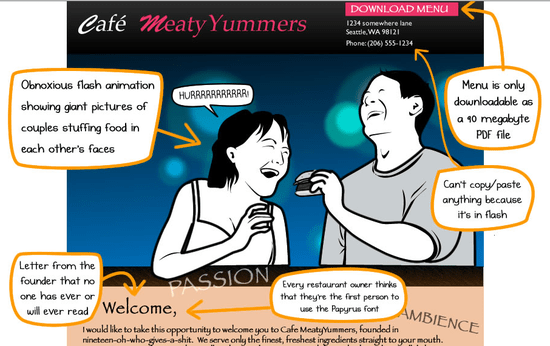
A wonderful internet comic strip, The Oatmeal, covered this topic and nailed it.

The page seems to be down temporarily, but a partial screenshot is seen above. In the meantime, check out the tumblr "Things Never Said About Restaurant Websites". Another reader:

I believe the reason they suck is very simple: they're cheap. As someone who's worked in and around the restaurant industry for many years, I know the ridiculously tight margins they operate on and the under-the-table, corner-cutting way of doing business that is essential if you want to survive. Restaurant managers usually have a friend, or friend of a friend, who designs websites – or even worse, they take a web design class at the Apple store and just do it themselves. Managers have bigger concerns to worry about.

Who needs a restaurant website anyway? We're all going there for the same info: menu, hours, phone number, address. Menupages.com. Done and done.

Another has a different perspective:

As a web programmer, I tend to think that restaurant websites are generally pretty good.  It was typically the case a number of years ago that many of them wanted all the annoying accoutrements, when Flash was all the rage, but those kinds of requests have tapered off.  

In fact, the last few bars/restaurants I did sites for specifically didn't want any of the clanging bells and whistles.  Some of that has to do with wanting to save money (Flash work is expensive), but it has more to do with the fact that they wish to make sure their website shows up correctly on visitors' phones, which means, in practical terms, using only a minimal amount of graphics and a nice, clean design.  

This is increasingly the norm. If you google "Chicago Restaurants" (I work in Chicago) and start clicking on the results, you'll see that, for the most part the music, animation (save for an image slideshow), the buttons with bad Photoshop effects, etc., have gotten scarce.  

Another expert writes:

"Why this bizarre preference for menus in PDF format?" As someone who has built websites for restaurant chains before, this has a very simple answer. Chains usually get their nice-looking printed out menus designed by the same company that does their print advertising. This is supplied to the chain as a PDF file for proofing purposes. When faced with putting a menu on their website, making changes to HTML is intimidating. They cannot generally do it themselves and a programmer would charge several hours of work at $50 to $100 per hour to make a nice looking HTML version. Any future changes to the menu would also have to go to a programmer, though little tweaks wouldn't take much time. On the other hand, being shown once how to upload the latest menu.pdf sitting in their email inbox is easy and a one time expense.

It makes even more sense with big chains that allow individual restaurants to modify their menu with slightly different prices, selection, or layout (all within the approved guidelines of the corporate offices of course). Imagine trying to get a thousand individual IHOP owners to input slightly different menus. But since the menus are all created by the nationally retained advertising firm, it's easy for them to just upload the proofed PDFs to each individual location's website automatically when they are changed.

There's also the issue of end user printing. There's nothing big chains hate more than non-professional looking things with their logos. But what do people do with their favorite restaurants that they repeatedly order from? They print out the menu and tack it onto a bulletin board. HTML is difficult to get a consistent look from, whereas the PDF file format will print the same on any computer. Sound silly? One of the first thing computer illiterate CEOs like to do when looking at a test version of a new website is print it out. Then they throw a hissy fit when the text wraps slightly differently on paper than on the screen.

This is why I left the business world to get a PhD in the social sciences.
The Fruits Of Syrian Sacrifice

The editors of MERIP, an online academic Middle East journal, believe the Syrian revolt caused an irrevocable regional transformation:

[T]he season of Arab revolt, including its Syrian phase, marks the end of an era. It is surely not authoritarianism per se that is disappearing in the Arab world, considering the Saudi quashing of the Bahraini rebellion, for example, or the worrisome signs coming from Egypt under the Supreme Council of the Armed Forces there. But no longer is mass social mobilization against injustice absent from the regional stage. No longer can the will of the people be so blithely ignored. There will be no more hereditary transfers of presidential power in republics, and the notion of uncontested executive authority has been shaken to its core. Even monarchies now want to appear to be on the side of the people, as the Saudi, Kuwaiti and Bahraini royal families clearly do when they recall their envoys to Damascus (their ulterior motives notwithstanding). In Syria, no matter what the outcome of the uprising, there will be new checks and balances on the regime and its coercive apparatus, not because regime insiders will have become democrats, but because they will now fear the street. …. Politics, in short, has returned to the Arab world.

Shlomo Ben-Ami observes that the Syrian protest movement has already blown apart Turkey's attempt at rapprochement with Iran.

Can You Live Without A Credit Card? Ctd

A reader writes:

I went the exact opposite tack in my early years: Can I live without cash?  If I couldn't purchase something with a check or credit card, then I didn't need it that bad.  Mostly that ruled out vending machines (no cokes, snacks or candy, which was good for my waistline) and impulse purchases. 

Checks were common and accepted everywhere, even at art festivals (using one nowadays seems odd).  Credit cards were less common; you almost had to have a card for each individual vendor, be it gas station or department store, so your wallet was HUGE. 

What makes my experience different than many others is that I paid off the credit cards (Visa, gas cards, revolvers – whatever) in full every month.  That "requirement" was factored into the decision to pull out the credit card.  Although it was a challenge, I honestly can't think of a time when I carried a balance on my credit cards.  Not as I worked my way through college or just after graduation when I lived paycheck to paycheck and had to mail the payments on a just-in-time basis or drop them off at the company to get a couple of extra days when needed.  Not when I bought my first house in Houston after its housing bust in the '80s or when I relocated four times for my job.
 
Thirty years later, while I have major credit cards in every flavor (Discover, VISA, MC, AMEX), I don't have an ATM card or debit card (I don't like the idea of a vendor reaching into my account).  Although I definitely carry cash now, I still don't use it often, so the bank trips are infrequent.  I have healthy savings and my only debt is a home mortgage (which is not underwater).  I have all I need and most things I want.  All this thanks to full employment, a conservative outlook on financial risk (I didn't mortgage my houses to the hilt or take out any capital via refi), the good fortune of good health, and lots of hard work and luck along the way.

So I think this is just a matter of self discipline, whether you are opting out of the credit card or cash worlds, because we live in an immediate gratification culture.  I grew up with five siblings, and we weren't wealthy nor exceptionally poor.  We all have respect for financial responsibility (no foreclosures or bankruptcies in the clan).  I know money was tight but we didn't lack for basics (food, clothing, shelter, health care, education) and we didn't miss out on anything of import.  I never recall being told "we can't afford it"; instead Mom always said, "you don't need it."  She was right, and I'm not sure that lesson is taught any longer.

The Importance Of Being Pseudonymous, Ctd

Alan Jacobs questions the ethics of "self-naming" and takes issue with Alexis’s claim that our public lives offline tend toward anonymity:

Imagine a person who comments regularly on certain blogs under a pseudonym, and writes her own blog under a different pseudonym, and then of course "IRL" or "offline" has an official legal name. Not an especially unusual situation, I imagine, and one that few of us would find upsetting or even noteworthy. What if she told one group of friends that her name is Carol Watson and another that it is Tamar Weinberg, while at work and to her family she's known as Jennifer Esposito? Do we have a problem with that? My sense is that most of us would find that kind of creepy – even those of us who find the use of various online names perfectly acceptable. But why? If it's okay online why wouldn't it be okay offline?

… I'm not sure precisely what Alexis has in mind here, but our public identities are attached to a lot of what we do everyday: not just our written and oral exchanges with friends and co-workers, but most of our purchases now that we increasingly use cards rather than cash. More than at any point in human history, the average person's everyday life is made up of statements and actions that are "public, persistent, and attached to [his or her] real identity." So in that sense our expectations for online conversation are outliers.

The Daily Wrap

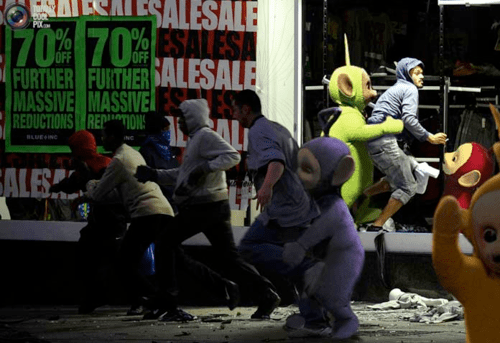
Telelooted
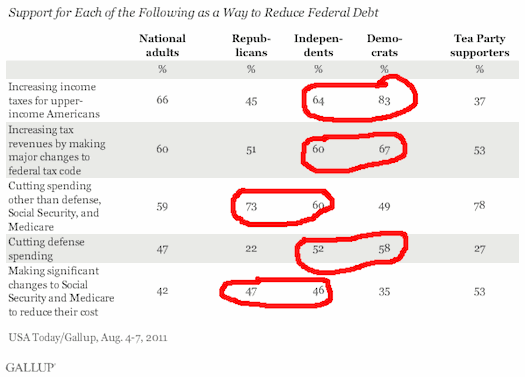
Today on the Dish, Andrew feared Rick Perry's unabashed extremism in such a bad economy and emphasized why minorities have stuck with Obama. Obama's approval rating lows beat out even Kennedy's, and due to the debt debacle, the GOP got a downgrade. Joshua Goldstein predicted a rise in inflation, Tina Dupuy imagined if liberals acted like the Tea Party, and readers remained fiscally conservative with their credit cards in tact. With two thirds of the country wanting high taxes on the wealthy, Andrew put the heat on the Democrats to actually enact some legislation. Santorum made nonsense arguments against marriage equality while the situation for gays improved worldwide. Megyn Kelly fought back against conservatives for maternity leave, Debbie Schlussel accused Whole Foods of jihadism, and the NRA accused Hillary Clinton of teaming up with Iran and North Korea.

Around the world, Vaughan Bell scoped the psychology of London's rioters, Maria Bustillos recalled the emptiness of looters' greed, and the London reax ranged from Max Hastings calling them wild beasts to photoshopped looters. Malise Ruthven grew concerned for ghettoized Muslims, Egypt and Tunisia were suspended in revolution limbo, Israel moved to expand new settlements and block off a future Palestinian state from Jerusalem, and Brad Thor butchered foreign affairs for the layman. Fallows checked the pulse for revolution in China, Michael Lewis weighed two almost impossible plans for saving Europe, and Stephen Cook designated Netanyahu a very vulnerable Israeli Republican.

On the home front, some veterans just wanted you to buy them a beer, while others got douche chills when they get thanked. Wikipedia needed an infusion of new editors, an Atheist came under "Christian" fire, and Rachel Toor tried to calm down nervous academics. Sexy bonobos beat chimps in intelligence, human dignity grew harder to separate from animal dignity, and America prepared for a flux of aging men. Restaurant websites tried to create atmosphere that just doesn't work online, and atheists could gain more acceptance with less yelling and more leading by example.

Chart of the day here, Southerner dissents of the day here, VFYW here, MHB here, and FOTD here.

–Z.P.

(Image from here.)

Tunisia And Egypt In Peril?

GT_TUNIS_110810

Marina Ottaway worries about the two revolutions:

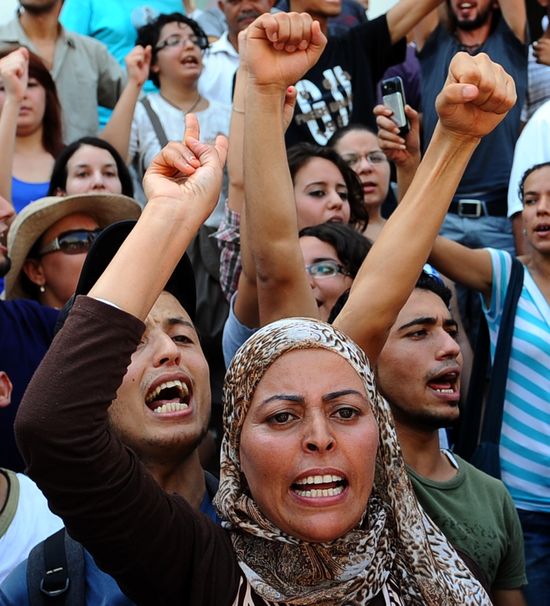
Egypt and Tunisia have entered a dangerous phase of their transitions. The interim governments have little legitimacy—they were set up as caretakers to organize quick elections. But elections are being postponed in both countries, the transition is stretching on and disillusioned crowds are taking to the streets again.

Popular pressure, necessary to maintain the momentum of reform, risks degenerating into the rule of the street. Countries in transition face contradictory imperatives: they need to move fast to elect legitimate governments that can implement real reforms, but they need time to achieve some consensus about the fundamental principles that should underpin the new political system and to enact laws to regulate elections and the formation of political parties. Finding a balance is a difficult task.

Nathan Brown takes a closer look at the Tunisian electoral process, while Erik Churchill puzzles through the country's issue with voter turnout. Larison thinks the US should just forget trying to "help" Egyptian liberals win their elections.

(Photo: People demonstrate on August 8, 2011 in front of Tunis' municipal theatre to demand an independent Justice and a clear break with former president Zine el Abidine Ben Ali's regime. By Fethi Belaid/AFP/Getty Images)