Getting To Withdrawal

Robert Farley thinks through the process of leaving Afghanistan:

In order to keep peace with his security bureaucracy, particularly the military and the CIA, Obama effectively has to negotiate internally for reductions he might hope to make to the current Afghan contingent. The power of the president over his own bureaucracy is limited, as bureaucratic warriors have many means for resisting policies that they dislike.

The United States military may be the most important player in the negotiations, and elements of the military are absolutely dedicated to a narrative of victory in Afghanistan. While the actual impact of the Surge in Iraq will be debated for years, the increase in the size and tempo of military operations in early 2007 along with the major reductions in violence that followed gave the U.S. military a narrative of victory in that conflict. Whatever the shortcomings of U.S. operations in the first stages of the Iraq War, by its end, the Army — and to some extent the Marine Corps — could explain to itself and others that it had learned to fight counterinsurgency in the proper way, and that it had effectively defeated enemy forces in Iraq. The availability of such a narrative may have been crucial to the Army's willingness to acquiesce in the substantial U.S. drawdowns of the past few years.

Applied to Afghanistan, this logic makes the overriding institutional interest of the U.S. military — again, particularly the Army and Marine Corps — relatively simple: Avoid defeat. 

The Emptiness Of Greed

Maria Bustillos remembers the anger after Rodney King and draws a comparison to the current riots in the UK:

[T]here's this materialist idea that a person is to be valued by his possessions, and it doesn't much matter how he acquires them. The "valuable" people are protected by the authorities, and those without "worth," as in "net worth," are not entitled to that protection. "Haves" and "have-nots," we say. … But then maybe you go and grab all this stuff and it's not going to fix you.

Not if you steal it out of a broken window, and maybe not if you steal it in a boardroom either, come to that. We all know this deep down, I believe, and, in 1992, I got such a strong feeling watching this poor kid with his enormous half-wrecked dining table that those who participate in looting understand the emptiness of greed better than anyone. Can the roots of the reduced crime rate in Los Angeles have been set down in those dark days?

An Editor Exodus, Ctd

A reader writes:

Wikipedia's problems have everything to do with the fact that the entrenched editors have long been discouraging new people from joining their ranks. Once upon a time, editing a Wikipedia article was simply a matter of clicking and making a change with the emphasis being on the fact that anyone could do so and that, as a consequence, there was a vibrant back and forth that eventually produced quality articles. As editors staked their turf, however, that free-flowing input dried up, since it became clear that, unless you were "on the board", as it were, any changes you might make would simply be instantly reverted, regardless of the actual quality of your contribution.

As these editorial cliques gained more and more authority over more and more articles, the incentive for casual users of the site to contribute to it dropped, which meant that fewer people were getting any experience editing the articles, much less having any motivation to become major contributors.

The worst part is that Wikipedia actively encouraged this in the hopes that it could shed the stigma of being considered a semi-reliable source of information. Wikipedia wanted to be a real encyclopedia, which meant that they decided that they needed "real" editors who would have authority over their domains. It's a little late for Wikipedia to turn around, now that those editors have lost interest, and say that, no, no, they really do want to return to the days when it was semi-anarchic and fun for everyone.

Face Of The Day

GT_STORE-OWNER-110810

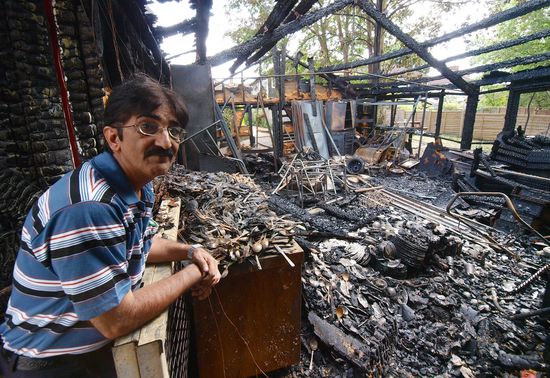
Azim Mohamed, the owner of a cutlery hire company, looks at the charred remains of his business on August 10, 2011, after it was set ablaze following disturbances in north London early Wednesday morning. British Prime Minister David Cameron said a "fightback" was underway Wednesday after four nights of violent riots, as he authorised police to use water cannon for the first time on the mainland. By Max Nash/AFP/Getty Images.

Malkin Award Nominee

"Here's a tip, Whole Foods: there is NOTHING "cosmopolitan" about Islam. In fact, Islam is the antonym to cosmopolitan. Retro is in. Retro back to the year 622 and the values of savages will NEVER be in. Whole Foods . . . For the Organically Conscious Jihadist. Way more humane because, hey, "free range chickens" can run away from the IED. allahu natural fruitbar," – Debbie Schlussel, angry that Whole Foods promoted its Ramadan selection.

Don’t Fear The Editor

Rachel Toor tries to calm students and academics waiting to hear back from their respective editors:

Now that I am a thesis adviser myself, I know that, even after meetings where I think I am being helpful and supportive, my students go home and cry. Later they suck it up and get the work done. I've also had students who internalize all their doubts, never voice them, and then blame me when their writing isn't going well. I'm not telling them exactly what they need to hear in exactly the right way. The problem is me, not them. Some become passive-aggressive. Some just become aggressive. Some never learn a thing.

But I also realize something else in thinking back on that conversation with my student in the cafe. I realize that after graduate school, it's not hard just to find attentive criticism of your writing. It's also a lot harder to find someone to whom you can admit your shame. If you're a new assistant professor, an adjunct, or a lecturer, who can you ask, "Is it normal to feel this way?" when you're feeling inadequate? Who can reassure you that yes, it is normal, and encourage you to keep doing what you're doing? Who can promise—or lie—that it will all be OK?

The Scheisse Hits The Fan

Michael Lewis, the most gifted nonfiction writer in America, explores Germany today. The basic problem with the euro-disaster (which some of us saw coming one day):

One of two things must happen. Either Germans must agree to a new system in which they would be fiscally integrated with other European countries as Indiana is integrated with Mississippi: the tax dollars of ordinary Germans would go into a common coffer and be used to pay for the lifestyle of ordinary Greeks. Or the Greeks (and probably, eventually, every non-German) must introduce “structural reform,” a euphemism for magically and radically transforming themselves into a people as efficient and productive as the Germans. The first solution is pleasant for Greeks but painful for Germans. The second solution is pleasant for Germans but painful, even suicidal, for Greeks.

Are The Tents Crushing Bibi?

GT_ISRAEL_110810

Steven Cook speculates:

Netanyahu (by the way, I refuse to refer to him as “Bibi”) is genetically a Likudnik, but if he had kept his American passport and name – Ben Nitay – he would almost certainly be a Republican.  The economic reforms that he undertook while Finance Minister between 2003 and 2005 were not Jabotinsky’s inspiration, but rather Friedman’s (as in Milton).  The prime minister can be credited with creating an environment conducive to Israel’s security-driven high-tech entrepreneurial success, but gutting social programs, housing subsidies (except for those in the West Bank), and welfare payments that at one time helped make life affordable for average and poorer Israelis may yet come back to haunt Netanyahu.  I would not expect Israel’s high-command to issue cryptic statements about being in “continuous consultation” and bundle the prime minister off to Eilat any time soon, but Netanyahu wasn’t a lock when he “won” the February 2009 elections – Likud actually got one less seat than Kadima – and he seems potentially vulnerable at this moment.

Nadav Eyal shares related thoughts.

(Photo: An Israeli man wears a mask of Israel's Prime Minister Benjamin Netanyahu during a protest against rising housing prices and social inequalities on July 30, 2011 in Tel Aviv, Israel. By Uriel Sinai/Getty Images)

Are Atheists Also Evangelicals? Ctd

A reader writes:

While I agree that Dawkins and Hitchens, and the rest of the New Atheist movement, are probably evangelical at least in the sense of being obsessed with getting people to abandon their old, wrong ways, I think that Aslan has widely missed the mark by positing that religious hypotheses must be given the same weight as any other hypothesis. He says, "The point is that, like any researcher or critic, like any scientist, I'm open to possibilities," but this is misleading, because the possibilities he's apparently open to are unfalsifiable and untestable. His examples, particularly string theory, are a fairly dead giveaway that he's not discussing this fairly.

String theory is a theoretical branch of physics that exists mostly in mathematical models, designed to reconcile two things that we know already to be true (relativity and quantum mechanics). It's an explanation of the gaps in our knowledge, and it may be incomplete. No one is asserting for certain that there are, what, eleven dimensions? They're asserting that if there are, we can explain apparent discrepancies between these two known facts. String theory is an admission of exactly what Aslan is seeking – that our best scientists working with the most advanced technology in the world cannot prove everything.

It is, however, an attempt to prove what they do not yet know, which is much further than the Universal Spirit hypothesis, which accepts ignorance by placing certain items arbitrarily beyond the purview of human knowledge, with no apparent backing other than the fact that the claims made by this hypothesis are outside human knowledge. Is my claim that the universe was created as a giant sauce pan by the Flying Spaghetti Monster any more credible simply because I have designated the true nature of the FSM as "beyond your knowledge"? No. It sounds like a con to say that you simply cannot and will never understand that which I am requiring you to accept as possible.

This Universal Spirit hypothesis, on the other hand, not only requires some very complicated assumptions, but it only exists to explain a single phenomenon that is not apparently countered by other, incongruous phenomena. Some less complicated assumptions yield more sensible answers: that humans respond to certain stimuli in a generally predictable fashion, and one of the more reliable forms of stimuli-response pairing is religious. Heck, we know that humans started out in relatively small groups in Africa. Perhaps religions simply followed a relatively similar evolutionary path in different regions because of the foundations set in our common heritage. The point is that these are all far more sensible, far more testable, far more likely than the existence of a timeless, undetectable, impossibly old and powerful alien intellect that subsists beyond the veil of the material world and guides human evolution to worship it.

In any event, we do agree on one thing: the "God probably isn't real" posters aren't terribly persuasive or helpful. I much preferred the "Good Without God" campaign I saw on many of the MBTA's trains and buses here in Boston last year. I can be hard growing up in a largely theistic society and finding yourself unable to believe as everyone else does. It's also good to confront religious people with atheism in their homes and neighborhoods and workplaces, in the same way it was good to confront them with homosexuality in these personal contexts. A surprising number of people, upon discovering my atheism, have told me that they didn't think I could be an atheist because I was so nice and sensible and not a teenager anymore.

Demonstrating that atheists are a wide variety of people, not just the church-burning black-metal-listening malcontents people seem to think of us as is a much better thing than yelling at them about their beliefs. Nobody likes being approached by Jehovah's Witnesses, but apparently the New Atheists think that the proper way to counter everything from cucumber-sandwich Anglicans to snake-handling born-agains is by informing them, absent any argument or evidence, that they're wrong.

The Psychology Of Riots

Tumblr_lpobddm5LB1r1qajlo1_500

Vaughan Bell explains it using the Elaborated Social Identity Model of crowd behaviour, basically a fancy academic phrase meaning "them vs us":

The problem police face is that in most large threatening crowds only a minority of people are engaging in anti-social acts. Lots of people ‘go along for the ride’ but aren’t the hardcore that kick-off without provocation. If the police wade in with batons indiscriminately, lots of these riot wannabes suddenly start to feel like they’re part of the bigger group and feel justified in ripping the place apart, mostly to throw at the coppers. Suddenly, it’s ‘them’ against ‘us’ and a small policing problem just got much much bigger – like attacking a beehive because you just got stung.

(Photoshop from here.)