A novel Trojan Horse strategy tried in Germany.
Month: August 2011
The Arab Spring And China
Fallows has a feature examining the prospects for democracy in China in context of the Arab Spring. Money quote:
Taiwanese of [the 70s] would tell him that, corrupt or not, the party was steadily bringing prosperity. Or that there was no point in complaining, since the party would eliminate anyone who challenged its rule. The parallel with mainland China was obvious. A generation later, Taiwan had become democratized.
Conceivably, that is what another generation might mean for the mainland—especially if the next wave of rulers are less hair-trigger about security, and more concerned about the lobotomizing effects on their society of, for instance, making it so hard to use the Internet. Which in turn is part of a climate that keeps their universities from becoming magnets for the world’s talent, which in turn puts a drag on China’s attempts to foster the Apples, Googles, GEs of the future. We don’t know, but we can guess that whatever China’s situation is, a generation from now, we will be able to look back and find signs that it was fated all along. “People predicted the fall of the Chinese Communist Party in 1989, and it didn’t happen,” Perry Link told me. “People did not predict the fall of the Soviet Union in 1991, and it did happen. I’m sure that whatever happens in China, or doesn’t, we will be able to look back and say why.” If only it were possible to do that now.
Jacob Stokes sees weakness in the Chinese regime. Amitav Acharya speculates about the spread of democracy in Asia more broadly.
Mental Health Break
About time for another tilt-shift:
Ryan Killackey writes:
I worked on this project on and off for over a year and a half. It is composed of over 10,000 photos shot in California by my wife and me.
(Hat tip: Eugene Wayne, via our Facebook page)
A Liberal Snaps
Matt Miller lets it rip on the president.
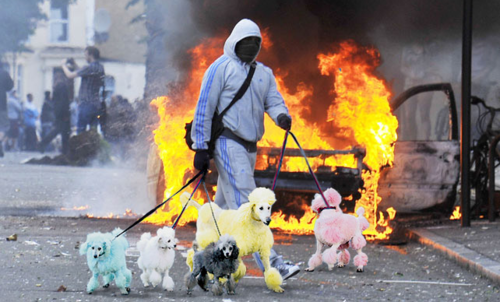
Photo-Shopping Looters

The Equality Wave
Charles Kenny highlights the fact that support for marriage equality in the US has grown "from one-third to more than half of the public in just seven years." He spots similar shifts worldwide:
[D]iscrimination against homosexuals is yet one more area where we are seeing signs of progress. Even while a married lesbian couple in India had to flee threats of honor killings in India last month, World Values Survey results find that the proportion of Indians saying homosexuality is "never justifiable" has halved in less than 20 years, from 89 percent in 1990 to 48 percent in 2008. That discriminatory culture appears on the wane suggests two things. First, quality of life is heading in the right direction for minority groups worldwide. And, second, this change will be to the world's great benefit in terms of improved development outcomes.
“Douche Chills”
A reader writes:
One of the things I love about the Dish is the way that diverse, seemingly unrelated threads can connect in meaningful ways.
Case in point: Every time I witness the awkwardness of a superficial "Thank you for your service" exchange, I get "douche chills." Of course these men and women should be thanked, but it can be done in more meaningful, thoughtful, and personal ways. Using that boilerplate phrase – and making damn sure everyone around you hears it – makes the exchange all about showing everyone what a great and patriotic American you are. That act of drawing unnecessary attention to oneself – just like the loud talker on the movie line from "Annie Hall" – sends me into "Fremdschamen" overdrive.
The View From Your Window

Santiago, Cuba, 7.17 pm
Can You Live Without A Credit Card? Ctd
A reader writes:
Not having a credit card doesn't mean you "actually live like a fiscal conservative". I buy everything I can with my credit card, using it several times a day, every day. I pay off my balance every month, in full. I am fully living within my means and buying only what I can afford. Are you more fiscally conservative than me? Of course not. People have been living beyond their means for as long as there has been credit. It didn't start with credit cards.
Well, think of my lack of a card as a function of my lesser faith in my own self-control. Another writes:
A fiscal conservative doesn't spend more because the plastic in his wallet is a credit card rather than a debit card. That is controlled by his internal budgetary thinking.
Which leaves the important difference between these two cards: The debit card gives the merchant a direct hook into your bank account. Perhaps for even more than you think you are being charged. On any dispute, you are fighting to get your money back. With the credit card, on any dispute, you are in the much better position of explaining why you aren't going to pay. I have credit cards that I pay off in full each month, including an Amex card. Debit cards may sound good, but they come with less legal protection than credit cards.
Another:
If you are fiscally conservative, credit cards can A) get you things – points, cash rewards, etc. B) give you much better consumer protection (many Amex cards double warranties and cover accidental damage) C) as you've discovered, give you great credit. I don't know how many credit cards I actually even have at this point, but I only use one of them really (the one with the best benefits), use it for everything I possibly can and pay it off IN FULL every month. No downside, all of the upside. And every year there are new deals on cards (recently there was a Chase card that gave you 50k Southwest points for signing up). Use it, get the reward, don't use it anymore unless you find that is the best reward for you. Your credit score will go through the roof as your credit to debt ratio becomes crazy good.
Work the system my friend, work the system.
Dissents Of The Day
A reader writes:
"Beautifully expressed"? That's what you called this. Well, maybe. It's certainly well written. But I'm surprised that it didn't get a bunch of votes for a Moore Award. "The planter mentality." Really? They can't just be misguided, uneducated, and wrong? They have to be human traffickers worth going to war over?
Another is more direct:
Okay, seriously, fuck this reader. As a Southern liberal who voted for Obama and gladly will again in 2012, I took offense to almost every word of that sanctimonious tripe.
I'd prefer to spend my life chained to the most backwards, Tea-Party, Limbaugh-listening, gun-toting, NASCAR-loving, backwoods hillbilly you've ever seen than to sit down for a single drink with this reader. It is one thing to be constantly condescended to by the rest of the country because we have funny accents and sweet tea. I am used to the constant reminders of the sins of our fathers (as if the sins were confined to one corner of the country). The Bible-belt moniker no longer bothers me like it used to.
However, one thing I will never get used to is the phenomenon of self-righteous Northerners talking about us as if we all love Jesus and guns and hate non-whites. Almost without fail, these are people who, other than the occasional trip to South Beach, have never been south of the Potomac; who have never lived in a small town; who have never seen a sunset in Texas; who have never never been to Shiloh, or Sharpsburg, or Mannassas, or Vicksburg; who think Faulkner is great because of his stylistic idiosyncrasies and who read the stories of Flannery O'Connor with horror and confusion rather than wonder; who have never loved their racist grandparents simply because family is family; who could not tell the difference between a Tennessee accent and a West Texas drawl; who have never seen the true devotion and love and warmth of the fundamentalist Christians they hate so vehemently.
When I was a boy, I loved the South. When I was a teenager, I hated it, wanted out. Now, I love it all over again, but for different reasons. I know the history of the place, and I know the mentality of so much of the Southern population. I know many Tea Partiers and NRA members and hard-line pro-lifers myself. I love many of them. Some of them are family. I love them too. I disagree with them, sometimes profoundly, but when you grow up with it, you learn to see beyond the caricature painted so crudely in the editorial pages and by your smug, self-satisfied reader. You learn that these people are every bit as capable of real compassion and sacrifice as any Northern son.
Your reader does not understand this place – does not care to try – because he/she does not like guns or Baptist churches or country music. That's fine. Your reader must sleep comfortably knowing that his fathers were on the right side of history. Well done. He/she sure earned his place atop the moral totem pole.
Your reader and I will likely vote the same way in 2012. Your reader, though, is an asshole.
Another:
I'm a Southerner and a Dish reader. Imagine my surprise when I read on your blog that in 2008 I viewed the election as "a nigger up against a son of the South". I understand that those weren't your words, but you believed that it was a sentiment worth posting. I felt sick to my stomach that you would post childish rantings of someone who lazily lumps whole groups of people into a simplistic category of evil. Try to maintain some objectivity and don't let your emotions make you a hypocrite. Such mean-spirited generalizations are not tolerated against blacks or gays, and neither should they be tolerated against an entire people.
Another:
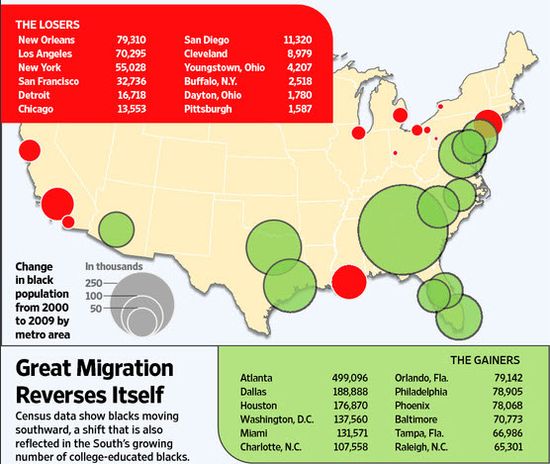
To dignify that email is beneath you. The reader who wrote it is beneath contempt, not to mention completely ignorant of today's South, where the "niggers" are returning in droves.
(Map via All Economics Is Local)
 The Dish