When Crazies Go On Cable

Jeff Stein demolishes the odd claim that Iran was responsible for downing the US helicopter in Afghanistan made by novelist Brad Thor, one of Glenn Beck's favorite "counterterrorism" analysts:

Asked about the helicopter incident, Thor started off with a riff out of right field, that the Afghan government is “riddled with Iranian spies.” He then offered CNN host John King a convoluted explanation of the weapon suspected of downing the helicopter, which seems to have been a rocket-propelled grenade, as something uniquely Iranian (as opposed to the Pakistan-supplied weapons they’ve been using for years).

Thor, whom King had introduced as someone “familiar with these types of operations” — which one can only hope he's regretted by now —  called them "flying IUD's." Surely he meant IED's.

Video of the debacle here (Thor's craziness at around the 4 minute mark).

“A Dagger Aimed At The Two-State Solution”

800px-PikiWiki_Israel_6084_Har_Homa

Hussein Ibish blasts Bibi's move to expand Har Homa, a settlement outside Jerusalem:

All Israeli settlement activity is problematic because it makes an eventual border agreement more difficult and increases the size of Israeli constituencies opposed to territorial compromise, but Har Homa is no ordinary colony.

It is miles from the centers of Israeli government in West Jerusalem and the Holy Basin in occupied East Jerusalem, the two areas that define the city in the public imagination. Har Homa lies at the extreme southwest corner of the large chunk of West Bank territory Israel redefined as "municipal Jerusalem" after seizing the territory in 1967. It is a shiny hilltop redoubt with only one entrance, in many ways reminiscent of a fortified castle. It cuts so deeply into the West Bank that it towers directly over Bethlehem, one of the most important Palestinian cities, and the new housing units will occupy an additional ridge.

If completed, Har Homa would almost close the ring of settlements cutting off the rest of the West Bank from East Jerusalem. The apparent purpose is to put to rest any notions that Jerusalem can serve as the capital of a Palestinian state as well as the state of Israel.

The State Department says it's upset over the new expansion, sparking predictable outrage from Commentary.

(Photo by Yehudit Garinkol via Wiki)

Quote For The Day

"If liberals were doing to their country what extremist tea party Republicans are doing to theirs – it would be called unpatriotic. A whole tsunami of sound bites would sweep the country calling for the sabotage to stop… If liberals did this to their own country they’d be called criminals. The tea party did do this to their own country and they are treated like avant-garde Civil War reenactors," – Tina Dupuy.

London Riot Reax: The UK Press

120773968

Max Hastings, The Daily Mail:

They are essentially wild beasts. I use that phrase advisedly, because it seems appropriate to young people bereft of the discipline that might make them employable; of the conscience that distinguishes between right and wrong. They respond only to instinctive animal impulses — to eat and drink, have sex, seize or destroy the accessible property of others. Their behaviour on the streets resembled that of the polar bear which attacked a Norwegian tourist camp last week. They were doing what came naturally and, unlike the bear, no one even shot them for it.

Amol Rajan, The Independent:

Revolutions are not born of hooliganism. These young people are not an organised movement with clear aims. They have no obvious leader, no head office, no command structure and no hierarchy. Far from storming Britain's Bastille, they are thieving trainers and LCD screens to flog on eBay. Nor is this is a direct response to Government austerity measures. Many of those rioting couldn't spell "austerity", let alone distinguish between the spending plans of Government and opposition.

Alex Massie, The Spectator:

Tories should not be surprised by these riots. Human nature being what it is the appeal of the mob – and, of course, for mob rule – remains a constant. True, the institutions that defend society against these kinds of outbreak – family, police, parliament and so on – may be thought weaker than in the past. Nevertheless they remain strong enough that, actually, British society is not, in the main, "broken". Pockets of terrible problems remain of course but when was it ever otherwise?

Zoe Williams, The Guardian:

This is what happens when people don't have anything, when they have their noses constantly rubbed in stuff they can't afford, and they have no reason ever to believe that they will be able to afford it. Hiller takes up this idea: "Consumer society relies on your ability to participate in it. So what we recognise as a consumer now was born out of shorter hours, higher wages and the availability of credit. If you're dealing with a lot of people who don't have the last two, that contract doesn't work. They seem to be targeting the stores selling goods they would normally consume. So perhaps they're rebelling against the system that denies its bounty to them because they can't afford it."

Tony Parsons, Daily Mirror:

Those involved – or their ­apologists – can bleat that it is about unemployment, or police violence, or the cuts in public services. But that is all rubbish. The people who are out on our streets robbing, burning, looting, throwing bottles and putting people of the minimum wage out of a job are self-pitying scumbags.

Sarah Sands, The Evening Standard:

It seems to me insulting and naïve to say that the rioters lacked entertainment. If they want something to do, they can start by cleaning up the streets. Youth unemployment is blamed but many of those on the streets were school age. "This country has lost something," said Mr Biber, and he is right. Tony Blair saw that there was a terrible cost to the erosion of institutional deference and put out his sandbags with something called the Respect agenda. Far too late.

Trevor Kavanagh, The Sun:

Don't blame the police on the streets of Hackney, Croydon or Brixton for letting Britain down.

Blame their politically-correct commanders and the handwringing politicians who adopt the cringe position when the "underprivileged" resort to violence. Blame the Macpherson Report which emasculated our police by branding the entire force "institutionally racist". Blame lawmakers like Justice Secretary Ken Clarke or Labour's "equalities" crusader Harriet Harman who believe a slap on the wrist is the answer. And blame hypocrites like Ken Livingstone and the race relations industry who have made a good living out of grievance politics and the victimhood of workshy whingers.

A. McE, The Economist:

The most intriguing explanation for misbehaviour so far was offered to Mark Stone, a Sky News reporter, who recorded looting in Clapham Junction on his phone. "Are you proud of what you're doing?" he asked one young woman who was stealing goods from a smashed-up store. "I’m just getting my taxes back," she replied. As appealing as this may be to Milton Friedman followers (in other circumstances), it is a pretty rubbish excuse for pillaging.

Charles Moore, The Telegraph:

One of the worst effects of the boom culture which even now, after more than three years of financial smash, infects our politics, is that it is considered larky to break the civil peace. During the tuition fee protests, organisations such as UK Uncut tried stunts such as “peacefully” occupying Fortnum & Mason, telling those who objected that they lacked a sense of humour. Nice people are shocked that Charlie Gilmour, Cambridge undergraduate and son of a rock star, was sent to prison for “only” swinging on banners at the Cenotaph.

Yet it is important to recover the sense that such disorder is not cost-free. This aggressive version of alternative comedy is now being imitated lower down the educational and social scale by the hoodies dancing around with stolen booze and phones. Returning to London yesterday, the Mayor, Boris Johnson, made a good point when he attacked the “jocular greed and brutality” of the looters. If you actually try to live your life, bring up your children or run your business in such a culture, it is no joke.

Matina Stevis, The Guardian:

London doesn't want to be Athens in 2008, or Paris in 2005 and 2007. A good place to start after the traumatic events of the last few days is to not shove the more complex problems under the carpet and pretend that the riots happened in a vacuum. If England is to learn from urban violence in other European cities, it ought to address the motivations and grievances of those participating in it. If it doesn't, trouble will return with a vengeance and it will hurt more, as it has in Athens.

Morning Star:

It is meaningless complaining that many teenagers show no respect without appreciating the reality that they too are often treated without respect.

Maurice McLeod, The Spectator:

The police — who, from what I saw, behaved with incredible control — can only do what their numbers allow. They rely on those that want to commit crime fearing being caught and for the rest of us to feel empowered to stand up to them when they get too brave. Sadly, none of that happened last night.

Nigel Morris, The Independent:

The pictures of blazing buildings in Tottenham, Hackney, Croydon and Ealing look likely to become the defining images of David Cameron's early days in Downing Street. Now he faces a massive test of his leadership qualities as the Government and police attempt to bring the lawlessness under control. If the violence continues, Mr Cameron's reputation will suffer a blow from which it could be impossible to recover.

Philip Johnston, The Telegraph:

Yet the riots we are seeing now are fundamentally different from those that have gone before. They might, ostensibly, have been triggered by the police shooting of Mark Duggan, a notorious gangster, in north London; but they are fuelled by pure greed, by a belief that something can be had for nothing. The usual brakes on such behaviour – either an appreciation that it is wrong, or by the prospect that the culprit will be caught and punished – are largely absent.

For this, we have to thank four decades of politically correct policing, and a gradual breakdown of the informal network of authority figures that once provided an additional element of control over the bad behaviour of young people. Adults are now reluctant, or too scared, to step in and stop things getting out of hand, or to impose a wider moral code – and in any case, they are no longer listened to. Deference to age and authority has been eroded by years of genuflection to the twin gods of multiculturalism and community cohesion.

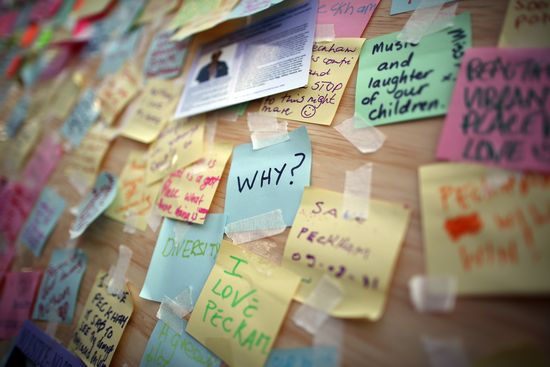
(Photo: A boarded up window of a discount store in Peckham carries notes of peace on August 10, 2011 in London, England. Hundreds of positive messages have appeared on the board in the last 24 hours calling for peace and tolerance. London had a mostly quiet night after 16,000 police were deployed.Trouble erupted in other cities, mosy notably Manchester, Birmingham and Nottingham. By Peter Macdiarmid/Getty Images.)

Most Americans Are Socialists

At least that's what they tell CNN's pollsters:

According to the survey, only a third say that taxes on wealthy people should be kept low because higher-income Americans help create jobs, with 62 percent saying that taxes on the wealthy should be high so the government can use the money for programs to help lower-income Americans.

"That sentiment has changed little since the 1990s," adds Holland.

The External Threat To European Muslims

GT_VOGEL_110809

Malise Ruthven, in the course of analyzing the dangers of the anti-Muslim right in Europe, points to another problem that the Islamic community faces:

Despite the challenges to social harmony posed by burqa-clad women, or even the occasional act of violence driven by rage at the host society’s perceived hostility, or indifference, the deeper dangers posed by a growing Muslim minority in Europe are not to the host communities: they are rather to the Muslims themselves. The export of the ultra-conservative, anti-integrationist cult of Salafism from the Arabian peninsula and similar cults from South Asia—with doctrines that enjoin disdain for, even hatred of European values and life-styles—is a real threat to social harmony, because they serve to ghettoize Muslims, to create in them a sense that they are a people apart.

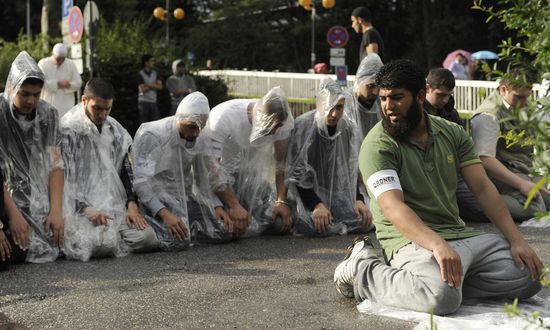
(Photo: People pray before radical Muslim cleric Pierre Vogel spoke during a gathering of sympathizers on July 9, 2011 in Hamburg, Germany. Vogel, a founder of the Germany-based Salafist organization Einladung Zum Paradies (EZP), or Invitation To Paradise, is known for his charismatic appeal to young Muslims, his diatribes against homosexuals, his rejection of religious diversity and his sympathy for former Al-Qaeda leader Osama bin Laden. By Christian Augustin/Getty Images)

Inflating Our Way Out Of Debt

Joshua Goldstein says it happens:

How will the USA ever pay it back? Historically, there is a way that countries pay huge war debts. They print too much of their currency and cause its value to fall, thereby letting themselves pay off debts with funny money instead of valuable money. This is a huge simplification but explains the core of what happens. My 1988 book Long Cycles showed that over five centuries recurrent spikes of inflation followed major wars. In the past decade U.S. wars have been far from major in historical terms, and the current quasi-recession holds down inflation for now, but over the coming years I consider inflation likely.

Why Do Restaurant Websites Suck So Much?

Screen shot 2011-08-10 at 1.30.54 AM

Farhad Manjoo investigates:

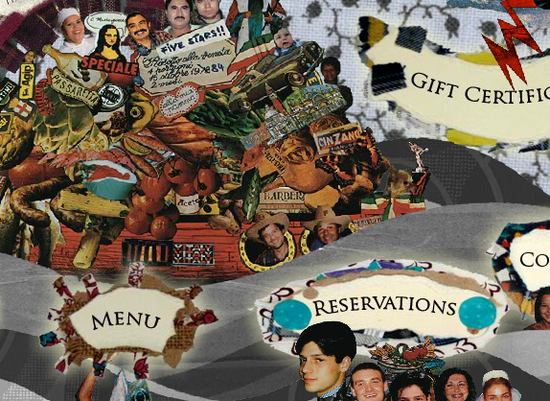
[T]he best answer I found was this: Restaurant sites are the product of restaurant culture. These nightmarish websites were spawned by restaurateurs who mistakenly believe they can control the online world the same way they lord over a restaurant. "In restaurants, the expertise is in the kitchen and in hospitality in general," says Eng San Kho, a partner at the New York design firm Love and War, which has created several unusually great restaurant sites (more on those in a bit). "People in restaurants have a sense that they want to create an entertainment experience online—that's why disco music starts, that's why Flash slideshows open. They think they can still play the host even here online."

The above screenshot is from the website for Cavatore, an Italian restaurant in Houston "that hired Web designers who were either a) on a Monty Python-besotted acid trip, or b) looking to induce epileptic seizures."

How Should We Approach Soldiers? Ctd

A reader writes:

As a veteran of nearly 19 years, my advice is just don’t say anything. Not to sound rude, but I neither need nor want your thanks. I didn’t join the Navy for the accolades of strangers. I wasn’t drafted and nor was I forced or pressured to join. I knew what I was getting into when I signed up. If you find yourself at an airport and have the urge to thank a serviceman, find one in a lounge and anonymously buy them a beer or pay their lunch tab. You’ll feel good about your mitzvah and we will avoid the public accolades, as I feel most humble people would want to do, but still get that feeling that someone out there gives a shit.

Another writes:

When I got back from Afghanistan a few years back, my friend and I were walking through an airport in uniform when a guy walked up to us and said, “Thank you so much. I really appreciate your service.” My buddy, Chris, who had been in mid-sentence and was getting annoyed, frankly, by all the thanks we were receiving, replied, “Great. Why don’t you buy us a beer?” The man, stunned, was scrambling for a response when Chris said, “I guess you don’t appreciate our service that damn much.” The guy ended up buying us both beers and running off to catch his flight. “That’s one less person who’ll interrupt a soldier’s conversation,” Chris said.

Another:

As a new Airman in 1965 I remember eating out in San Antonio with a few of my platoon mates and having someone pick up the check.  We never found out who it was or even knew it had been done until we tried to pay when we left.  I have done the same on a few occasions since.

Another:

I’m noticing this topic springing up around the Internet in the past few months, especially on Tom Ricks’ blog.  (A recent theme is the culture of entitlement that is now taking hold in the vet community as they come to see free drinks as a given.) You might be interested in my comment that Ricks reposted as a full post.

My take is that “thank you” is a poorly thought-out statement. We have gone too far in our national effort to atone for Vietnam. In concrete terms, my service in Iraq did nothing for anyone in the United States or Iraq.  The only conclusion I can come to is that it encouraged not just ill will, but violent action toward Americans. Only the tiniest handful of special operators are out there killing anyone who was ever gonna hop on a plane and start laying IEDs in Times Square.  The rest are killing people who probably never had to be killed.  

It’s not fun to be thanked for that.  It also makes it really difficult to tell the thanker what really happened and what I really think of the war. The objective part of me tries to see the innocent intention behind the words, but mostly it feels like we are avoiding a real conversation about the responsibilities of citizenship in wartime.