Separating Human From Animal

Cory Cotten-Potter argues it's harder than you think:

GT_CHIMPANZEE_110809 When humanity is examined in a scientific context most of the traditional theories are problematic.  Man is a rational animal, yes, but the great apes have been shown to be capable of logical reasoning, and there is evidence to suggest that African grey parrots should be added to the list.  Man is a tool-using animal, but so are apes, dolphins, elephants, and others. Human dignity as a defining concept offers little help; although it is an integral part of many political, religious, and philosophical texts and may help shape our valuation of humanity, there is no consensus regarding its conceptual origin. Many agree that humans have an innate and inalienable dignity, yet the concept of dignity is usually proscriptive regarding humanity’s actions, not descriptive of humanity’s condition.

(Photo: A chimpanzee in the Budongo Trail at Edinburgh Zoo holds a chimp proof camera on January 26, 2010 in Edinburgh, Scotland. The 11 chimps at the zoo are being featured in a BBC Natural Worl Documentry on January 27. They have been taking part in a voluntary study called "The Chimpcam Project," a collaboration between the Royal Zoological Society, University of Stirling and Burning Gold productions. The chimps have experienced video streaming for the first time, learned how to use touch screen technology and have been given the camera to shoot their own footage. By Jeff J. Mitchell/Getty Images)
The Old Man Boom

Room For Debate asks contributors to discuss the finding that "the number of men age 65 and older increased by 21 percent from 2000 to 2010, nearly double the 11.2 percent growth rate for women in that age group." Demographer Ronald Lee augments the data:

This difference reflects a change in earlier smoking behavior for men and women. Men took up smoking earlier in the century than women, so male life expectancy experienced its period of slow growth a while ago while the sex gap in mortality widened. Women started smoking later, and the slow improvement in their life expectancy reflects this.

Alicia H. Munnell weighs "cost vs benefits":

[T]he convergence in life expectancy may well lead to an improvement in the economic well-being of older Americans.

Of all the factors associated with poverty in old age, the most critical is to be a woman without a husband. Nonmarried women who enter retirement tend to end up poor, because the U.S. retirement income system bases benefits on earnings, and women have lower lifetime earnings than men. Married women, who share in their husband’s benefits, fare much better than single women. Only 8 percent of married women aged 65 to 69 are poor or near poor, compared to 28 percent of the nonmarried.

Chart Of The Day

Chart1

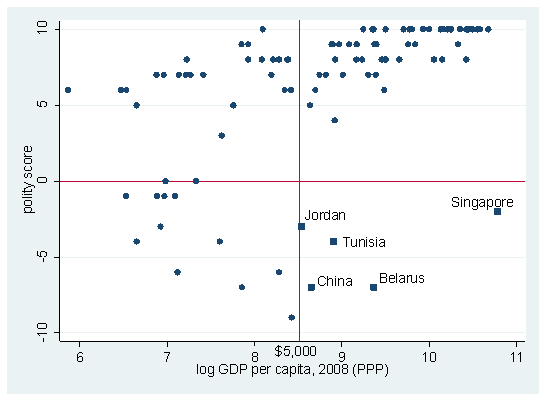
Dani Rodrik captions:

Can you get rich without democracy? Yes if you are an individual, but probably not if you are an entire country. As the figure below shows, there are very few countries that have developed beyond $5,000 in 2005 PPP dollars without becoming democracies somewhere along the way (unless they are an oil economy)…The exceptions in the chart are interesting.

An Editor Exodus

Adrian Chen explains why Wikipedia is in trouble:

According to [Founder Jimmy] Wales a lot of the core Wikipedians have simply aged out, got married and found that they have better things to do with their time. Previous rumors of Wikipedia's demise have focused on a lack of any new stuff to add; but this seems like a real existential threat.

Wikipedia needs to get cool again, somehow. When Wikipedia launched in the early naughts it was attractively subversive—it pissed off your teachers, journalists and any square over 40, basically. Idealistic young nerds flocked to the site with that early web 2.0 communitarian fervor. But new editors aren't showing up at the same rate. After years at the top result on practically every Google search, Wikipedia has lost its urgency.

Jon Mitchell looks at what the company is doing to stay fresh:

Wikimedia has put out an A-to-Z list of new, worldwide educational programs designed to get students to contribute editing and writing. Last month, Wikipedia rolled out an interface for users to rate the quality of Wikipedia pages, as well as to indicate whether they are knowledgeable about the topic. This tool could be used both to compensate for diminishing editorial support by prioritizing low-rated articles, and it could also be used to identify new potential editors.

Along those lines, Nathan Pippenger plugs a study on identifying and incentivizing Wikipedia’s "coolfarmers."

The Daily Wrap

Tweet
Today on the Dish, Andrew envisioned Obama's path to winning the fall with tax reforms a la Reagan, and burrowed into the theology and strategy of Rick Perry, the Christianist's Christianist. The Palins welcomed a new baby to the family on the heels of another quick marriage, Andrew defended Bachmann's crazy eyes on Newsweek as being a trait of her own, and Ryan Lizza was startled by Bachmann's pro-slavery influences. Pete Wehner asked tea-partiers to shame Judson Phillips, Beinart put America's decline in historical context, and Chait deconstructed Westen's fairy tale using Roosevelt as an example. Nate Silver called out S&P but Andrew saw it as necessary for the Grand Bargain, while Drezner and Michael Cohen followed up on the federal crackup. Drum solicited constructive criticism about how to fix the economy but international economists weren't optimistic. The right responded with calls to impeach Obama but they have already ruined themselves in the polls.

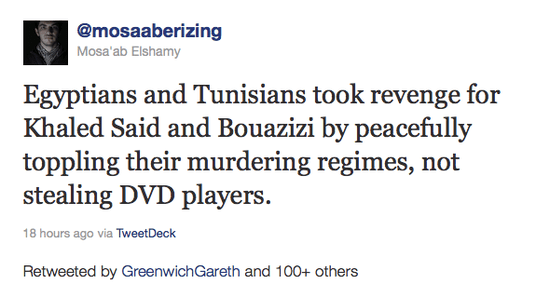
On the London riots, Andrew saw comparisons to DC's looting in 1990 and Egypt's revolutionaries reminded everyone that they didn't get their country back by stealing DVD players. Some looters robbed injured kids, sales of metal baseball bats skyrocketed, some fought back peacefully, and John Derbyshire opted to let London burn. In other international news, Congress used their important vacation time to travel to Israel, and the protesters in Israel forced the government to look to defense cuts there as well. Blake Hounshell didn't think Assad had much time left in Syria while disagreements grew in Tahrir Square at the start of Mubarak's trial. Dahlia Lithwick emphasized that Rumsfeld torture could happen to you, and we were pretty sure Russia has not attacked the US recently. Joshua Foust questioned US deaths in Afghanistan because we shouldn't still be there; meanwhile veterans were happy to be thanked once they've told you how they served.

Andrew defended Bert and Ernie's right to not be gay, the Republican party was close to winning the fight in breaking up longterm families, a poor family could sell their used microwave for three days worth of food, and anonymous identities online remained important for public discourse.

Chart of the day here, beard redux here, FOTD here, MHB here, VFYW here, and VFYW winner #62 here.

–Z.P.

What Are They Dying For?

GT_MARINES_110809

Joshua Foust uses the recent helicopter crash in Afghanistan to remind of the war's grim reality:

[A]s shocking and as sad as the loss of 30 American troops is, the fundamental strategic picture of the war hasn’t changed. Nearly 50 troops have died in Afghanistan so far in August; while that’s high, 65 ISAF troops died in June. The number of soldiers killed says very little about their effectiveness: In war, fighting can be hard with many dead but ultimately serving some purpose. The real scandal in Afghanistan isn’t that Americans are getting killed. The real scandal is that we don’t know why we’re there.

Dan Savage is succinct:

Osama is dead. Declare victory, get the fuck out.

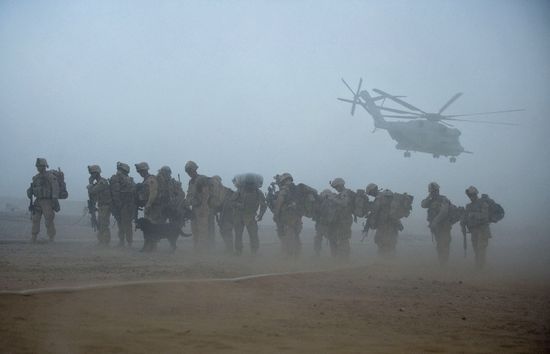
(Photo: US Marines from the 2nd Battalion, 8th Marine Regiment of the 2nd Marine Expeditionary Brigade wait for helicopter transport as part of Operation Khanjar at Camp Dwyer in Helmand Province in Afghanistan on July 2, 2009.

US Marines launched a major offensive into the Taliban heartlands of southern Afghanistan before dawn as President Barack Obama's new war plan swung into action. With dozens of aircraft ferrying out troops from various bases, the assault aimed to insert forces into insurgent strongholds in Helmand province in what officers said was the biggest offensive airlift by the Marines since Vietnam. Operation Khanjar (Strike of the Sword), involving nearly 4,000 US forces as well as 650 Afghan police and soldiers, would bring security to the Helmand River valley ahead of presidential elections on August 20, commanders aid. By Manpreet Romana/AFP/Getty Images)

Twisting Adam Smith

Shikha Dalmia corrals neocon attempts to enlist the philosopher's analysis of British foreign policy in their cause:

Nowhere does [Smith] suggest that maintaining absolute defense supremacy in the world, as neocons who question any shrinkage of America’s global military footprint want, is a remotely worthy goal. To the contrary, there are plenty of other passages in which Smith discusses the futility—both moral and practical—of keeping colonized people pliant to maintain an empire. Indeed, Smith was part of the Enlightenment’s anti-imperialistic intellectual tradition whose other major protagonists were Jeremy Bentham and James Mill.

Face Of The Day

GT_NEPALESE_110809

A Nepalese woman from the Kirat ethnic minority community helps adjust traditional jewelery during a program to mark the 17th International Day of the World's Indigenous People in Kathmandu on August 9, 2011. Thousands of indigenous people from across the country gathered for the day's celebration in the Himalayan nation. By Prakash Mathema/AFP/Getty Images)

Words With No English Equivalent, Ctd

A handful of readers finish off the thread. One writes:

There's a word in German that I absolutely love and which doesn't have an English equivalent (as far as I know): Regenbogenfamilie. The literal translation would be 'Rainbow family'. Its meaning: families in which kids are raised by two same-sex partners.

Another:

Your reader cited "vavoso" [sic] as a Spanish word with no English equivalent that he remembers from his childhood.  However, it's "baboso," not "vavoso."  (I can tell that your reader learned to spell this word as a child!) The closest literal translation we have in English is "slob" or "drooling," but a more idiomatic rendering would be something such as "doofus" or "dummy." 

My favorite Spanish word with no English equivalent is "empalagarse" (the reflexive verb form) or "empalagado" (the adjective form).  It refers to the unpleasant feeling one experiences after eating too much of something too sweet and rich (close to "cloying" in English, if "to cloy" could be used reflexively (e.g., "I'm cloyed" or "I cloyed myself")).

Another:

While “Fremdschämen" has its appeal, longtime listeners of Howard Stern know that he uses the almost too-perfectly evocative term “douche chills” to describe the feeling of embarrassment one experiences on behalf of another. (I’m fairly certain Stern coined it back in the '80s; my friends and I have been using it for at least 20 years, and I’ve heard it used regularly among the stand-up comedy crowd here in NYC.)

As for another word with no English equivalent, my personal favorite is the German “Weltschmerz” (literally, “world pain”), used to describe the melancholia/romantic pessimism/powerlessness/apathy one feels comparing the actual state of the world to one’s idealized version of it. Insert Obama reference here.

Another points to the politically incorrect "tard tingles" as a variant of "douche chills". One more:

Your reader is wrong to claim that US English does not have the equivalent of "wanker". Of course it does: Jerk-off.

Economists To World: Muddle Through?

Api.asp

Nouriel Roubini and Ian Bremmer debate the international financial crisis. Roubini is frustrated by the political outlook:

I think the fundamental problem is that tough choices need to be made — gradual fiscal austerity, structural reform — [which] imply [the necessity of] governments that can look beyond the electoral cycle. And we don't have a situation in which this is possible, when growth is anemic, unemployment is high, and deleveraging is painful. Governments don't have the leadership to do the right thing, not nationally, and not in terms of international cooperation. So, smart individuals might be here and there, but fundamentally, there is a political economy problem in most advanced economies that remains unresolved.

Ian Bremmer's prognosis should raise the hair on your neck:

The real point is that this has been the year of kicking the can down the road. The Europeans are doing it; Japanese are doing it; the Americans are showing that they're doing it. And the biggest danger is (though, I personally don't think it's 2013-2014; it's later) is the Chinese are kicking a bigger can farther down the road than anyone else.

Felix Salmon advises those freaking out in the US. My own view is that deleveraging takes time and we should be patient. That's awful news for the unemployed, but more debt now wouldn't help. We have essentially borrowed prosperity from the future for the last thirty years. And now the future is the present. The music stopped before Obama took office, it is now clear. But he's left with the legacy.

Who do I blame? The feckless, selfish boomers – but mainly the most feckless boomer of them all, George W. Bush, now uncontroversially the worst president in all of our lifetimes. All those future spending cuts should have his name embossed on them; and when the tax increases come, as they must, they should bear his name.

(Chart: NYT.)