A reader writes:
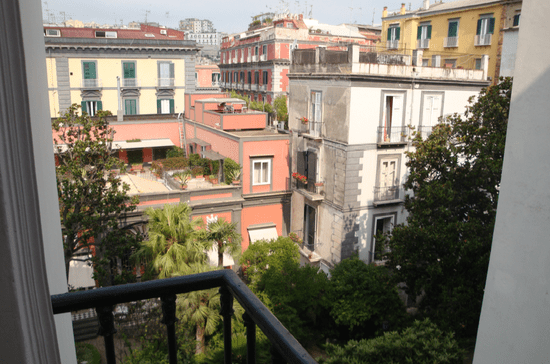
I never play unless I think I’ve been there, and this place looks really familiar. But it looks like a lot of places: Krakow? Wiesbaden? Munich? Bucharest? Probably not, because those places don’t have healthy looking palm trees. They do, however, have exactly the same architecture as this picture. The shutters are functional, not decorative, and the awnings offer protection from the sun, but there are no AC boxes in any of the windows. Either there is a historical society that’s active enough to prevent the installation of AC boxes, or this place doesn’t get so hot that it needs them. For no other reason than other than that I’ve been there, I’m going with Mallorca.
Another writes:
My friend, a tango nut, recently went to Buenos Aires, Argentina. He’s also a fantastic photographer and returned with pictures of spectacular pink and yellow buildings. Due to the pink buildings, the ornate architecture, and the variety of trees (not just the palm trees), I’m guessing Buenos Aires. Other than that, I have no idea where this is.
Another:
The San Telmo neighborhood in Buenos Aires? Last week my brother and I came within eight feet of guessing the right window. This week I’m hoping to have guessed the right hemisphere.
Another:
The architecture is reminiscent of Imperial Russian cities, and the flora suggests somewhere along the Black Sea or perhaps the Caspian. I’m going to go with Odessa, Ukraine, only because I love the city so much. Could be anywhere from the Bulgarian Black Sea Coast to Baku, Azerbaijan.
Another:
Macau, China? Been there. High density. European style buildings. Fingers crossed.
Another:
I’m guessing that this window is somewhere in the Castelo parish in Lisbon. The photo shows us colorful buildings with balconies, wrought-iron railings, ‘quoins’ used as architectural details on a couple of buildings, rooftop gardens, mediterranean plants and many TV antennas. And a glimpse of some black-and-white tiles in a patio below our window. These are all features of the old neighborhoods in Lisbon, and I could find evidence of them when scanning around Castelo, but I couldn’t find any building that matched one in our view, so I’ll have to leave it at that. (My brother thinks the location is in the southern hemisphere – you should see his guess arriving in your in-box soon.)
Another:
I have now guessed Lisbon in this contest three separate times (each more wrong than the last). I wanted to guess it again, because the architecture and coloring of the buildings is exactly the same. Of course those styles aren’t even remotely uncommon across all of Mediterranean Europe and Latin America. In fact, the trees in the frame and the rooftop patios suggest somewhere warmer to me. So Rio De Janeiro it is! I’ll guess the Leblon neighborhood, even though I think most of the buildings there are newer.
Another:
OK, so this VFYW is so generic that, despite Google Maps’ 45 degree up-close satellite view, I’m unable to pinpoint an exact location.
The architecture has me certain it’s Rome and the linear positioning of the buildings indicates a grid pattern. The neighborhood looks quite well-to-do and you can see a hill in the background, so my educated guess is that the window is in the neighborhood fanning out from the foot of the Piazza di Spagna, perhaps along the via dei Condotti or the Via del Corso. There are lots of upscale B&Bs and hotels around there so I wouldn’t be shocked. No certainty here, but worth a try.
Another:
Somebody is going to get the exact address on this one, but the picture just screamed “Rome, Italy” to me so I decided to write in. The hills, the architecture, the roof terraces … I can’t honestly remember if there are any/many palm trees in Rome, but there’s no climate reason that they couldn’t be grown there. (The only other time I’ve written in was when you had the view from my neighbor’s window in Amsterdam! Too bad that was not a contest; I’d have won hands-down.)
Another:
The fact that I am actually able to send this email makes me happy! My boyfriend is Genovese and I’ve been there twice (we live in NY). I was just trying to figure out whether to use the yellow or the pink/peachy color for the living room wall when I saw this week’s VFYW contest. I feel pretty sure that it’s Genova, Italy, especially because of the slight elevation in the back. My boyfriend refuses to looks for clues to figure out the exact location and says that it could be anywhere. So I am left only with Genova.
Another:
I’m almost certain it’s Italy. The architecture (windows, stone work, etc.) and color pallet is undoubtedly Italian – I’ve lived in buildings just like these while there both as a student and English teacher. But where in my family’s homeland? Well, there’s the palm tree, indicating something coastal, and the seemingly non-flat topography, which indicates northern, on the west side of the boot in particular where there are some jagged rocky plateaus. The tight clustering of the buildings indicates an older, bigger city, so probably not San Remo or other vacation town. If I can come up with something more specific, I’ll follow up. Until then, it’s Genoa (or Genova!).
Another:
I recently visited Old San Juan for the first time, and when I saw this photo, with its colorful buildings and shuttered windows, I was instantly transported back to my Caribbean idyll. But this is not Old San Juan. For one thing, while the city is hilly, it doesn’t have such prominent heights with buildings so elevated above others around them. Instead I’ll go out on a limb and say Naples, Italy.
A handful of readers correctly guessed Naples, but none of them could get very specific based on the generic nature of the photo. One writes:
Judging by the style of the buildings, I am convinced that we are somewhere in Italy. Beyond that, the closeness of the structures makes it look like we are in an urban area, toward the south, as the plants attest. It can’t be Rome because none of the hills rise quite like that with apartments along the top, which makes me think Naples. (Alas, there’s no view of the street and the telltale piles of trash!)
Another:
Clearly Italy. A large city with an old, wealthy district built on steep hills; garden vegetation more characteristic of the central and southern regions. The apartment buildings in the far background, with newer ones peering over what looks to be an older construction possibly built above an old city wall or fortification (or cliff-hill), suggest Rome, and that glimpse of old wall seems to be the strongest precise location hint. But Naples has similar new-upon-old layers, and the deep reddish stucco of the large building in the center midfield is far more characteristic of Naples, as are the still-predominant TV antennas.
Our best guess, using my father’s professional opinion: Pizzofalcone viewed from the Chiaia neighborhood, possibly taken near Via F. Crispi, near the French Institute, not far from Piazza Amedeo.
Another:
A quiet side street somewhere near the Piazza Medaglia D’Oro. I had instant recognition. I know only one city with that shade of red on it’s buildings. It looks like the view from my late Uncle Vito’s house – of course I’ve lost the address. His son is a journalist who probably reads your blog. Maybe he sent it in.
The following Naples guesser is the only one to have gotten a difficult window in the past, so he is this week’s winner:
I’m going with Naples based on the familiar architecture and hilly terrain featured in the background. The buildings are definitively Italian in style. The vibrant pastels are reminiscent of everything I remember about the Amalfi Coast.
We’ll get a book out to you soon.
(Archive)
 The Dish