The Eyes Have It

Enhanced-buzz-31107-1312825221-10

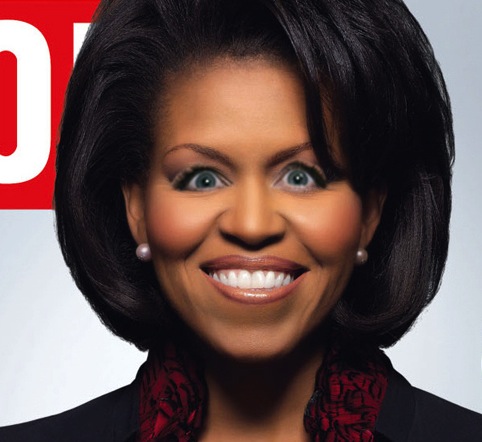
Matt Stopera justifies "Hot Chicks With Michele Bachmann's Eyes":

It had to be done.

The infamous cover photo here. Original meme here. Jessica Grose sides with Dana Loesch and others who have played the sexist card:

I hate it when Michele Bachmann makes me defend her, but I'm with Loesch on this one: The Newsweek cover was unnecessarily unflattering. I doubt Newsweek would portray a male candidate with such a lunatic expression on his face. As much as it pains me to admit it Bachmann is a legitimate candidate and major magazines should treat her like one.

This will sound suck-uppy, but the idea that Tina Brown is some sort of misogynist is, well, unhinged. Of course a newsmagazine would run a crazy-looking cover of a male candidate if that candidate often looked somewhat crazy, if only to attract eye-balls and interest in what remains a terrific piece of reporting. Bachmann's wide-eyed manic gaze is not a photo-shop. It's one of her obvious physical traits. And it has nothing to do with being male or female.

The Fairy Tale Of Drew Westen, Ctd

Chait shoots an arrow through its heart:

Roosevelt generally enjoyed broad public support despite having no success at persuading Americans to share his Keynesian view. (Westen subsequently writes, "if you give [Americans] the choice between cutting the deficit and putting Americans back to work," they'll favor the latter. But the problem is that Americans don't see that as a choice, which is wrong, but not a form of wrongness any president has succeeding in correcting.)

Roosevelt's fortunes are a testament to the degree to which political conditions are shaped by the state of the economy. Roosevelt was wildly popular during the recovery, which coincided with his populist 1936 reelection campaign. Yet Roosevelt's most populist governing period came after that election, when he took on the Dixiecrats. That period coincided with an economic relapse (caused by his premature abandonment of fiscal stimulus) which in turn severely damaged Roosevelt's popularity. All these facts are rather hard to square with Westen's narrative — not a surprise, I suppose, given his professed favoring of simple narrative over complex facts.

A Monkey Cage commenter points to a TNR editorial from 1933 that reads:

The head of a coalition government, accordingly, can exercise his freedom of action only within limits; the moment he irrevocably alienates his support on either the Right or Left, he is through. In the case of Mr. Roosevelt, you find that while he has acted with amazing boldness and imagination on a multitude of questions, he has shown great reluctance in facing up to a fight on any single clear-cut issue.

Previous commentary on Westen's piece here and here.

Yglesias Award Nominee

"The notion liberalism is responsible for killing a billion people in the 20th century is grossly irresponsible and ludicrous. I assume Phillips is saying American liberalism is synonymous with Nazism and Communism, that it is the animating ideology of Hitler, Mao, Stalin, Saddam Hussein, the Khmer Rouge, the Hutu militia, and countless other 20th century genocidal killers and movements. This is not simply an ignorant statement (how he arrives at the figure of a billion people is impossible to know; as a reference point, the deadliest military conflict in history, took the lives of somewhere around 70 million); it’s quite an unhelpful one," – Pete Wehner, on Judson Phillips.

“This Was Always Going To Happen”

Article-2023874-0D5B629200000578-550_964x639

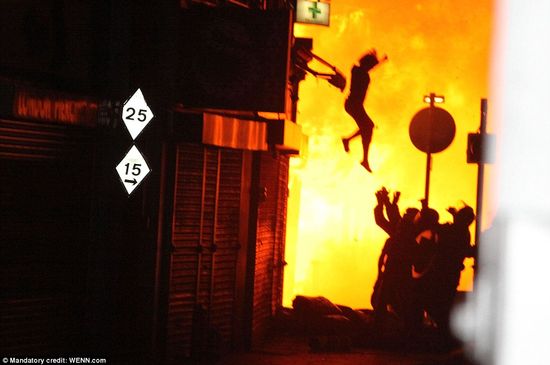
What is behind the outbreak of mass criminality on London's streets? Don't blame immigration or race. Many of the victims were immigrant shopkeepers:

Many of the independent Turkish and Kurdish grocery shops, takeaways and hairdressers in the street do not have shutters or security guards. So closing early and going home just isn't an option. Workers, friends and relatives stood on guard — some with baseball bats — outside the businesses yesterday evening after word spread at about 4pm that a loot was being planned.

Don't blame racism:

As David Lammy, Tottenham’s MP, has said, these are no race riots. The Eighties uprisings at Broadwater Farm, as in Toxteth and Brixton, were products, in part, of a poisonous racism absent in today’s Tottenham, where the Chinese grocery, the Turkish store and the African hairdresser’s sit side by side.

I think it's clear that a great deal of this is pure criminality unleashed by an insufficiently tough police reaction to the initial incident that sparked the rioting. I remember the dynamic in my DC neighborhood when I watched it burn in 1990. A soft initial police response gave permission for dozens of sheer thugs to come and loot and burn the neighborhood from elsewhere. Don't believe me? Here's a resident unafraid to tell the truth. Here's a video from a resident watching Clapham Junction being looted:

And the use of social media and nifty little bikes reveals the criminal opportunism here. But even Mary Riddell in the Telegraph sees the background of austerity, accelerating social inequality and the bleakness of the economic future as part of the context:

It is no coincidence that the worst violence London has seen in many decades takes place against the backdrop of a global economy poised for freefall. The causes of recession set out by J K Galbraith in his book, The Great Crash 1929, were as follows: bad income distribution, a business sector engaged in “corporate larceny”, a weak banking structure and an import/export imbalance.

All those factors are again in play. In the bubble of the 1920s, the top 5 per cent of earners creamed off one-third of personal income. Today, Britain is less equal, in wages, wealth and life chances, than at any time since then. Last year alone, the combined fortunes of the 1,000 richest people in Britain rose by 30 per cent to £333.5 billion.

Europe’s leaders, our own Prime Minister and Chancellor included, were parked on sun-loungers as London burned. Although the epicentre of the immediate economic crisis is the eurozone, successive British governments have colluded in incubating the poverty, the inequality and the inhumanity now exacerbated by financial turmoil.

Britain’s lack of growth is not an economic debating point or a stick with which to beat George Osborne, any more than our deskilled, demotivated, under-educated non-workforce is simply a blot on the national balance sheet. Watch the juvenile wrecking crews on the city streets and weep for all our futures. The “lost generation” is mustering for war.

(Photo by Wenn.com via the Daily Mail.)

Wasilla Update

There's a new Palin, born three months after Track's marriage, in Palin tradition (McGinniss scooped). Paternal grandma is uncharacteristically silent. And Mercede Johnston upgrades her reputation with a September center-fold in Playboy. Maybe that's her way of trying to stop the grandmother of her nephew announcing a run for the presidency. Good luck with that. Also:

According to Mercede, Bristol Palin sent a text message to Levi during her pregnancy that read, "Ever since the moment I found out I was pregnant, I prayed to God you weren't the father." She added that her brother did not like Bristol to drink, as it made her "more promiscuous."

Levi's book comes out in September too. I'm sure you can't wait.

Rick Perry: The Christianist’s Christianist

Prayer In some ways, the emergence of a Republican candidate who takes every single aspect of George W. Bush’s political persona and adds a logarithm, is a healthy sign. I’d rather have a candidate who is explicitly saying that his politics is based on religion and his political rallies are actually spiritual rallies, than one whose theocratically-driven conservatism is on the downlow. There’s a reason Sarah Palin’s favorite Republican is Perry; and a Perry-Palin ticket would, in so many ways, epitomize the moment when Republicanism shuck off its secular outer garments and embraced an entirely God-driven, gut-enhanced, gun-toting agenda. Their Jesus is a very personal one. He believes in increasing wealth and power as the ultimate goal, the universal ownership of lethal weapons, pre-emptive warfare, rounding up and deporting illegal immigrants, the death penalty on steroids, and, of course, torture. But some neocons are fine with that. The neocon Jesus, is, after all, a precinct manager. Jonathan Toobin:

Though liberal elites may mock the tens of thousands who turned out to join Perry in prayer, their public expression of faith probably seems perfectly normal to many Americans and not just those who are right wing GOP activists. The idea of a “naked public square” in which faith is conspicuously absent has little support among most Americans.

There is surely a distinction between the expression of religious faith in politics and a mass religious rally as the de facto announcement of a presidential campaign. But at least Toobin blurts out what so many on the right seem to elide or downplay or simply deny:

the enormous influence religious conservatives have on GOP caucuses and primaries

Tom Van Dyke zooms out to note how the Deist Founding fathers, lionized by those dedicated to a fundamentalist myth of America’s constitution, would be amazed (and appalled) by the spectacle:

To the Founders, God was a reality, not a theory. When Washington presumed to speak for “my fellow-citizens at large,” this raised no controversy. But America’s Deity to which he gave thanks was “the Almighty Being,” “the Great Author,” with an “Invisible Hand.” Not Jesus the Christ, with all the doctrine that accompanies him.

And so, the irony is that here in the 21st century, while religion, religious conscience and Christianity itself are punked in various courtrooms as being inherently irrational, presidents and maybe-presidents are becoming more explicit in articulating Christian doctrine than the Founders ever found proper, even back when there were few Jews and even fewer Muslims thereabouts.

Josh Green quoted Dr. Richard Land, the President of the Ethics and Religious Liberty Commission of the Southern Baptist Council:

[T]he most interesting question for me is whether the country is ready for somebody who looks and sounds like George W. Bush on steroids.

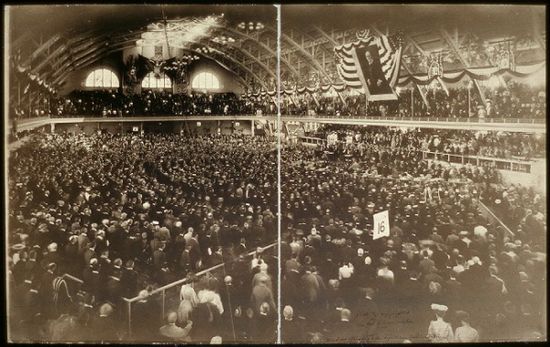
(Photo: George R. Lawrence, General View, Opening Prayer of the 1904 Republican National Convention, 1904, via Tyler Green)
A Federal Crack-up, Ctd

120693027

After rounding up some initial reax to the S&P downgrade, Dan Drezner insists that our political system is not broken:

S&P has failed to observe the political aftereffects of the debt deal.  As I argued previously

[T]he thing about democracy is that it has multiple ways to constrain political stupidity and ideological overreach. The first line of defense is that politicians will have an electoral incentive to act in non-crazy ways in order to get re-elected. The second line of defense is that politicians or parties who violate the non-crazy rule fail to get re-elected. So, in some ways, the true test of the American system's ability to stave off failure will be the 2012 election.

The first line line of defense has been breached, but the second line of defense looks increasingly robust.  Public opinion poll after public opinion poll in the wake of the debt deal show the same thing — everyone in Washington is unpopular, but Congress is really unpopular and GOP members of Congress are ridiculously unpopular.  At a minimum, S&P needs to calculate how the current members of Congress will react to rising anti-incumbent sentiment.  If they did that analysis and concluded that nothing would be done, I'd understand their thinking more.  I didn't see anything like that kind of political analysis in their statement, however.

Michael Cohen holds a very different view from across the Pond:

[W]hatever one may think of Standard & Poor's recent downgrade of US debt, the ratings agency view that "the effectiveness, stability, and predictability of American policy-making and political institutions have weakened" seems almost self-evident. […]

America is increasingly moving toward a parliamentary system in which politicians, rather than voting along regional lines or in pursuit of parochial interests, cast their ballot solely based on whether there is a D or R next to their name. Such a system might work well in the UK, but in the US, with its institutional focus on checks and balances and the many tools available for stopping legislation, a parliamentary-style system is a recipe for inaction.

Politicalprof blames the media. Previous commentary on federal dysfunction here and here.

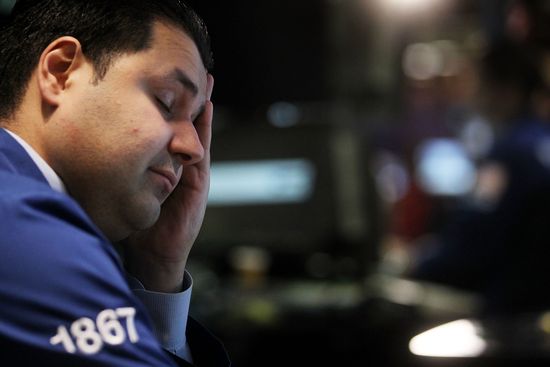
(Photo: A trader works on the floor of the New York Stock Exchange during afternoon trading on August 8, 2011 in New York City. The Dow finished down more than 600 points after Standard and Poor's downgraded the U.S. credit rating. By Mario Tama/Getty Images)

How Should We Approach Soldiers? Ctd

A reader writes:

I'd have to agree with Elizabeth Samet about the awkwardness of thanking servicememebers for their service. Unless you know the service member personally, it can devolve into a selfish spectacle for the benefit of the civilian and render the person in the uniform into a caricature.

Having said that, I became a civilian employee of the Navy two years ago and work for a humble retired veteran. Around last Veteran's Day after some prompting, he shared some stories with me, and I thanked him for his service. He choked up and attempt to hold back some tears. Apparently in over 20 years of service, no one had even thanked him before, including his wife or three daughters.

So, I say, get to know a service member or veteran. Then, after they share their experiences, thank them for their service.