Applying Austerity

Poverty_amenities

Melissa Boteach and Donna Cooper reject the Heritage Foundation's claim that America's poor aren't really poor because they own certain appliances. Yglesias bolsters their case with the above graph:

Back in the late 1920s, a refrigerator would be worth a lot more than eight days’ worth of food. And a microwave wouldn’t exist at all. But in the modern day, these appliances don’t represent meaningful levels of accumulated wealth. What’s more, they’re not luxuries. They’re actually thrifty things to own. If a single mom raising three kids sold her fridge, she’s be making a very imprudent call from a strictly financial point of view. Buying food at the grocery store and saving it thanks to the miracles of modern refrigeration is sound household budgeting.

Has Russia Attacked America?

Eli Lake has done a series of stories at the Washington Times alleging Russian responsibility for the bombing of the US Embassy in Georgia. Joshua Foust is skeptical. So is Mark Adomanis:

The basic disagreement between the CIA and the State Department on the most important aspect of the entire episode should be a giant red flag to a journalist, and would lead any minimally inquisitive person to ask a number of questions such as: Since Borisov [the bomber] is not in Georgian custody, what is the nature of the evidence that so conclusively proves he was acting under orders?

Videotapes? Audio recordings? A confession from a co-conspirator? And if this evidence from the Georgians is so overwhelming and straightforward, why can’t the State Department and the CIA agree on its interpretation? What specifically led the CIA to attribute Borisov’s activity to the GRU, and what specifically led the State Department to attribute it to a rogue operative? Has the disagreement between the CIA and State occurred from the start, or is it a more recent development?

And, at a higher level, what possible motivation would the Russians have to take the almost unbelievably provocative action of bombing a US embassy? And, finally, why would they do this at a time when, by all accounts, their relations with Washington were improving?

Chart Of The Day

6021221058_914dc6238a

From Nate Silver's post on "Why S.&P.’s Ratings Are Substandard and Porous":

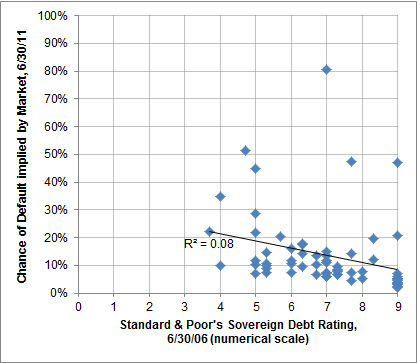
[The chart] presents a comparison of S.&P. ratings as of June 30, 2006, to the risk of default five years later (on June 30, 2011) as measured by the prices of credit default swaps, financial instruments that pay an investor if there is a default on a bond obligation.

S.&P.’s bond ratings from five years ago would have told you almost nothing about the risk of a default today. They had no insight about the threats in European markets, nor about which countries in Europe were relatively more likely to default. (Norway, which remains among the most solvent countries in the world, had a AAA rating in 2006, but so did Ireland and Spain.)

By comparison, simply looking at a country’s ratio of net debt to G.D.P. would have been a better predictor of default. It wouldn’t have done well by any means: it only explains about 12 percent of default risk. Still, this simple statistical indicator does better than the S.&P. ratings.

Sundown For Assad?

Watching the recall of the Saudi ambassador from Syria yesterday, as Bahrain and Kuwait's top diplomats followed suit, Blake Hounshell thinks the Syrian president is toast:

I expect that over the next few days, we might see fewer provocative moves — like this weekend's bloody assault on the eastern city of Deir az-Zour, which seems to have provoked King Abdullah's ire — from the Syrian regime. Perhaps Assad and friends will announce a fresh round of "reforms" — always, of course, with trap doors and escape hatches that render them meaningless. But at this point, Assad seems doomed; after so much bloodshed and anger, any genuine political solution will inevitably lead to his ouster. His wisest course of action now is to find a safe place to spend his retirement (perhaps Vogue will give him a job?).

Enduring America has been all over the latest bloodshed and mass protests.

The Daily Wrap

Today on the Dish, Andrew defended Obama from Drew Westen's lefty attack, praised Obama's calm in the face of criticism, and viewed the S&P downgrade as a condemnation of the right. Benen argued that the right already rules the economy, stimulus spending remained unpopular, and Robert Hughes helped take Westen down a notch. Ronald Reagan's solicitor-general dissed Boehner, and Andrew was ready to retire compassionate conservatism. Andrew marked Bachmann's similarities to Palin, Judson Phillips earned a well-deserved Malkin award for accusing the left of mass murder and Matt Steinglass destroyed Phillips' weak argument for more military spending.

In international news, Andrew didn't view flogging as torture but readers pushed back, and the American reward for bin Laden may have tempted a Pakistani intelligence officer into outing him. Larison analyzed British austerity and putting their military on a diet, and we debated whether it's appropriate to thank soldiers whenever we see them. Not all of Egypt's Islamists would vote together, al-Shabaab's withdrawal didn't quell the fighting in Somalia, Israel's protests hit all new highs, and because of all its adherents, there is no single doctrine of Islam.

In national affairs, Andrew bemoaned the perverse logic of credit cards and credit, Angry Birds approached the bosom, and philosophers tried their hands at online dating. Hucksters forced people to pay to remove their mug shots from the internet, twentysomethings tried to get laid, and lazers changed our cemetaries.  Southern belles rebelled against their Garden And Gun characterization, and coffee acted like a drug with different effects for different people. Traffic intersections evolved past the left turn, Philip Tetlock continued to analyze pundits as hedgehogs or foxes, and readers toyed with international languages. The Grant administration made beards cool again, Oscar Wilde wouldn't have watched "The A-List" and a gay Dodger invented the high five.

Charts of the day here and here, cool ad watch here, VFYW here, FOTD here, and MHB here.

–Z.P.

(Video: Smoke from the riots in London, filmed by Prokopi Constantinou) 

Tent City Grows

GT_ISRAEL_110808

Gershom Gorenberg gives some perspective on the scale of this past weekend's protests:

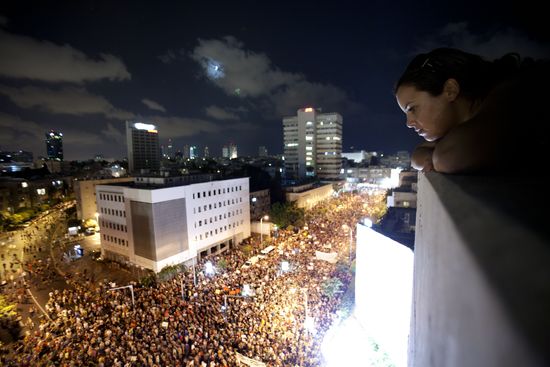
Add up the estimates of 300,000 in Tel Aviv and 30,000 in Jerusalem and more elsewhere and you come to this startling idea: one out of every 20 Israelis was on the streets demanding a better country Saturday night – the equivalent of three million people in France, four million in Egypt, 15 million in the United States. And those comparisons themselves shatter, because, as Ma’ariv’s NRG site reported, the police couldn’t possibly keep track of the crowd that broke down gates and overflowed into alleys and side streets. Or as a police source told the paper: “This is the biggest demonstration we’ve ever, ever faced. We’re seeing hundreds of cars that have simply been left on the Ayalon Freeway and people are walking to the demonstration.” And that’s besides the people who couldn’t get on the overpacked trains to Tel Aviv.

Rafael Frankel thinks Bibi's government is ill-prepared to deal with the tent movement. Yglesias analyzes how Israeli housing problems contribute to settlement expansion.

(Photo: Thousands of people march in the streets during a protest against the rising cost of living on August 6, 2011 in Tel Aviv, Israel. Protests across Israel were spurred following a Knesset vote to approve the national housing committees law, which places the authority for approving building projects in the hands of regional committees. By Uriel Sinai/Getty Images)

There Is No Islam

Jeb Koogler reminds us of a crucial point:

Religion does not speak and therefore cannot be essentialized. To talk of Islam as though it has a correct interpretation, i.e. “Islam says…”, is to begin from a poor understanding of religious hermeneutics. It is human beings who subjectively, and in a continuously changing way, interpret religious texts and provide accounts as to “correct” religious dogma and practice.

We often witness this attempt to essentialize Islam in contexts like this one: “What does Islam say about killing apostates?” This is a nonsensical question. “Islam” says nothing about the issue. Rather, the different schools of Islamic jurisprudence say something, groups of Indonesia and Saudi and Pakistani Muslims say various things, classical Sufis say other things, and so forth. We cannot speak about a definable essence — or correct meaning — of a religion with 1.2 billion adherents.

Somalia’s War Rages On

Apparently a devastating famine and al-Shabaab's withdrawal from the capital isn't enough to stop the fighting. Alex Thurston worries about escalation:

Reuters’ Richard Lough argues that al Shabab’s withdrawal indicates that within its divided leadership, the “international wing influenced by foreign fighters who favor guerrilla tactics like suicide bombings…won the day.” This wing’s victory, Lough adds, “could herald a wave of al Qaeda-style suicide attacks.” Whether or not that prediction proves true, the widespread reports of divisions within al Shabab suggest the movement’s tactics may soon change, making a conventional military campaign against them more difficult.

Joshua Goldstein is more upbeat. Hawa Abdi recounts a harrowing tale of her experience with Somalia's war.