Well, in Andrew Sprung's words, today's brutal, unsparing attack on Obama from the dreamy left was "a rhetorical nuke dropped on ground zero in the liberal heartland." I have no doubt that it will appeal to many who are depressed and demoralized by a presidency fighting both a global depression and a brutal, extremist right-wing opposition. And the one good element of the piece is that it starts from the very beginning, with disappointment that Obama didn't launch from Day One into a reprise of an idealized modern FDR and LBJ wrapped into one. Sprung's is a must-read in response.
To take just one point, does Westen believe that, after TARP, a much bigger stimulus would have been able to get through Congress? And for what? These are not the 1930s, and in a much higher tech society, Depression era shovel-ready projects were not so easy to find. And the aversion to tax cuts seems strange. Aren't they among the most effective way to stimulate demand quickly? And how much debt would we now have with such a stimulus? The trouble with telling stories is that fiction isn't fact. And Obama faced a country that had become so leveraged in public and private that the 1930s option Westen wanted was a chimera. Is $14 trillion not enough debt?
Westen laments that Obama failed to rally the country with a clear explanation of the baddies (whom close to half the country voted for) versus the goodies. Westen is simply wrong and Sprung tackles every specific complaint Westen makes with a clear Obama speech doing exactly what Westen wanted. For example:
Westen:
Nor did anyone explain what health care reform was supposed to accomplish (other than the unbelievable and even more uninspiring claim that it would “bend the cost curve”), or why “credit card reform” had led to an increase in the interest rates they were already struggling to pay.
Obama, Sept. 9, 2009:
Our collective failure to meet this challenge — year after year, decade after decade — has led us to the breaking point. Everyone understands the extraordinary hardships that are placed on the uninsured, who live every day just one accident or illness away from bankruptcy. These are not primarily people on welfare. These are middle-class Americans. Some can't get insurance on the job. Others are self-employed, and can't afford it, since buying insurance on your own costs you three times as much as the coverage you get from your employer. Many other Americans who are willing and able to pay are still denied insurance due to previous illnesses or conditions that insurance companies decide are too risky or too expensive to cover.
We are the only democracy — the only advanced democracy on Earth — the only wealthy nation — that allows such hardship for millions of its people. There are now more than 30 million American citizens who cannot get coverage. In just a two-year period, one in every three Americans goes without health care coverage at some point. And every day, 14,000 Americans lose their coverage. In other words, it can happen to anyone. But the problem that plagues the health care system is not just a problem for the uninsured. Those who do have insurance have never had less security and stability than they do today. More and more Americans worry that if you move, lose your job, or change your job, you'll lose your health insurance too. More and more Americans pay their premiums, only to discover that their insurance company has dropped their coverage when they get sick, or won't pay the full cost of care. It happens every day.
I remember that speech vividly. It was the most persuasive case I have ever heard for real reform, and it ended with universal healthcare, a goal every president before him failed to achieve. I agree on one thing: the case for this law was subsequently left unmade. But I have a feeling that when the GOP promises to repeal it, we will hear again. And the case cannot be made by one man alone. His party, including its liberal wing, ran away from the reform almost as soon as it was passed. And the liberal media outlets did the same, referring to sulk about the public option rather than see and celebrate and explain the very real progress that had been made.
What Westen seems to have wanted was the Democratic version of George W. Bush, contemptuous of his opponents, ruthless in his often unconstitutional determination to get his agenda through, divisive and polarizing. But Obama would not have won election on those grounds and did not have a mandate for that. He was elected as a moderate Democrat, prepared to engage any pragmatic solution to obvious problems, while not splitting an already polarized country even further.
That he has tried to do, against an opposition party that decided to double down on polarization, on politics as warfare, on politics as a game, and bereft of any ideas except taking us back to before the New Deal. What has to be defeated is not just their agenda, but their modus operandi. Only by patiently out-lasting and out-arguing them will Obama be able to do this. And it says a lot about the utopian left that they do not see the wisdom and responsibility of this strategy.
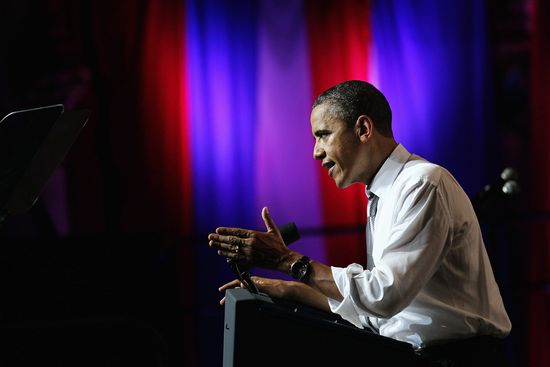
(Photo: U.S. President Barack Obama speaks to supporters during a fundraiser at the Aragon Ballroom on August 3, 2011 in Chicago, Illinois. The fundraiser, billed as a birthday celebration for the President who turns 50 years old tomorrow, featured entertainment by Herbie Hancock, Jennifer Hudson and others. By Scott Olson/Getty Images.)
 they'd be less likely to make mistakes under fire, Arkin believes, and less likely to strike at noncombatants. In short, they might make better ethical decisions than people.
 The Dish