by Patrick Appel
The economy added no jobs in August. Felix Salmon sighs:
You can call this a double dip, if you like, or you can view it as a kind of aftershock of the financial crisis. Either way, the economy is clearly now below its stall speed, and we don’t have access to the mechanisms necessary to get it moving again. That is going to make for poisonous politics, Washington gridlock, and untold human misery among millions of new and long-term unemployed across the land.
Ezra Klein is in a similar mood:
Though the trends might be better than they were in early-2009, the labor market is in much worse shape, and it's clear that more action, and perhaps even big action, is desperately needed. I do not, however, expect that to be the actual response to this news.
Barry Ritholtz disagrees:
Bottom line, the number sucked and looking to the next few weeks we’ll hear more about QE3 and Obama’s jobs plan and the political class will still not understand that short term steroid shots into the economy does not alter long term behavior and a price is always paid when the stimulus wears off, aka debt, taxes and inflation. The US economy needs to FERBERIZED and left alone instead of being attended to every 2 hours.
There are now 14 million workers who are looking for work and cannot find it; the figure nearly doubles if you include workers who are in part-time jobs but want to be employed full time, and those who want to work but have stopped looking. A broader measure of the unemployment rate that includes these underemployed workers is 16.2 percent.
One thing terrible jobs numbers could do is galvanize public and elite opinion in a way that weak jobs numbers wouldn’t. In the next few weeks, there could be movement in the three major initiatives needed for recovery.
Investors are likely to be disappointed, given that the run of data in recent days had appeared to ease fears of recession. The result heaps a lot of pressure on President Obama's jobs speech, due next Thursday, although it is hard to see he can come up with much that will make a difference, in the short-term at least.
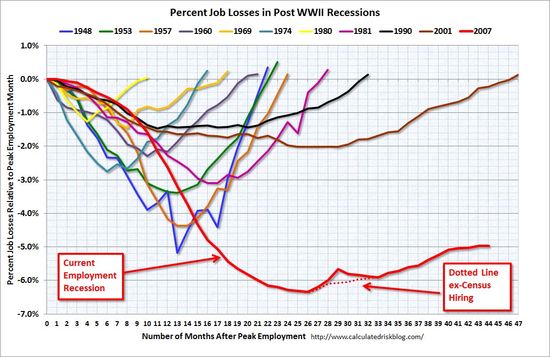
Chart from Calculated Risk. More charts on the jobs situation here.
 The Dish