Reza Aslan compares Mohamed Bouazizi, the man who immolated himself in Tunisia, to Mohamed Atta, the oldest of the 9/11 hijackers:
These two fires — the one lit by the hijackers on September 11, 2001, the other sparked by a single individual in a small Tunisian town ten years later — form the bookends to the 9/11 decade. Indeed, you can draw a straight line from one to the other. Their kindling was the same: humiliation, lack of dignity, a smoldering frustration with the ways of the world, and the overwhelming urge to set it all alight. Their fuel was the same: both fires spread through satellite television and social networking sites, something al-Qa‘ida had pioneered long before there was any talk of a “Facebook revolution.”
Yet, on this 10th anniversary of the attacks of 9/11, when Americans are embroiled in debates about what that day meant for us and how it changed the way we see ourselves in the world, perhaps we should pause for a moment and recognize the single most significant thing that the fires sparked by Mohamed Bouazizi and Mohamed Atta share in common, which is that neither of them had anything to do with us.
It was not the invasion of Iraq, or nation-building in Afghanistan, or Bush’s “freedom agenda” that deafened young Muslims to al-Qa‘ida’s call. It was al-Qa‘ida’s bloodlust in Iraq and Afghanistan. It was the fact that between 2004 and 2008, Muslims accounted for 85% of the casualties from al-Qa‘ida attacks (between 2006 and 2008, that number surged to 98%). Above all it was the youth themselves — the very kids that the 9/11 attacks were meant to mobilize. Though fed up with their dictatorial regimes and spurred by 9/11 to do something about it, by the end of the decade, these kids had discovered a far more effective model for action, a different symbol to rally around: that of young Mohamed Bouazizi, standing in the middle of traffic, holding a small, flickering flame in his hand.
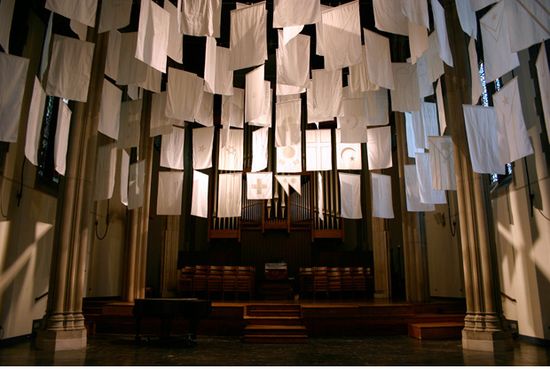
(Image: "White Flags,” a new installation at New York City’s Union Theological Seminary by Aaron Fein, of all 193 flags of the United Nations in white on white fabric)
 The Dish