That's Shibley Telhami's belief:
Would Palestine be a stable state? The first measure is if it would be more stable than the alternatives. Instincts of both the Arab and Jewish publics are about right: The alternative would probably be more unstable and, importantly, more destabilizing, particularly for neighboring states. The stability of a small Palestinian state in the West Bank and Gaza would depend less on Palestinian internal divisions and economic viability than on the stability of the political and security arrangements with Israel, Egypt and Jordan.
Aaron David Miller, on the other hand, worries about the new state's viability:
The fact is, it isn't the Israelis who have a demographic problem; it may actually be the Palestinians who simply cannot marshal enough control over their disparate parts to harness their people power into an effective strategy. Any Israeli government — even one that was serious about negotiations — would try to develop separate approaches to deal with these divisions: a military/security policy toward Gaza; a co-optation strategy toward the West Bank; and a border-security approach toward the diaspora. If it looked like the forces of diplomacy, rather than the forces of history, might dictate the outcome of the Israeli-Palestinian issue, perhaps these various pieces of the Palestinian puzzle could be worked out and addressed. But today, with no sustainable negotiations on the horizon, that does not appear to be the case. A Palestine in pieces does not bode well for a conflict-ending solution, and no paper resolution or upgrade in status in New York this month will change that.
World Politics Review has a series of essays that focus, respectively, on institutions, economics, and refugees in a Palestinian state (free registration required). Ali Ghraib argues it would have limited ability to use the ICC to charge Israelis with war crimes.
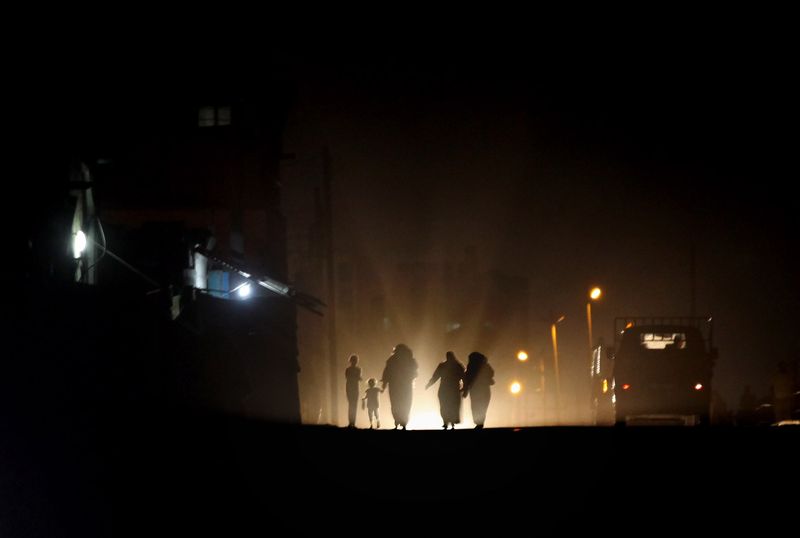
(Photo: Palestinian women walk along the road at night during one of the frequent power cuts across Gaza City on August 17, 2011 in Gaza City, Gaza. By Christopher Furlong/Getty Images.)
 The Dish