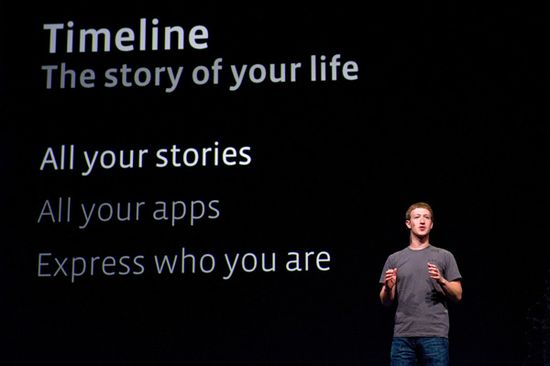
Douglas Crets explains the new Facebook feature, Timeline:
What makes this significant is that prior to the update people were just talking and posting in real-time the things they wanted to share with their friends. This new format allows you to go back in time to periods in your life that happened before there was a Facebook, making your Facebook profile into a graphically-intense version of your entire life.
Alexis Madrigal sees the larger implications:
Facebook's Timeline confirms what writers have long known: narratives are how we structure our relationships with the world. Stories are how we make meaning. …
Facebook's version of autobiography is very specific. It is data-driven. It is simple: Alexis likes the iPad. Alexis eats a hamburger. Alexis reads The Innovator's Cookbook. It is a ranked, chronological database of a life. It is technically complex but grammatically simple. It is multimedia, but not rich. It is autobiography without aesthetic effort. It is a story without words.
Carolyn Kellogg follows the money:
From the initial screen shots that have circulated, Timeline seem to be using some of the strategies (and possibly the technologies) of e-book publisher Push Pop Press to assemble photographs and text into its autobiographical page. Push Pop Press, which had previously published a single e-book for the iPad — Al Gore's "Our Choice: A Plan to Solve the Climate Crisis" — was acquired by Facebook in August. At the time, the publisher wrote on its website,"Although Facebook isn't planning to start publishing digital books, the ideas and technology behind Push Pop Press will be integrated with Facebook, giving people even richer ways to share their stories." Richer, that is, for millions of Facebook users turned memoirists — and perhaps Facebook, too.
Nicholas Thompson has a more pessimistic take on what Facebook wants.
 The Dish