A reader writes:
As an optical physicist, I can't let the unscientific comments by Alexis go unaddressed. A simple green laser pointer bought on Ebay for $20 won't blind someone pointing into their own eye directly unless they hold it there for some time. Even more importantly, while it is true that the surface area illuminated by the laser increases with distance from the source (not "cone" or whatever that means), the intensity decreases by the square of distance. So in fact, counter to what Alexis says, you are less likely to blind a pilot, not more. Sure, you'll hit their eye, but the intensity will be too small to do any damage. Unless you are willing to spend serious money on a very high-end laser, you couldn't blind a pilot.
That being said, however, you can dazzle the viewer to such an extent that they temporarily lose their dark-adapted sight, which is very bad for a pilot on approach. This is the reason for cracking down on these idiots. There is no need to throw around loose comments like "blinding" when the truth is bad enough.
Another goes into greater detail:
As someone who studies optical sciences, I wanted to point out a couple things. One is to make sure that we represent things correctly. It should be clear that while the radius of a laser increases with distance, it's intensity also drops off. If it's increased in diameter from a small point to enough to "fill a cockpit," it's no longer going to be that bright comparatively. If we assume conservatively that's a 10x increase in size, that means it's 100 times less bright than before. There's nothing mysterious about why this is; it's just the conservation of energy as the light spreads out. If it helps, think about it as the opposite of putting a magnifying glass between your hand and the sun. Not that much more light is actually hitting your hand; it's just all hitting it in one spot now. The energy is the same, but the intensity has changed.
The second thing I wanted to mention is more of a question of general safety. Shining laser pointers at an airplane probably wouldn't be such a problem if you couldn't buy a laser pointer online that is so powerful that it falls within the most dangerous category of laser safety classifications. Note, the "most dangerous category" caps out pretty low compared to say using a laser to cut things, but this does mean that if I was keeping it in a lab I'd have an obligation to make sure people didn't wander into the area or accidentally turn it on to make sure no one gets hurt or blinded by it. I'd have warning labels on my door, lights to let people know it's on, I'd carefully plan the layout of my lab and the laser itself would be equipped with a key switch and a safety interlock just to start with. Or you can buy one online and keep it in your pocket till you find something it'd amuse you to point it at, like a plane.
Going back to my earlier numbers, for example, with a 1W laser, which I found in 5 seconds online using Google, even after the beam expanded 10 times and it's intensity was 100 times less than before, it'd still be 2-10 times as bright as your typical 5 or 1mW laser pointer from across a room. And the one I found is green, which would mean even for the same wattage, it'd still look multiple times brighter to your eye than a typical red one because of the way our eyes responds to different wavelengths of light. Now that would be a distracting and dangerous beam of light.
I want to end with mentioning this is not a call to regulate laser pointers. It's great that people think lasers are awesome, but it'd be nice if that came with more awareness of what they were holding.
Update from a "visual engineer for flight simulation" using a federal email address:
The second expert you summoned has it correct, but the first expert, the optical physicist, should go back to school. The laser intensity does not decrease "with the square of distance". If that were true, we wouldn't have used lasers to reflect off of
reflectors on the moon left by Apollo astronauts and other probes to the moon. Your first expert is also mistakenly lumping laser behavior with the attenuation of a light or radio frequency emitter that "radiates" equally in all directions such as a traditional light bulb or a non-directional radio transmitting antenna.
Your second "expert" does a better job of explaining that the increase of the point light to a broader area after a mile or so distance decreases the intensity per unit area – same as a video projector is brighter or dimmer as a function of distance. But neither one mentions that fine scratches on the plastic cockpit window can also cause the laser light to spread out and possibly make it impossible to see out the window – the same effect can sometimes happen to a car driver if direct sunlight hits a car windshield that is cracked – the sunlight will illuminate the inner plastic safety layer and the entire plastic layer lights up and you can't see through the windshield at all. I have seen this amazing dangerous effect.
It would be better to refer your readers to this site, where other dangerous effects they don't mention are discussed.
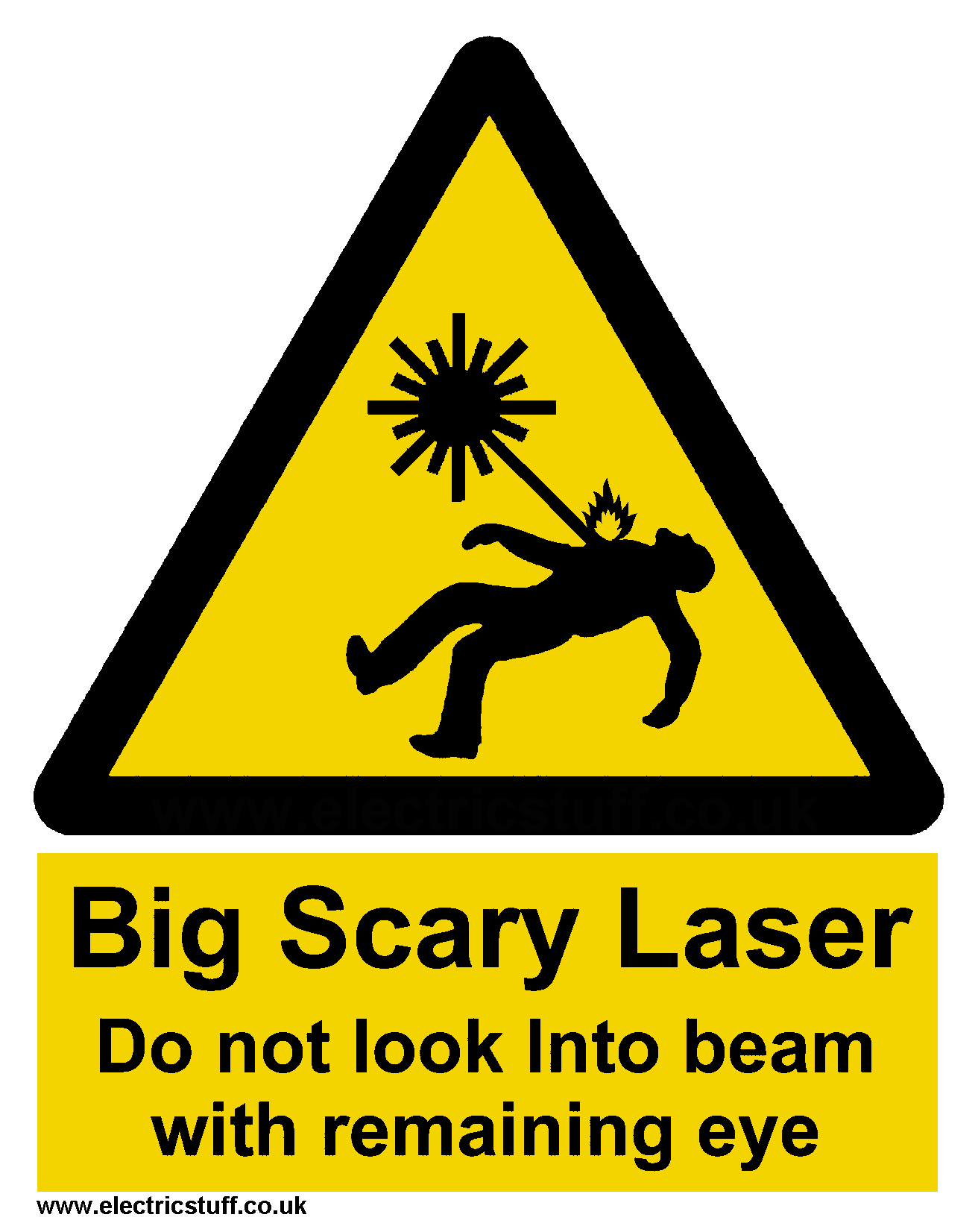
Another reader updates by sending the above image of "the laser safety placard we use at our plant."
 The Dish